
Australia's greatest allrounder
Keith Miller had a batting average that was 14 more than his bowling average, which easily puts him in the top rung of allrounders the world has seen

S Rajesh
17-Oct-2010
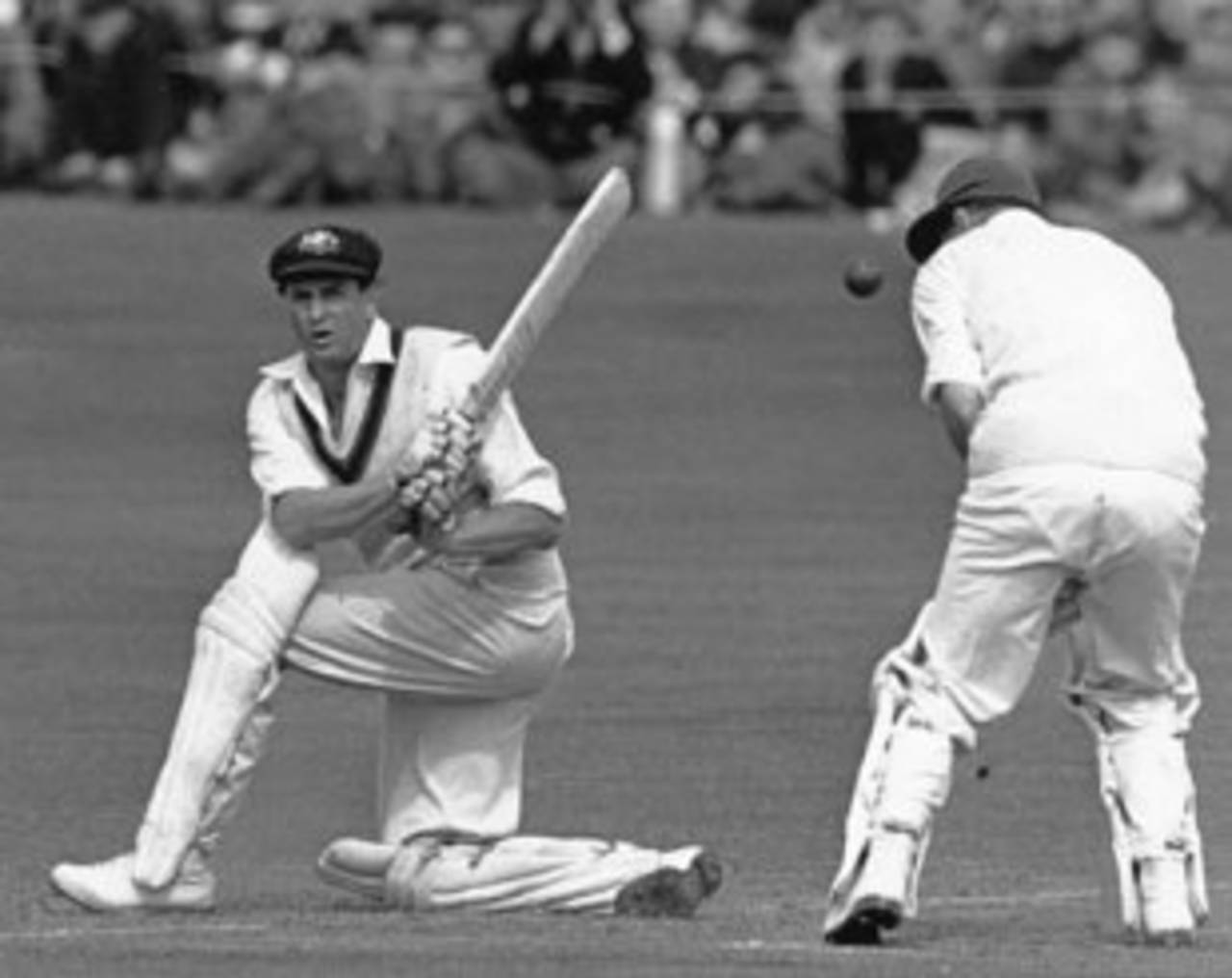
Keith Miller is one of only three allrounders who have their names on the honours board at Lord's both for their batting and bowling • Getty Images
More than 50 years after he played his last Test match, Keith Miller remains, quite easily, the best allrounder Australia have ever produced. Despite the lingering feeling that he never quite had the drive and the hunger to pursue statistical milestones, Miller still finished with outstanding numbers, with a career batting average touching 37 and a bowling average of under 23. Sid Barnes, his Australian team-mate, accurately summarised Miller's sheer talent and his attitude to cricket: "If Keith had had the same outlook as Bradman or Ponsford, he would have made colossal scores. He could, if he desired, have become the statisticians' greatest customer." Miller perhaps fell short of becoming the statisticians' greatest customer, but nevertheless he visited them often enough, achieved significant numbers, and did it all with a flamboyance that was thrilling to watch.
When he began his first-class career, he was a specialist batsman, and a very occasional bowler. On his first-class debut he scored 181 for Victoria against Tasmania in Melbourne in 1937-38. When first-class cricket in Australia was stopped due to the War, in 1941, Miller had, in 14 matches, scored two centuries and two fifties and had taken a solitary wicket, from seven overs. When he came back from the War, after serving with distinction as a fighter pilot, though, his fast bowling was a potent weapon, and it surprised England in the "Victory Tests" in which Miller played for the Australian Services team.
In the Test match arena too, Miller's batting was his stronger suit in the early days: in the first 20% of his career, his batting average exceeded 54 and his bowling average was less than 21, though he only took 27 wickets in 11 matches. In only his second Test, against England in Brisbane, he had match figures of 9 for 77, but that was an exception in what was largely a batting-dominated period in his career. Thereafter, though, the batting fell away slightly but the bowling remained lethal, as Miller formed a formidable combination with Ray Lindwall.
In his last year-and-a-half in international cricket, Miller's batting stats improved, but his bowling dropped off marginally. However, his highest Test score, 147 against West Indies in Kingston, and his only ten-wicket haul - against England at Lord's - both came during this period. He had also scored a century at Lord's on his earlier visit, thus making him one of only three overseas players - Vinoo Mankad and Garry Sobers are the others - to be on the honours board at Lord's both for batting and bowling.
| Period | Runs | Average | 100s/ 50s | Wickets | Average | 5WI/ 10WM |
| First 11 Tests | 599 | 54.45 | 1/ 3 | 27 | 20.85 | 1/ 0 |
| Next 33 Tests | 1685 | 32.40 | 3/ 9 | 100 | 21.77 | 3/ 0 |
| Last 11 Tests | 674 | 39.64 | 3/ 1 | 43 | 27.11 | 3/ 1 |
| Career (55 Tests) | 2958 | 36.97 | 7/ 13 | 170 | 22.97 | 7/ 1 |
His all-round skills were so good that Miller remains one of only two Australians (Monty Noble, who played in the 1890s and 1900s, was the other) who scored more than 1500 runs and took over 100 wickets, and had a higher batting average than a bowling one. The difference for Miller was 14, which is easily the best among Australians.
| Player | Tests | Runs | Average | 100s | Wickets | Average | 5WI | Diff in ave |
| Keith Miller | 55 | 2958 | 36.97 | 7 | 170 | 22.97 | 7 | 14.00 |
| Monty Noble | 42 | 1997 | 30.25 | 1 | 121 | 25.00 | 9 | 5.25 |
| Ray Lindwall | 61 | 1502 | 21.15 | 2 | 228 | 23.03 | 12 | -1.88 |
| Richie Benaud | 63 | 2201 | 24.45 | 3 | 248 | 27.03 | 16 | -2.58 |
| Shane Warne | 145 | 3154 | 17.32 | 0 | 708 | 25.41 | 37 | -8.09 |
In fact, Miller's numbers compare favourably to the all-time best allrounders in the world: among those in the 1500-run-and-100-wicket club, only three have a higher difference between batting and bowling averages. One of them, Jacques Kallis, clearly favours batting - he averages less than two wickets per Test. Apart from him, Garry Sobers and Imran Khan are the only ones who rank higher than Miller.
| Player | Tests | Runs | Average | 100s | Wickets | Average | 5WI | Diff in ave |
| Garry Sobers | 93 | 8032 | 57.78 | 26 | 235 | 34.03 | 6 | 23.75 |
| Jacques Kallis | 140 | 11,126 | 55.07 | 35 | 266 | 31.59 | 5 | 23.48 |
| Imran Khan | 88 | 3807 | 37.69 | 6 | 362 | 22.81 | 23 | 14.88 |
| Keith Miller | 55 | 2958 | 36.97 | 7 | 170 | 22.97 | 7 | 14.00 |
| Shaun Pollock | 108 | 3781 | 32.31 | 2 | 421 | 23.11 | 16 | 9.2 |
| Trevor Goddard | 41 | 2516 | 34.46 | 1 | 123 | 26.22 | 5 | 8.24 |
| Tony Greig | 58 | 3599 | 40.43 | 8 | 141 | 32.20 | 6 | 8.23 |
| Monty Noble | 42 | 1997 | 30.25 | 1 | 121 | 25.00 | 9 | 5.25 |
| Ian Botham | 102 | 5200 | 33.54 | 14 | 383 | 28.40 | 27 | 5.14 |
| Richard Hadlee | 86 | 3124 | 27.16 | 2 | 431 | 22.29 | 36 | 4.87 |
However, the Australian teams Miller played in generally had strong batting line-ups, and it was as a bowler that Miller was needed more. With new-ball partner Lindwall, Miller formed an awesome combination. As a bowling pair they complemented each other superbly: Lindwall had exceptional control, and Miller was so unpredictable that batsmen didn't know what to expect. Both were highly effective: during the 11 years in which Miller played his international cricket, both were easily among the best bowlers of their era.
| Bowler | Tests | Wickets | Average | 5WI/ 10WM |
| Jim Laker | 30 | 134 | 21.46 | 7/ 3 |
| Ray Lindwall | 55 | 212 | 22.16 | 12/ 0 |
| Keith Miller | 55 | 170 | 22.97 | 7/ 1 |
| Brian Statham | 32 | 101 | 23.85 | 2/ 0 |
| Bill Johnston | 40 | 160 | 23.91 | 7/ 0 |
| Alec Bedser | 51 | 236 | 24.89 | 15/ 5 |
When Miller performed to his potential, Australia usually won. Of the 55 Tests he played Australia won 31, which illustrates how strong the team was during that era, and Miller's contributions in those victories were immense: with the bat he averaged 43.39, and he scored four of his seven hundreds in those games; in contrast, in the nine Tests he played in that Australia lost, his average fell to a miserable 17, and he scored only one half-century in 18 innings.
With the ball, he was an even greater match-winner, and is one of only seven Australians who've taken more than 100 wickets at a sub-20 average in victories. All of his seven five-fors helped Australia win matches.
| Bowler | Tests | Wickets | Average | 5WI/ 10WM |
| Clarrie Grimmett | 20 | 143 | 17.60 | 15/ 6 |
| Dennis Lillee | 31 | 203 | 18.27 | 17/ 6 |
| Richie Benaud | 24 | 128 | 18.32 | 10/ 1 |
| Ray Lindwall | 33 | 138 | 19.13 | 8/ 0 |
| Glenn McGrath | 84 | 414 | 19.19 | 18/ 3 |
| Garth McKenzie | 18 | 112 | 19.49 | 9/ 3 |
| Keith Miller | 31 | 113 | 19.60 | 7/ 1 |
Miller had a special affinity for the West Indians: four of his seven Test hundreds and three of the seven five-fors came in the 10 Tests he played against them. In each of the two series versus West Indies, Miller achieved the double of 250 runs and 20 wickets, a feat that has only been accomplished 22 times against all opposition in Test history. Sobers and Ian Botham are the only ones to do this on three occasions, while Kapil Dev is the one player, apart from Miller, to do it twice.
In one of those Tests against West Indies, in Kingston, Miller took 6 for 107 in West Indies' first innings and scored 109, thus making him only the third Australian at the time to manage the double of a century and a five-for in the same match. Since then, Richie Benaud has been the only Australian to match the feat; he did it in 1958, which means it hasn't been achieved by an Australian in the last 52 years. The degree of difficulty of the task can be gauged from the fact that it's only been done 23 times in Tests; and of the four famous allrounders who played in the 1980s, neither Kapil nor Richard Hadlee achieved it in their entire careers.
S Rajesh is stats editor of Cricinfo