
Moments that made Twenty20
How Twenty20 went from being hit and giggle, through Modi's machinations and Stanford's chopper, to becoming a licence to print money
Richard Gillis
14-May-2009
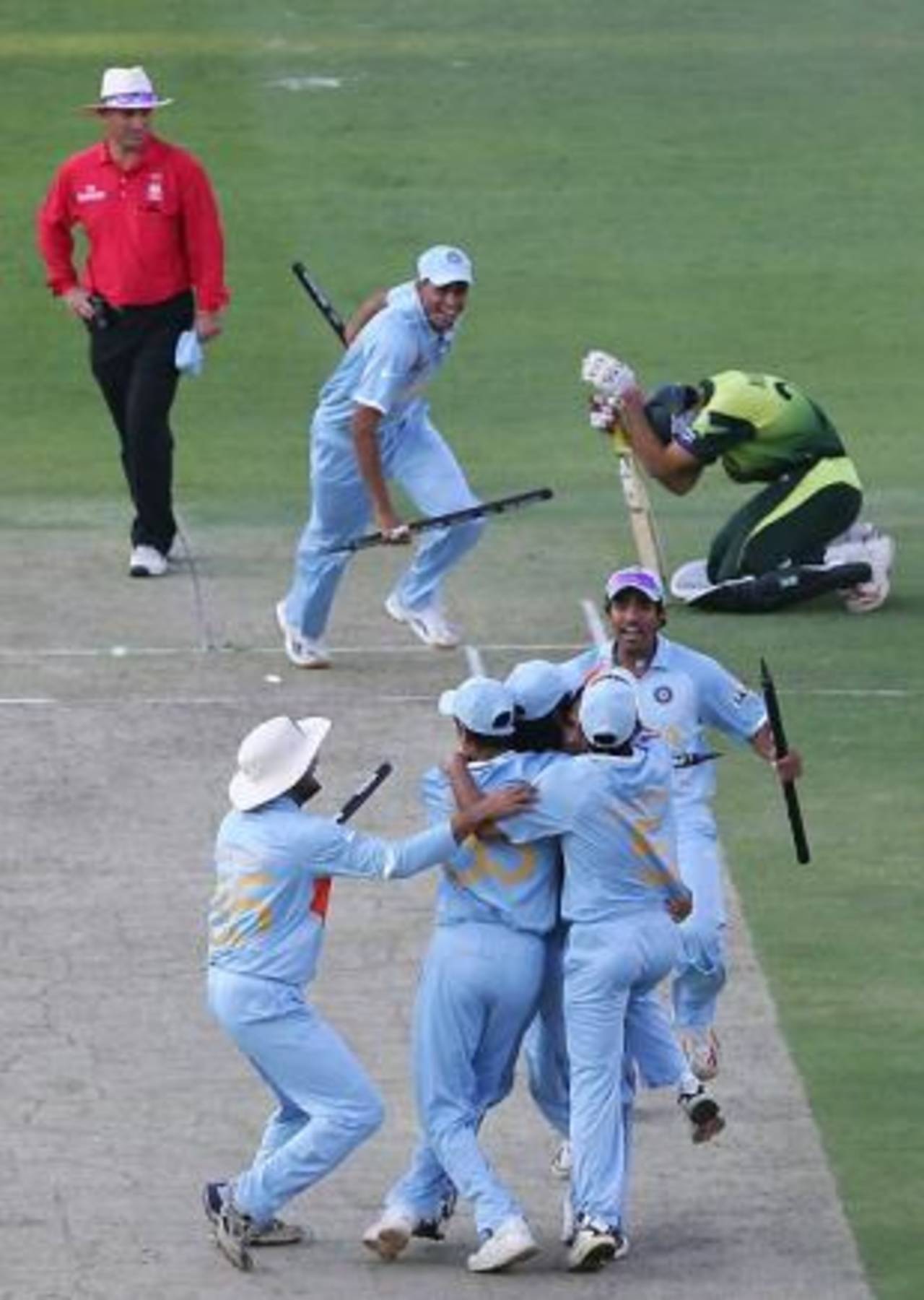
We did start the fire: India win the World Twenty20, and indifference in the country turns into hysteria • Getty Images
India falls in love with Twenty20 - September 2007
Pakistan's Misbah-ul-Haq top-edges a sweep off Joginder Sharma, and is caught by Sreesanth round the corner with four needed off three balls. India win the inaugural ICC World Twenty20 watched by over 400m people on TV, one of the biggest audiences ever outside an Olympics or football World Cup. India's first major trophy since the 1983 World Cup is the cue for open-topped bus rides through Mumbai and mass Twenty20 hysteria (after early indifference) in the world's second-largest economy.
Pakistan's Misbah-ul-Haq top-edges a sweep off Joginder Sharma, and is caught by Sreesanth round the corner with four needed off three balls. India win the inaugural ICC World Twenty20 watched by over 400m people on TV, one of the biggest audiences ever outside an Olympics or football World Cup. India's first major trophy since the 1983 World Cup is the cue for open-topped bus rides through Mumbai and mass Twenty20 hysteria (after early indifference) in the world's second-largest economy.
Celebrity, money, cricket - February 2008
In the ballroom of the Hilton Towers Hotel in Mumbai, at the inaugural IPL auction, 10 of the best players in the world are bought and sold for a collective $7.175m in the first two hours. By the time dusk falls, India's richest men have spent just shy of $35m. MS Dhoni goes for $1.5m in the first round of bidding, while Hyderabad fork out $1.35m for Andrew Symonds. Cricket is now a high-stakes game. After a slow start for his Royal Challengers Bangalore franchise (cost $111.6m), Kingfisher beer tycoon Vijay Mallya sacks the team's chief executive as they walk to his private jet.
In the ballroom of the Hilton Towers Hotel in Mumbai, at the inaugural IPL auction, 10 of the best players in the world are bought and sold for a collective $7.175m in the first two hours. By the time dusk falls, India's richest men have spent just shy of $35m. MS Dhoni goes for $1.5m in the first round of bidding, while Hyderabad fork out $1.35m for Andrew Symonds. Cricket is now a high-stakes game. After a slow start for his Royal Challengers Bangalore franchise (cost $111.6m), Kingfisher beer tycoon Vijay Mallya sacks the team's chief executive as they walk to his private jet.
Stanford plays the name game - June 2008
Like a huckster in a Coen Brothers movie the Texan billionaire Sir Allen Stanford flies into Lord's in a rented helicopter, as the ECB passes the moral high ground to the Sun. "Don't you think," says John Etheridge, the paper's esteemed cricket correspondent, posing the first question at the press conference, "this is all very vulgar?" How right he was. But despite the Texan's own recent demise, Stanford-style events will prosper as brands seek to own content rather than merely sponsoring it.
Like a huckster in a Coen Brothers movie the Texan billionaire Sir Allen Stanford flies into Lord's in a rented helicopter, as the ECB passes the moral high ground to the Sun. "Don't you think," says John Etheridge, the paper's esteemed cricket correspondent, posing the first question at the press conference, "this is all very vulgar?" How right he was. But despite the Texan's own recent demise, Stanford-style events will prosper as brands seek to own content rather than merely sponsoring it.
Twenty20's first superstar - June 2008
Graham Napier walks out to bat at the Ford County Ground, Chelmsford a journeyman county pro, earning around £40,000 a year. An hour, and 58 balls, later his life has changed forever. Napier hits 16 sixes (a world record) and 152 runs. His career goes from down the tube to YouTube. Napier is now an IPL player (average salary £75,000 for six weeks' work) and Twenty20 becomes a career option for the next generation of players.
Graham Napier walks out to bat at the Ford County Ground, Chelmsford a journeyman county pro, earning around £40,000 a year. An hour, and 58 balls, later his life has changed forever. Napier hits 16 sixes (a world record) and 152 runs. His career goes from down the tube to YouTube. Napier is now an IPL player (average salary £75,000 for six weeks' work) and Twenty20 becomes a career option for the next generation of players.
Cricket's dotcom boom - September 2008
As the world's economy goes into meltdown, cricket is having its own dotcom moment, when anyone with a smart idea and Lalit Modi's phone number can make fortunes. Australia, South Africa and India agree a Twenty20 Champions League and walk away with $975m from ESPNStar. The ECB opts not to be involved, leaving it on the outside as the money is shared out.
As the world's economy goes into meltdown, cricket is having its own dotcom moment, when anyone with a smart idea and Lalit Modi's phone number can make fortunes. Australia, South Africa and India agree a Twenty20 Champions League and walk away with $975m from ESPNStar. The ECB opts not to be involved, leaving it on the outside as the money is shared out.
Twenty20's second superstar - January 2009
David Warner becomes the first player for more than 100 years to represent Australia without having played first-class cricket. Warner opens the batting on his Twenty20 international debut in Melbourne, against South Africa with only a handful of one-day and T20 games for New South Wales behind him. His emergence also prompts manufacturer Gray-Nicolls (his sponsor) to develop a double-sided bat with a pressed hitting area on the reverse, designed for easy switch-hitting or reverse-sweeping for batting innovators like Warner.
David Warner becomes the first player for more than 100 years to represent Australia without having played first-class cricket. Warner opens the batting on his Twenty20 international debut in Melbourne, against South Africa with only a handful of one-day and T20 games for New South Wales behind him. His emergence also prompts manufacturer Gray-Nicolls (his sponsor) to develop a double-sided bat with a pressed hitting area on the reverse, designed for easy switch-hitting or reverse-sweeping for batting innovators like Warner.
Player power - January 2009
For a moment during the row over the England captaincy the ECB gets a glimpse of a brave new world. Kevin Pietersen can walk. And there is little it can do to stop him. The IPL has handed the biggest stars something they have not had since Packer: leverage. The best players in the world have a viable alternative to playing Test cricket. Football has wrestled with the club v country row for years, and the same tension will define cricket's future. Power and money will flow away from the official boards and towards players and their agents.
For a moment during the row over the England captaincy the ECB gets a glimpse of a brave new world. Kevin Pietersen can walk. And there is little it can do to stop him. The IPL has handed the biggest stars something they have not had since Packer: leverage. The best players in the world have a viable alternative to playing Test cricket. Football has wrestled with the club v country row for years, and the same tension will define cricket's future. Power and money will flow away from the official boards and towards players and their agents.
From Arnie and Tiger to Sachin and KP - September 2007
IMG was founded on a handshake between super-agent Mark McCormack and golfing legend Arnold Palmer, and the company now represents Tiger Woods and Roger Federer among many others. McCormack's legacy is sport as entertainment. No surprise then that Modi looks to Andrew Wildblood, IMG's man in India, to turn the idea of the IPL into a billion-dollar product.
IMG was founded on a handshake between super-agent Mark McCormack and golfing legend Arnold Palmer, and the company now represents Tiger Woods and Roger Federer among many others. McCormack's legacy is sport as entertainment. No surprise then that Modi looks to Andrew Wildblood, IMG's man in India, to turn the idea of the IPL into a billion-dollar product.
RIP ODI - April 2007
The 2007 ICC Cricket World Cup is the beginning of the end for the 50-over game, which has propped up the cricket economy for two decades. A global audience tunes in to see seven weeks of empty seats, boring one-sided games, extortionate ticket prices and umpiring incompetence; "2007 ICC CWC" is puffed up and pompous, sport run by marketing men. There has to be another way.
The 2007 ICC Cricket World Cup is the beginning of the end for the 50-over game, which has propped up the cricket economy for two decades. A global audience tunes in to see seven weeks of empty seats, boring one-sided games, extortionate ticket prices and umpiring incompetence; "2007 ICC CWC" is puffed up and pompous, sport run by marketing men. There has to be another way.
Party like it's 1953 - July 2004
Ticket touts on St John's Wood Road? The last time Lord's sold out a county match Denis Compton was still pushing Brylcreem. But Middlesex Crusaders v Surrey Lions on a balmy June evening pull in 26,500 people to Headquarters, each paying between £5 and £10. County chairmen across the country watched open-mouthed.
Ticket touts on St John's Wood Road? The last time Lord's sold out a county match Denis Compton was still pushing Brylcreem. But Middlesex Crusaders v Surrey Lions on a balmy June evening pull in 26,500 people to Headquarters, each paying between £5 and £10. County chairmen across the country watched open-mouthed.
Seven counties are out-voted - April 2002
Two years before the first-ever game between Hampshire and Sussex at the Rose Bowl, Stuart Robertson, then marketing manager at the ECB, has the idea for a 20-over competition to replace the Benson & Hedges Cup. It goes to the county chairmen for approval. The vote goes through 11-7 in favour of adopting the new format. Middlesex, Sussex, Yorkshire, Warwickshire, Somerset, Glamorgan and Northants each voted against.
Two years before the first-ever game between Hampshire and Sussex at the Rose Bowl, Stuart Robertson, then marketing manager at the ECB, has the idea for a 20-over competition to replace the Benson & Hedges Cup. It goes to the county chairmen for approval. The vote goes through 11-7 in favour of adopting the new format. Middlesex, Sussex, Yorkshire, Warwickshire, Somerset, Glamorgan and Northants each voted against.
Richard Gillis is an award-winning sport business journalist.
This article was first published in the June 2009 issue of the Wisden Cricketer. Subscribe here