| Series | Countries | Live Scores | Fixtures | Results | News |
Features
|
Photos | Video & Audio | Blogs | Statistics | Archive | Games | Mobile | ||||||||||||||||||||
|
It only serves to devalue the next game, especially if it's a crucial one

Andrew Fidel Fernando
February 17, 2013
![]()
|
|||
|
Related Links
Features : Jayawardene stands by captaincy switch
Players/Officials:
Mahela Jayawardene
| Misbah-ul-Haq
|
|||
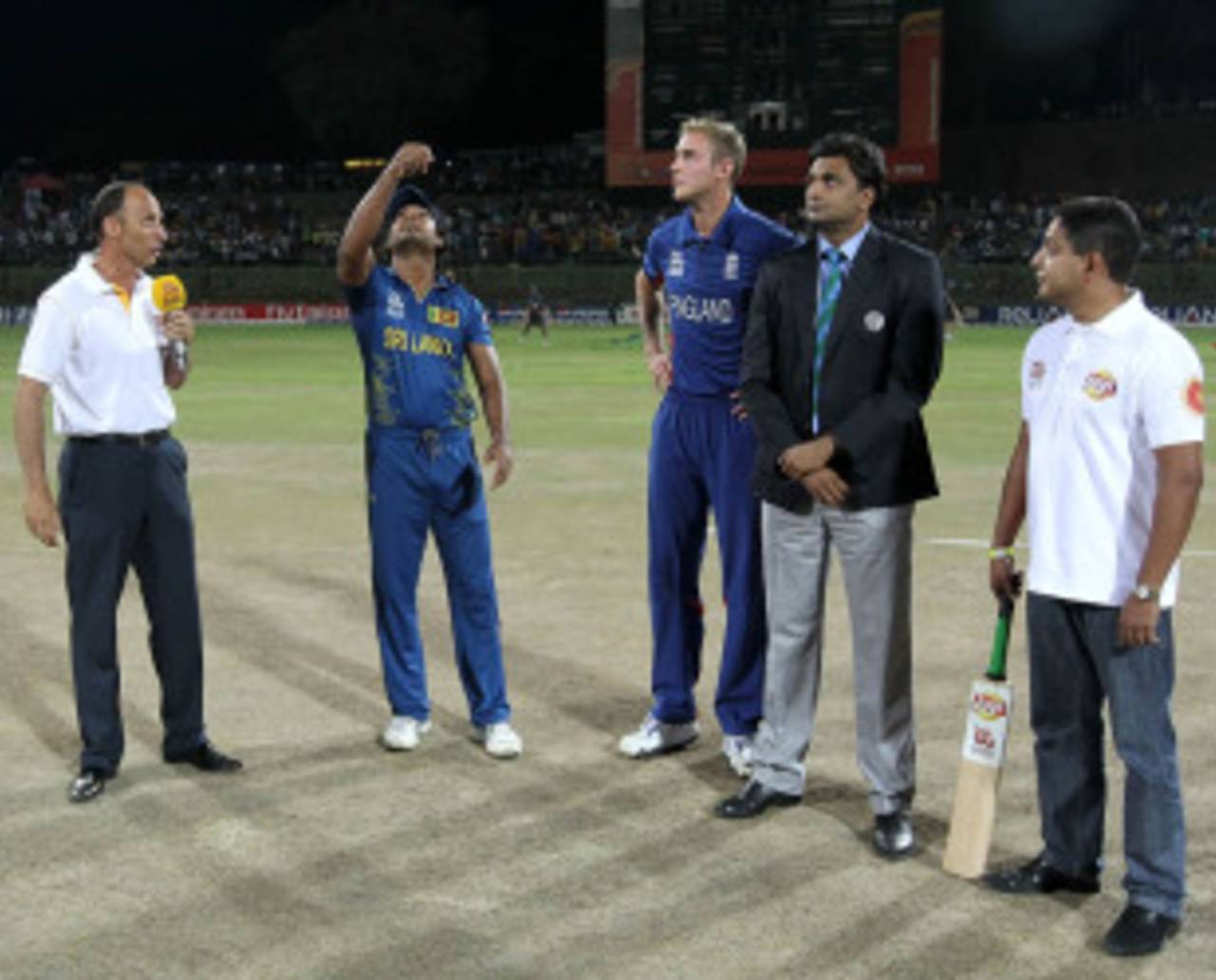
In Sri Lanka's final Super Eights match in the 2012 World Twenty20, Kumar Sangakkara strode out for the toss in place of Mahela Jayawardene. "Mahela has lost three tosses in a row," was the line Sangakkara tried to peddle, but it was clear that trickery was afoot. When Sri Lanka came out to field, Jayawardene directed the fielders, changed the bowlers and generally called the shots.
Social media quickly figured Jayawardene was dodging a possible second over-rate infringement, which would lead to a suspension, and lit up with debate. Some condemned Sri Lanka's captain for flouting the rules, others praised him for it. After the match, Jayawardene confirmed, with more than a hint of glee at having cheated the system, that the switch had aimed to ensure he did not miss the semi-final.
As the rule stands, if a captain oversees two over-rate offences in the same format within 12 months, he is forced to miss his next match in the same format. In addition, the entire team is docked 10% of their match fee for every over that is deemed to be tardy, and the captain is fined twice that amount.
Sri Lanka's ruse had been conceived by the team manager because in the previous match they were found to be one over short of the minimum over rate. Their match against West Indies was not noticeably duller because of a slightly slower pace of play, nor had there been any inkling an infringement had occurred until the ICC's release came through. Yet if Sri Lanka had transgressed equally indiscernibly under Jayawardene's watch in their next game against England, or indeed in the semi-final against Pakistan, they would have lost their captain and best T20 batsman for a crucial match in a major tournament. The penalty seems too severe for the crime.
More frustratingly, the rule actually seems to defeat the purpose for which it was drawn up. If the rule-makers had hoped to make cricket more watchable by requiring quick play, they cannot punish violations by compromising the quality of the next match, which they do when they ban a key player.
In June last year, Pakistan lost Misbah-ul-Haq for the first Test against Sri Lanka for an over-rates infringement. What followed in Galle was their only Test loss of the year. There is no guarantee that Misbah would have made any difference to the result, but as their coach Dav Whatmore pointed out, Sri Lanka couldn't claim to have beaten Pakistan's best team.
The rule is likely born of broadcasters' demands, but perhaps harsher fines can serve as an acceptable deterrent for captains instead. Whatever the solution, the current rule, which aims to enhance the game, ends up devaluing it.
Andrew Fidel Fernando is ESPNcricinfo's Sri Lanka correspondent. He tweets here
© ESPN EMEA Ltd.
| ||||||
| Comments have now been closed for this article |
||||||
'You can't taint the whole IPL'
Bowl at Boycs: Geoff Boycott on spot-fixing, Adil Rashid's future, and yorkers in Test matches
Harsha Bhogle: The spot-fixing controversy teaches us about the pitfalls of insecurity and of the desire to keep up with the Joneses
The new Harmison? Or is it the new Caddick?
Numbers Game: Stuart Broad is destructive at his best, but at other times his bowling average is unusually high
Aakash Chopra: Apart from luck, you need to pick your team wisely, get to bat at the top, and have your captain's support
Less cricket on TV? Hallelujah
Matt Cleary: Why Channel Nine should be applauded for not broadcasting domestic cricket in Australia
Even at the height of his success with the national side, Sreesanth was a lonely cricketer who felt hard done by
A talent that didn't know its own worth
Sreesanth wasn't the most likeable team-mate or opponent, but he had skill beyond doubt, which we might have seen the last of
Mumbai Indians still have a better head-to-head record against Chennai Super Kings, but once again on the big occasion, they came second
A time for anger, a time for action
Out of the shattered lives of three young men caught up in allegations of fraud, newer and stronger players must emerge
Vijay slips, Ashwin does a Sahara
Plays of the day from the IPL qualifier between Chennai Super Kings and Mumbai Indians in Delhi
Spirited Sunrisers exceed expectations (83)
Sunrisers began this tournament as one of the underdogs, but fought impressively to reach as far as the Eliminator
Even at the height of his success with the national side, Sreesanth was a lonely cricketer who felt hard done by
Mumbai Indians still have a better head-to-head record against Chennai Super Kings, but once again on the big occasion, they came second
Anderson's magic not to be missed (50)
None of the other three England bowlers with 300 Test wickets - or many other of the game's finest swing merchants - could have bowled better than James Anderson at Lord's
A case of peaking too early (42)
Royal Challengers began the season in full steam, but failed to replicate their consistency away from home
ICICI Bank M2I. Register Now and Get A Gift Offer.
Safe & simple online money transfer. Apply Now!
Buy Wisden 2013 & get a FREE Playfair
Available now at Cricshop
I find many comments made by many here are ridiculous. What is most funny is that when SL intelligently take advantage of loop holes, then it becomes an issue. And that becomes against the spirit of the game. What about sledging then. So when Greig Chappel bowled the underarm to avoid hitting a six was not against the spirit of the game. Additionally, there are new rules like two new balls should be used from either ends facilitating mainly fast bowlers but not the spinners and reverse swing bowlers. Am I the only one thinking that many Aus/Eng cricket authorities pushing to get advantage for their sides? Cricinfo please post.
Posted by cricket-india on (February 18, 2013, 16:28 GMT)today's players miss enough games anyway due to injuries or fatigue; no point making them sit out even more with these silly rules. no spirit of cricket is served by this. just have higher cash penalties for slow over rates and get it over with. don't criticise mahela/sanga or anyone esle who have found a way around it. ad breaks sleazily packaged as strategic time-outs are not seen as impediments to the game and violations of its spirit but captains taking an extra minute or two to set a field is a gross violation???
Posted by torsha on (February 18, 2013, 14:24 GMT)Well what SL did was against the spirit but by excluding this rule can certainly help MSD and AB.
Posted by razaqaiser on (February 18, 2013, 13:04 GMT)dont ban captains dont fine anyone, instead add penalty runs to the opposite team. Devise a formula like duckworth and lewis to add these penalty runs to the opposition. Fr teams batting second in one day, calculations could be made after every 20 overs to force the fielding captain to finish in time.
Posted by Wouterb on (February 18, 2013, 9:15 GMT)The on field umpires are not taking sufficient control to ensure that teams are not ensuring that over rates are managed effectively - a typical example is that i was at Newlands on both dates at the start of play and breaks play normally starts 2 minutes after it should - also in between there is to much leeway given to fielding sides so hence needs better and more proactive leadership by umps
Posted by Cluedin on (February 18, 2013, 9:13 GMT)A solution could be to add the number of runs from the highest scoring overs to the batting team's score if they are guilty of wasting time/ slow over rate. In the case of the batting team causing the delay the on field umpires need to take the situation in their hand by giving one warning to the batsman and then retiring the said batsman hurt in the case of another incidence of delaying tactics. This would balance the issue.
Posted by ygkd on (February 18, 2013, 7:10 GMT)It was said of the West Indies thirty-odd years ago that they slowed things down to about 12 overs per hour when things weren't going their way, thus effectively resting their pace bowlers without requiring a spinner. They were a truly great team but things like that, although beneficial to those doing it, cannot at all be good for the game. I would like to see a tough stance on any such behaviour, whoever does it and whenever it happens. If that means that someone like Jonathon Trott for example, whose batting I freely admit to liking immensely, but who has raised a few eyebrows for taking a while between facing balls, is ultimately timed-out for taking too long, then so be it. Equally, though, if bowlers take too long walking back to their mark etc, the team should be subject to a run penalty. Ninety overs in a day shouldn't take seven hours.
Posted by@SolFish - actually, it had little or nothing to do with curbing the dominance of the Windies quicks. It was to try and increase what had become often funereal over rates, which were a by-product of most teams stacking up on fast men, thereby increasing the number of overs bowled, the amount of cricket played, and (hopefully) make the game more interesting for spectators.
Captains at every level are responsible for the on-field conduct of their team, and that extends to over rates.
Posted by SolFish on (February 18, 2013, 3:21 GMT)We don't hear of batsmen being penalized for low run rates, wasting time when they stop the bowler in the midst of his run up, time used for referrals to the 3rd umpire, balls knocked out of the ground. Please quit placing the blame on the bowlers or the fielding team, these silly rules only came about because of the WI 4 prong pace attack of the 70's to prevent their domination and the hit them in the pocket if they persisted.
Posted by PM_india on (February 18, 2013, 1:04 GMT)The writer needs to improve his journalism skills. He has devoted almost his whole article to a couple of incidents and given his opinion in a couple of sentences at the end. A good journalist would have provided more insights into his rationale in the article.