
'If we make it out alive, we'll play for New Zealand'
New Zealand's Murray Parker looks back to the night, 45 years ago, when he and his Otago University team-mates nearly met a watery end

Andrew McGlashan
Mar 13, 2013, 2:41 AM
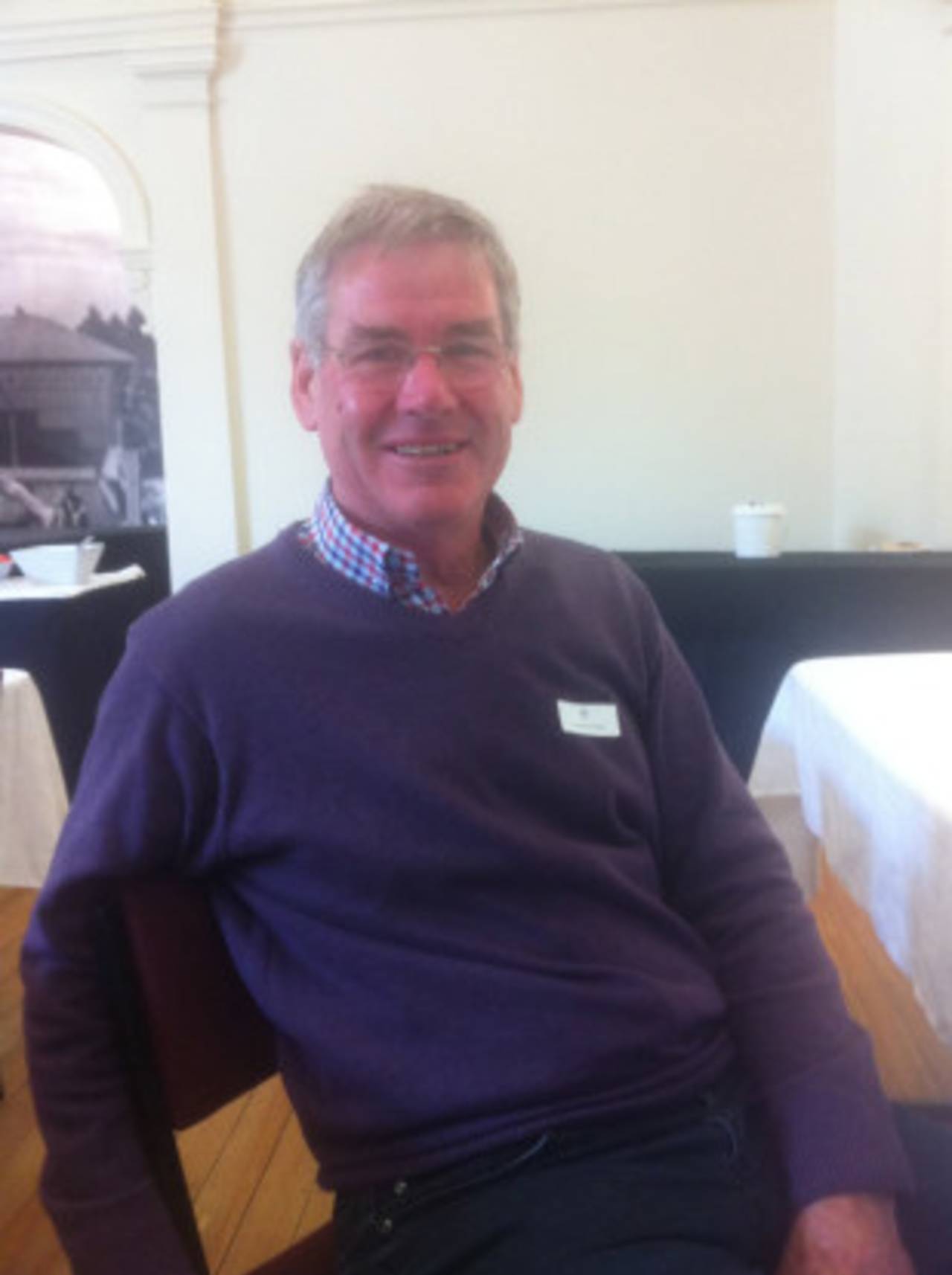
Parker survived one of New Zealand's worst maritime disasters and went on to play three Tests • Andrew McGlashan/ESPNcricinfo Ltd
During the Dunedin Test there was a quite extraordinary reunion. Few of the 11 Otago University cricketers of the class of 1968 are household names, but they all share a remarkable story.
On a wild, wet and windy South Island evening, caused by Cyclone Giselle, which had moved down over North Island, leaving a trail of destruction, the players, having travelled from Dunedin to Christchurch by train, boarded a boat named Wahine for an overnight journey to Wellington. It was rough sailing, but that didn't stop the bar being a popular hangout.
Then, in the early hours, an almighty jolt rocked the ship as it hit Barrett Reef, outside of the harbour. A few hours later it was listing badly and soon the call to abandon ship was made.
One of the players, Murray Webb, remembered saying: "If we make it out alive from this, we'll play for New Zealand." In all, 53 people died in one of New Zealand' worst maritime disasters. However, all 11 cricketers survived. And two of them, Webb (now a well-known caricaturist in New Zealand) and Murray Parker, did go on to represent their country.
The story has been told in a new book The Team That Never Played, pulled together by Ronald Cardwell and Bill Francis, who tracked down the 11 players and brought them back together for the first time in 2013.
Parker, who played three Tests on the 1976 tour of India and Pakistan, spoke to ESPNcricinfo.
He was 19 in 1968, enjoying the student life, and his cricket talent had been noted. "Although I certainly wasn't the best - I was mainly a drinks carrier," he says as he starts to relocate the event 45 years later. "A bloody good one," shouts Ray Hutchinson from across the dinner table.
As the Wahine made its way through the rough seas that night, spirits were high among the players. "When we woke in the morning it was rough," Parker says. "I remember getting dressed and hearing a crunch, then thinking we must have hit the wharf. Then Hutch [Hutchinson] ran in and said, 'Get your life jackets on.' I didn't even know where mine was."
The seriousness of the situation was not immediately apparent, but over the next few hours the crisis developed. "There was no panic," remembers Parker, "which was a good job because the corridors were very narrow and if people had been running around screaming, few of us would have been able to get out. Being students we were down on F deck, with the cars, and slowly made our way up to B deck."
For more than six hours the passengers huddled on deck, barely able to see off the side of the boat due to the awful weather, before the decision was made to launch the lifeboats. "We would listen to a transistor radio to hear how we were getting on," Parker says.
The cricketers had been split up and would spend up to a week not knowing if their team-mates had survived. "We had no idea. It was only when he were back at training as people starting turning up," Parker says.
On the lifeboats there were no individual thoughts. "Everyone looked out for each other, pulling in as many as you could," Parker remembers. "The lifeboats were meant to have engines but - sods' law - they didn't work. We had to paddle them by hand. There was a 60- or 70-year-old lady who had a compound fracture of her leg and she was paddling away with the rest of us."
The Wahine's capsize happened only about 400-500 metres from the coastline, but it took the hand-powered lifeboats at least a couple of hours to reach land. "We were rowing against the elements. It was hard work. We landed on Seatoun beach." The cold, tired, soaked survivors were helped by locals, given dry clothes and warm drinks. Still, though, Parker did not know the fate of his friends.
"We gathered at Wellington railway station. A few of the other players wandered in, but by the time we started to disperse, we hadn't seen them all. I had no wallet. I lived in Auckland at the time and was given a free train ride to meet up with my parents."
A week later, after an Easter break, the cricketers returned to training in Dunedin - "with borrowed kit, as we'd lost all ours," Parker says. Eleven team-mates were counted. "We exchanged stories. It must be remembered that while we made it, there were many who did not."
Life returned to normal. Parker played for the university side, Otago, and Canterbury, where his consistent form caught the eye of the selectors. "Canterbury had a terrific team, but I was fortunate to get picked."
A three-month tour of India and Pakistan was his reward, with his brother John as the captain. "There was no nepotism," Parker promises. He made his debut in Karachi, scoring 40 in the second innings as New Zealand earned a draw. Majid Khan, Javed Miandad and Mushtaq Mohammad made hundreds for Pakistan. Warren Lees made his only Test century, 152, in reply, during a seventh-wicket stand of 186 with Richard Hadlee, which stood as a New Zealand record until 2004. Two more Tests followed and a solitary ODI. "It was a wonderful experience. I'd never seen anything like it before. Both India and Pakistan were very good teams."
Webb's Test career was equally brief, despite a first-class bowling average of 23.39, with three matches from 1971 to 1974 - against England, West Indies and Australia - but the numbers certainly don't tell the whole story.
As careers were forged, some in cricket, many outside, livings earned and families started, did it ever seem plausible that the 11 players on the boat that evening would meet up again as a team? "It never crossed my mind," Parker says, "but isn't it amazing?"
Andrew McGlashan is an assistant editor at ESPNcricinfo