
Did one shot help England win MCG Test?
The early aggression from England's openers set the tone for their chase of 175, and one blow had a significant impact

Matt Roller
27-Dec-2025 • 12 hrs ago
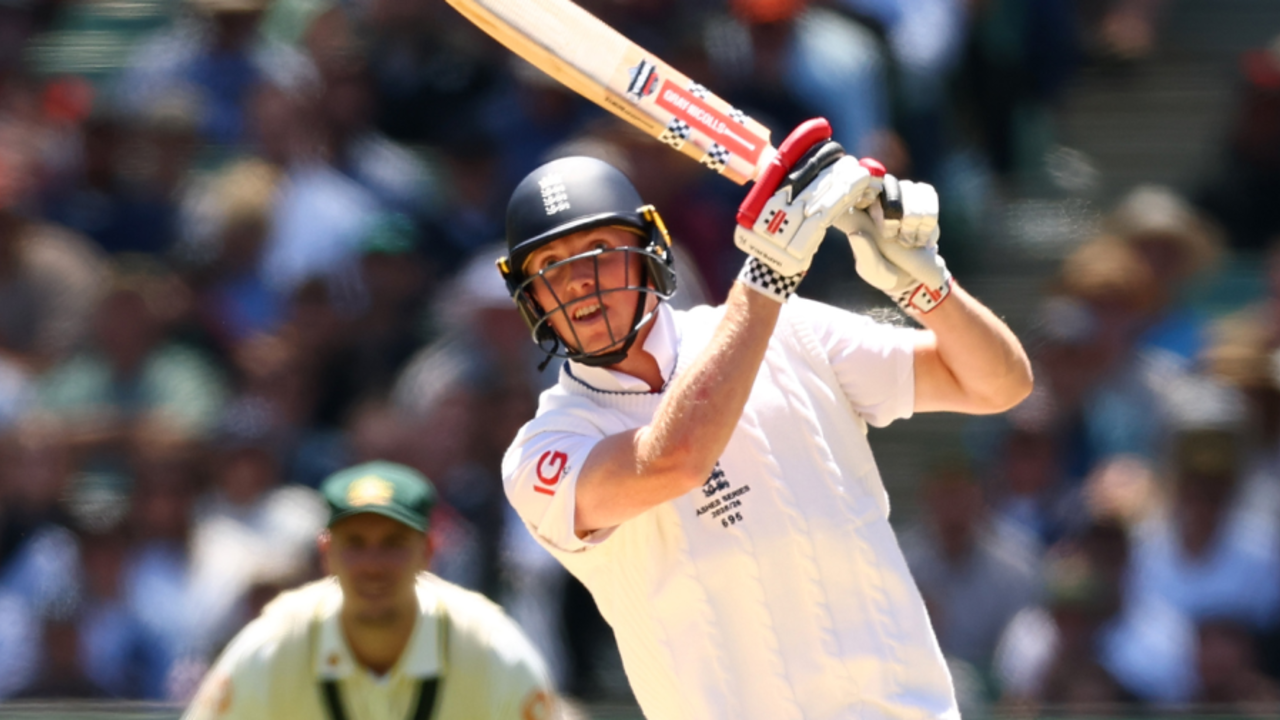
Zak Crawley played his shots early, including what could have proved a vital six • Getty Images
It might just have been the shot that won England the Boxing Day Test. Not Harry Brook's attempted flick off his pads which scudded away for four leg byes to seal a four-wicket win, but Zak Crawley's drop-kick back over Michael Neser's head for six in the fourth over of England's run chase.
Crawley and Ben Duckett's opening partnership was once a strength of England's batting but has quickly transformed into a glaring weakness in Australia. Crawley started the series with a pair in Perth and Duckett's method has been exposed by Australia's attack, to the extent that their fourth-innings stand of 51 at the MCG was their highest of the tour.
But in the context of a 175-run target, and a wild match in which the highest partnership was the 52-run stand between Cameron Green and Michael Neser in Australia's first innings, these were priceless runs. "That opening partnership between Zak and Ducky was a huge, huge reason as to why we chased that total down," Ben Stokes said.
Crawley's straight six off Neser was the first truly authoritative shot of the chase, after Duckett had whipped a pair of early boundaries off his toes in between a series of play-and-misses. Kept in his crease by Alex Carey's decision to stand up to the stumps, Crawley's reach turned a good-length ball into a half-volley, which he swung firmly back down the ground.
But perhaps the most significant feature of Crawley's shot was where the ball landed: just in front of the LED advertising boards that are now ubiquitous at international venues, before crashing firmly into them. Steven Smith identified the shot as the moment that the seam on the new ball softened, giving Australia's fast bowlers less to work with.
"I thought the way they started with the bat was good," Smith said. "They were really aggressive, tried to break the back of a reasonably small chase on a tricky wicket and they got off to a bit of a flyer. A couple of their heavy blows softened our seam quite a bit and probably didn't offer quite as much as it had for the rest of the game after that, so credit to them.
"They obviously played some shots where they hit the ball pretty hard and then I think Zak hit one into the LED boards, and that definitely softened the seam, no doubt about it. But credit to them for doing that."
England players have previously cited the impact that the LED boards can have on the condition of a new ball as a reason for their early aggression in white-ball cricket. Last year, they benefitted from them in a different way, when West Indies' Mikyle Louis hit a ball into the boards which promptly started to reverse-swing during a Test match at Edgbaston.
The ball continued to deviate after Crawley's six - even if to a slightly lesser extent - but Smith identified it as the turning point on the final day. "I think [the ball] did a fair amount for the whole game - [it was] just probably when the ball got softened from a few lusty blows from their top order today, where it started to go a little bit less, potentially," he said at the post-match presentation. "Without that, it [the pitch] was still going to offer plenty."
Stokes, meanwhile, praised his batters for committing to their attacking style in conditions that rewarded it, before adjusting their gameplan once the field spread. "There was only one way of going about chasing that tally down, which was to go out there and try to put the pressure on from ball one, to be honest," he said.
"Your best possible way of being successful out there was looking to be very proactive against a very, very good bowling attack who are relentless in their line and length, and on a wicket like that, you can't allow bowlers to be able to just run up and put the ball where they want to without putting them under some kind of pressure."
Crawley went on to score 37 off 48 balls - the longest innings by an England batter in either innings of a bizarre, fast-forward Test match - and is now England's leading run-scorer in the series with 256, despite his pair in the first Test.
"When Zak and Ben started building a partnership, the field started to go back and then [they] were able to rotate," Stokes added. "Zak identified that moment and then played slightly differently. It wasn't just the boundaries that were allowing us to tick that total down; it was the ones and twos, and the running between the wickets… I was very pleased with the way that we went about that."
After Duckett's dismissal for 34 off 26 balls - his highest score of the series - England threw a surprise by sending Brydon Carse out at No. 3. Carse, who had batted at No. 10 in the first innings, swung wildly before he was caught at deep third for six off eight balls, but his brief innings delayed meant that England's specialist batters faced a slightly older ball.
"That wicket was very tricky, especially with a newer ball, and the top order from both teams were struggling to find a way to consistently score runs or feel any fluency," Stokes explained." We went with an idea of sending someone who's got talent with the bat and a very good eye for hitting the ball [in at No. 3].
"If he gets a quick 20 or 30, that's massive in a very small run chase, but unfortunately it didn't quite come off. Even the 15-20 minutes he spent out there made it a little bit easier for Beth [Jacob Bethell, who made 40 from No. 4] to build the innings that he did."
Stokes also revealed that he had initially floated the idea of sending the hamstrung Gus Atkinson up the order, only to realise that he would not have been allowed to. "There was a bit of a dumb moment from me… I realised after about 15 minutes 'he can't bat until No. 8 anyway' because he'd been off the field, so that quickly went out of the window."
Matt Roller is a senior correspondent at ESPNcricinfo. @mroller98