I don't like cricket, I love it: the NPL marks a new stage in Nepal's obsession with the game
Fans in the country, historically crazy for the sport, have found a new object of affection in the Nepal Premier League
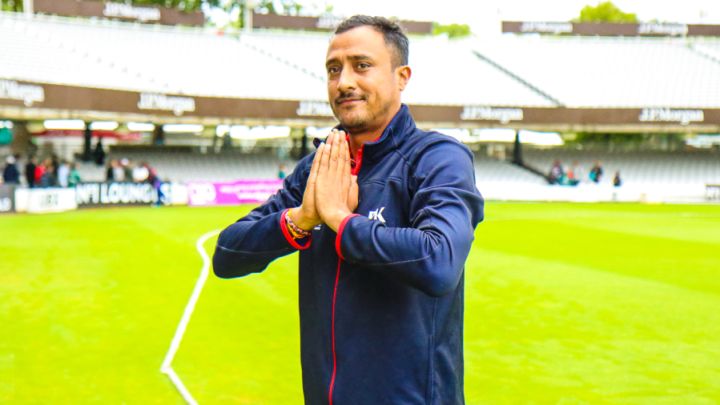
It's 11pm on the eve of the Nepal Premier League playoffs and Paras Luniya has only just sat down for our interview. The Biratnagar Kings co-owner has spent the evening hopping between franchise obligations. His phone rings again. A sponsor is keen on scheduling a podcast.
Ever since Luniya pulled off a coup by signing Faf du Plessis as a marquee player for a certain number of NPL games, his phone hasn't stopped ringing. Now, with Kings in the playoffs, the effect has been multiplied. "Only two matches remain, but sponsor interest has surged beyond belief," he says.
He shows a stream of WhatsApp messages from politicians, celebrities, family, friends and friends of friends. All of them have a common request: tickets. They aren't particular about the seating or hospitality; they're happy to get just about anything Luniya can scrape up. Local newspapers reported on-sale tickets were lapped up within 15 minutes of going live.
Tickets weren't Luniya's only headache that night. Fans had begun gathering in large numbers inside the team hotel, just to catch a glimpse of Faf, sending security into a mild panic. Eventually, a last-minute decision was taken to move the former South Africa captain to a luxury resort on the outskirts of Kathmandu to avoid chaos.
You only needed to spend five minutes around du Plessis to understand that he had become the epicentre of the frenzy surrounding the tournament. At every Biratnagar Kings game that week, a massive banner greeted him. In the stands, chants of "RCB, RCB" rang out loud.
They came from Nepal's RCB fan club - an officially registered body formed by a group of friends in late 2023. At the time of the NPL playoffs in December 2025, the club had over 40,000 followers on Instagram, a number that had tripled since the eve of last year's IPL final, when Royal Challengers Bengaluru won that tournament for the first time.
The fan club has evolved into a meticulously run collective with 13 board members - a president, a secretary, two handling media and PR, and others assigned to marketing and community engagement. Before every match, advisories go out telling supporters exactly which ticket zones to target. Often fans end up wherever seats are available, because demand far outstrips supply. They always arrive in numbers, dressed in red, chanting relentlessly.
Du Plessis may have spent far longer with Chennai Super Kings than with RCB in the IPL, but in Nepal he is an RCB superhero. The devotion seems intensely personal.
The Biratnagar Kings owners graciously help the fan club meet their hero. A day after Kings were thrashed in Qualifier 1 and a day before the Eliminator, around 20 members of the fan club arrive at the team hotel carrying a memento, which includes a framed photo of du Plessis wearing an RCB jersey, thanking him for coming to Nepal.
They have waited more than an hour for an interaction that ends up lasting a little over a minute. They take a group photograph and du Plessis signs a few autographs. Some of the fans hurriedly click selfies while he's signing. Afterwards, du Plessis gently places the gifts aside and walks off to dinner.
The fans are ecstatic. They have met their hero. They have taken photographs and signatures, made memories. He spent less than 100 seconds with them, but they will remember it for years.
You wonder if this passion is reserved for just the global stars. Apparently not.
On the eve of the NPL final, Rohit Paudel's cafe, 17 Beans, on Kathmandu's upscale Shram Marg, begins filling up with fans eager for a glimpse of Nepal's captain. Paudel's parents have travelled from Lumbini to watch their son lead his home franchise, Lumbini Lions, in the title match. They have barely had time to sit at a table before fans queue for photographs. Paudel obliges everyone before getting back to his parents, and to his favourite hot chocolate mocha - a drink he recommends we try.
Kushal Bhurtel, once Paudel's housemate a decade ago, has seen this mad passion both as a fan and as a player. The two moved from their home towns to train together, with Bhurtel channelling his disappointment at not breaking through initially by coaching his "younger brother".
He didn't take rejection lightly. He'd grown up watching India play and he was going to do whatever it took to play them.
That passion found its highest expression when Bhurtel rejoined the national team on the morning of a World Cup qualifier match in 2023. Only five days prior, his mother had had to be rushed to Kathmandu from their home town after suffering serious burn injuries in an accident. Paudel urged Bhurtel to stay back in hospital with his mother, but Bhurtel turned up for the game anyway - and scored a century.
"Cricket ka junoon," Bhurtel says about that time, referring to the game as an obsession. "Even in her moment of pain, my mother's words were, 'Go, play. Your sister is here [with me]. You have worked hard, go make the country proud.' Today, fully recovered, she watches her son play in packed stadiums. Nothing makes her happier than seeing crowds queue for him.
Even visiting professionals from countries where cricket is hugely popular are taken aback. Sheldon Jackson, the retired Indian domestic wicketkeeper-batter, who plays for Sudur Paschim Royals in the NPL, found himself surrounded wherever he went, receiving a level of attention he never experienced even during his IPL stint with Kolkata Knight Riders.
"Fans were literally reeling out [details of] some of my favourite knocks," Jackson says. "I had people wait for hours in the hotel lobby to meet me and talk about some of my innings only people who follow Indian domestic cricket would remember. They even recalled specific stumpings."
None of this surprises Paras Khadka, Nepal's inspirational former captain who currently works for the Cricket Association of Nepal (CAN). Khadka wants to position the NPL in a way that brings in players from across the world, who he hopes will then contribute to driving tourism to the country.
At the Everest Hotel, where teams and officials gather on the eve of the playoffs, the frenzy takes another turn. This time, it isn't for a player, but for "Taklu dai" - Andrew Leonard, the long-time champion of Associate cricket, and former Cricket Ireland employee, who is commentating at the NPL. (The nickname literally translates to "bald older brother".)
"This must be my 15th or 16th trip," Leonard says, before giving the gathered throng a casual wave that sends them into raptures. Cafes, restaurants, hotel lobbies - he is stopped everywhere for selfies. Leonard reciprocates in his inimitable style. He understands Nepali and makes an effort to speak it. That's all it takes.
"Lenny is as much an icon as the players," says Khadka, still a superstar himself. Nepal's captain when they first played at the T20 World Cup, in 2014, Khadka is a magnetic presence.
He has been busy helping establish the NPL, which offers CAN a new revenue stream apart from the annual funding they receive from the ICC.
As the association's secretary, his work days often stretch to 14 hours, sometimes more. The time of our scheduled meeting with him has had to be revised several times because of how busy he is. "Ministry meetings, sponsors, owners, players… 24 hours hasn't felt enough during the NPL," he says. "Waiting for life to slow down after the tournament."
The NPL, Khadka says, was always about the long game. Unlike in the inaugural season, franchises have had more preparation this time. Biratnagar Kings sent their local players to a three-week boot camp in Mumbai. Janakpur Bolts ran exhaustive training sessions under their head coach, Shivnarine Chanderpaul. Monty Desai, Nepal's former head coach, and now in that role for Kathmandu Gorkhas, travelled around Kathmandu for scouting programmes, drawing on his previous coaching experience to hand-pick players.
"The franchises have done a phenomenal job," Khadka says. "We were clear from the start that this would be an investment phase. For three to five years, profit won't come. That's how leagues grow." The commercial response, though, has exceeded expectations. "Each team now has six or seven brand partners," he says.
That is driven home wherever you go. Paudel stares at you from hoardings across Kathmandu, selling a range of products from ACs to TVs, mobile phones to jeans. Bhurtel sells bikes and advocates for digital payments. Dipendra Airee is a brand ambassador for a leading automobile maker. "The league itself has around 15 to 17 brands," Khadka says. "Nearly 100 brands were involved in one tournament. That shows how Nepal cricket's value has grown."
Anubhav Sirohiya, co-owner of Kathmandu Gorkhas, has been surprised by how massive the tournament has become. "In our contract negotiations with prospective sponsors, we found out how companies saved up on advertising budgets to be able to spend in the December window during the NPL," he says.
"Some of them even wanted to invest [later] having missed the bus and seen how massive it has become. It's so big that everything else shuts down around the NPL."
The commercial success has forced those in the corridors of power to take note. Ahead of NPL 2025, the government sanctioned funds to refurbish the Tribhuvan University Ground into a 12,000-capacity venue, with bucket seating, modern media facilities and corporate boxes.
Khadka hopes this push will have a knock-on effect in other parts of the country. In two years they hope to be able to play the league across at least four venues in a caravan model. "If we monetise this correctly," he says, "the money can flow back to districts and provinces. Cricket needs to become a viable career, not just for national players but at grassroots levels too. The NPL has been a major catalyst in Nepal's rise in international cricket."
The impact is already visible.
Nandan Yadav moved to Australia looking for career opportunities while playing cricket on the side. A trip back home, and a tearful plea from his mother that he not go back, changed everything. Performances for Karnali Yaks in the inaugural NPL earned him an ODI debut in 2025. He is now part of Nepal's T20 World Cup squad.
Sher Malla's career has had a similar arc. Virtually unknown before the NPL, he finished the second season as one of the joint-highest wicket-takers, and also was the Emerging Player of the Tournament, helping Lumbini Lions lift the title.
"The aspirational value has changed," Khadka says. "Today, kids can Google a Nepali cricketer and see a future, financial security, endorsements and opportunity. Parents are willing to invest. That shift is massive."
A young Nepalese player with a base contract stands to earn between NPR 3 and 5 lakh (approximately US$2000-3500) through the NPL in contract fees. Established stars earn anywhere between 15 and 20 lakh. Kathmandu Gorkhas even handed out rookie contracts this year, in the ballpark of NPR 3 lakh, to players as a developmental incentive.
"Players outside the national team now have some sort of financial security that incentivises them to train in the off season," says Desai. "In today's day and age of million-dollar deals, this may not look like much, but for a country as passionate as Nepal is, it's a doorway to much bigger things. Young kids want to be the next Rohit Paudel, Sompal Kami and Gulshan Jha."
Looking ahead to the World Cup, Khadka has already been flooded with ticket requests. "I can't oblige them all," he says, smiling. "In the US in 2024, when we played Netherlands in Dallas, it felt like playing in Kathmandu. Out of 8000 people, maybe 50 were Dutch. That really took the ICC and the global cricket community by surprise.
"It showed what Nepal cricket represents. Whenever we play at home, stadiums are jam-packed. This being our third World Cup, and India being so close to Nepal, easy to travel [to], familiar language, food and culture, we expect strong crowd support. We want to show our presence not just on the field but off it as well."
Shashank Kishore is a senior correspondent at ESPNcricinfo
Read in App
Elevate your reading experience on ESPNcricinfo App.