With vision and heart, IS Bindra made things happen in cricket
The former BCCI chief was a heavyweight administrator who made a difference
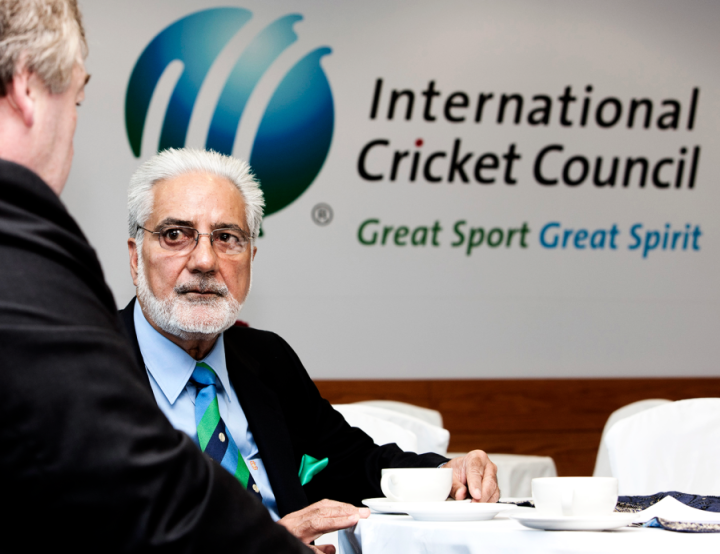
I first met Inderjit Bindra soon after I started representing the PCB at the ICC. I had met with Madhavrao Scindia, the BCCI president then, and Jagmohan Dalmiya, who would serve in that role later, in 1991. One of the items on the agenda was the hosting rights for the 1996 World Cup. I was Pakistan's sole representative at this meeting, chaired by Colin Cowdrey, who asked the board to approve England as the host for the 1996 World Cup. Jaggu asked for the matter to be discussed on the second day of the meeting.
Overnight Jaggu briefed me on the successful hosting of the 1987 World Cup by India and Pakistan. England were required to submit their terms and conditions for hosting rights to the 1996 World Cup, but had not presented them at the meeting. I spoke to Arif Ali Abbasi [the PCB CEO at the time], who agreed we should not rubber-stamp England as the host.
The next morning I raised the point that the terms and conditions for the hosting rights had not been submitted for the board to evaluate England's offer. I asked for the minutes where England were nominated as host; Jaggu made the point that without opening the hosting rights to other ICC members, it would be impossible to evaluate whether England's offer was acceptable. This was the beginning of my long working relationship with Jaggu, and through him, Bindra.
Following this meeting, BCCI and PCB representatives held several meetings in London, Lahore and Delhi. We agreed a joint bid, including Sri Lanka, would be submitted. It was proposed by Bindra and Dalmiya that the bid committee would be chaired by the PCB chairman. The joint World Cup committee, the Pakistan-India-Sri Lanka Committee, or PILCOM, was formed.
During the meetings leading up to PILCOM's bid, I got to know Bindra well and to appreciate his deep understanding of what it would take to make the World Cup a success. He had played a major role in the staging of the 1987 World Cup, the first to be played outside England.
I was told that there had been doubts whether that tournament would take place because of political tensions between India and Pakistan. Bindra, a senior bureaucrat and former special secretary to the president of India, understood exactly how things worked in India and Pakistan. He apparently suggested to General Zia-ul-Haq, the president of Pakistan, that he make a spontaneous visit to India during the 1986-87 Test series between the two countries. General Zia's visit, "cricket diplomacy" as it came to be known, gave assurances to England, Australia and the other ICC members that the World Cup would not be affected by tensions between the countries.
Bindra was a heavyweight cricket administrator. Unlike most bureaucrats he would look at the bigger picture and always be prepared to give his opinion, forcefully if necessary. He was warm-hearted but always frank and not afraid to call a spade a spade.
Mr Bindra was a very important player in moving power in cricket away from England. He understood that often we in Asia needed to hold our ground and not just rubber-stamp decisions coming out of England
This trait came out strongly during the 1996 World Cup. Australia and West Indies refused to play their pool matches in Sri Lanka due to concerns over security. At a meeting in Kolkata, he took on the representatives of those teams and England, who were refusing to reschedule their matches. As BCCI head, he proposed that a joint team of Indian and Pakistani players play a match against Sri Lanka in Colombo to show solidarity with Sri Lanka and assure other participants that Sri Lanka was safe.
The 1996 World Cup was a resounding financial success; it was the first time money started coming into the game. PILCOM had not relied on state broadcasters in the host countries but appointed WorldTel as the tournament's media-rights holder for substantially more money than anyone could have expected at the time.
Following the success of that tournament, Bindra broke the hold Doordarshan, the Indian state broadcaster, held over cricket broadcasting in India. Previously the BCCI had had to beg and persuade Doordarshan to broadcast cricket in India, for little or no financial gain to the board. Bindra took Doordarshan on. He developed a relationship with IMG, the sports-marketing company, and they bought the overseas cricket rights for India; they also bought all the production and broadcast rights for Pakistan cricket. Bindra's introductions to IMG created the opportunity for the PCB to monetise their broadcast rights for the first time.
He was always open and honest in his dealings with the PCB. Following on from the success of the 1996 World Cup, IMG spoke to the BCCI and suggested we play India-Pakistan series at neutral venues around the world. After a lot of discussion, the two boards decided they would play in Canada, which became known as the Friendship - or Sahara - Cup. IMG had said to Bindra that they would sponsor and broadcast the matches and would pay the BCCI a higher amount than to PCB (without the PCB knowing). Bindra declined. He was of the view that both countries contributed to the success of the series and should receive the same amount. He told the PCB that he wanted us to hear it from him, "rather than you learning later that BCCI was receiving more money than PCB".
He played a huge role in India-Pakistan cricket relations. He was very much at home in Lahore and had many friends in Pakistan. This was probably, I think, because he was a Sikh and Punjabi, and so his thinking and culture were similar to those of people from the Punjab on Pakistan's side. Occasionally I would joke with him in Punjabi, or when I didn't want Jaggu or anyone else to understand something we were saying.
His passing comes at a time when, sadly, too many geopolitical issues have crept into cricket. The sport should be kept totally apart from any sort of politics. Pakistan and India were playing a Sahara Cup tournament when the Kargil conflict happened in 1999. Jaggu phoned me asking what we should do because it was not possible to play in that environment. I agreed and said we needed to wait until things settled down between the two countries. It was that sort of conversation, not a threat from one to the other, that we won't play Pakistan because of this, or we won't play India because of that. It was putting cricket ahead of anything else.
It was the same when I became ICC president and chairman in the 2000s. I visited India and met with their board. I said India and Pakistan had kept an open relationship with each other and I wanted it to be the same between the ICC and BCCI. I realised that India would hold certain positions from time to time which differed from those of the ICC. I told them I did not have a problem with that. We would deal with those on merit. But one thing I would strongly recommend was not to cross the line where we damaged the game of cricket.
That was a principle we always kept in our sights. We would always work for the best interests of the game. Bindra was very good at that. He would attend ICC meetings when the BCCI's president at the time, Sharad Pawar, was unable to. He was a strong character who would argue and stick to his position to safeguard the BCCI's interests. But neither he or Jaggu crossed the line where the game would be harmed.
Ehsan Mani worked for two decades at the ICC, including as president from 2003 through 2006. He is also a former head of the PCB
Read in App
Elevate your reading experience on ESPNcricinfo App.