
A far from straightforward delivery
Martin Williamson looks at the background to India's Test debut

Martin Williamson
Jun 23, 2007, 2:56 AM
 |
|
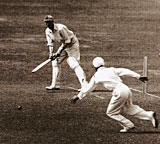
India's Test debut, at Lord's on June 25, 1932, started in dramatic fashion when they reduced a strong England side to 19 for 3 inside the first hour. There was to be no fairytale ending. Douglas Jardine, who by the end of the year had become a figure of hatred in Australia, twice bailed England out and India, hit by injuries as well, lost by 158 runs. Jardine, however, might have played a completely different role in the match.
The politics of India at the time meant that the captain of the All-India side had to be from nobility, much as the England captain had to be an amateur. This narrowed the field considerably as while there were eligible candidates, none of them were good enough as players. But the game needed the money and patronage the nobility brought with them.
In 1929 India were admitted to the ICC and Anthony de Mello, the secretary of the Indian board, suggested that perhaps an Englishman could captain India, mainly to act as a neutral who might be able to bridge and handle ethnic and religious divides. The man suggested was Jardine, Bombay born, from a family with strong links to the country, and reportedly on the verge of going to settle back there. The idea never came to anything, and Jardine ended up leading England against them at Lord's. Other candidates included KS Duleepsinhji, despite his education at Cheltenham and Cambridge, but it is widely believed that Plum Warner talked him out of any such thoughts and persuaded him to play for England.
New Zealand had made their Test debut in 1926 and West Indies in 1928, so India was sure to follow. It should have happened in 1930-31 but a tour by MCC was cancelled because of a civil disobedience campaign, and another attempt the following season was scrapped when threats to boycott all matches in Bombay were made.
And so it was that India were scheduled to tour England in 1932, but even then it was far from straightforward. Although arrangements began to be made in the first half of 1931, as late as August there were doubts as some provinces objected and threatened to boycott the trip.
|
|

|
On February 4, it was announced that the Maharajah of Patiala, a massively rich and generous benefactor and keen player, would lead the side. A driving force in Indian cricket, he was a natural choice. Kumar Shri Ghanshyamshinhji was named vice-captain and the deputy vice-captain was the Maharajah of Vizianagram, equally rich and keen but no cricketer, and a bitter rival of Patiala. Vizianagram had been expected, or more likely had expected, to lead the side but was usurped when Patiala stepped in.
It was expected that the Nawab of Pataudi would be included but the release announcing the team said he had "not been considered as he informed the Board of Control he could not participate in the tour." This bland comment disguised anger that he had turned his back on India at the 11th hour. Even the reserved Times editorial said his decision had caused "soreness as he had definitely promised to play ...he took part in all of the trials and accepted the captaincy of one of the sides in the last match".
There was some speculation whether foreigners - primarily Englishmen - living in India would be eligible, but it was decided not to go down this route. "It is," said The Times, "a thing for young India." Some were certainly good enough. Reggie Hudson, described by Wisden as the best services batsman of the inter-war years, was scoring so many hundreds that one fellow officer said he was becoming "a nuisance". He was in England anyway in 1932 and in a first-class match at The Oval in August scored 217 in 225 minutes for the Army against the RAF, the second hundred coming in 70 minutes.
Patiala's selection caused raised eyebrows in The Times. It noted he had played little cricket in the preceding two years and had preoccupied himself with leading a group of princes who regarded democracy and the likelihood of a new constitution with "a nervous eye".
The side left Bombay - huge crowds turned out to see them off - on April 4 but by then Patiala and Vizianagram had withdrawn. Vizianagram was the first to pull out, ostensibly through illness but more likely he was put out at not only being overlooked as captain but even as vice-captain. His move was unwise, as soon afterwards Patiala himself withdrew, again because of ill health. The Maharajah of Porbandar stepped into the void, but Vizianagram's behaviour as captain of the 1936 tour indicated that India had a lucky escape.
Whereas Vizianagram insisted on playing all the Tests in 1936, to the team's detriment, Porbandar knew his considerable limitations and only occasionally took to the field. To him, it was inconceivable that he would captain them at Lord's, and so on the eve of the Lord's Test he told his side that CK Nayudu would captain them.
|
|

|
Porbandar was woken in the night by several players who told him they would not play under Nayudu. His vice-captain, Ghanshyamshinhji, was not with the tour party at the time, and so Porbandar sent a cable to Patiala in India. The no-nonsense response came back. They were to play.
So several of the Indians were hardly in the best state of mind as they took to the field the next morning. Not that England's openers were in any better state of mind. Herbert Sutcliffe and Percy Holmes, who ten days earlier had set a world record in an opening stand of 555 at Leyton, only arrived in London in the early hours as Yorkshire's match against Sussex at Leeds had only ended at 6pm the night before.
Within ten minutes both were back in the pavilion and India were finally underway.
Fifty-one years later, to the day, Lord's was the scene of possibly Indian cricket's greatest day when Kapil Dev lifted the World Cup.
Is there an incident from the past you would like to know more about? E-mail us with your comments and suggestions.
Bibliography
A History of Indian Cricket Mihir Bose (Andre Deutsch, 2002)
Douglas Jardine: Spartan Cricketer Christopher Douglas (Methuen, 2002)
The Cricketer Wisden Cricketers' Almanack
A History of Indian Cricket Mihir Bose (Andre Deutsch, 2002)
Douglas Jardine: Spartan Cricketer Christopher Douglas (Methuen, 2002)
The Cricketer Wisden Cricketers' Almanack
Martin Williamson is executive editor of Cricinfo