
What's gone wrong for Suryakumar Yadav?
India's T20I captain has not been among the runs for over a year, and the numbers suggest that worrying technical issues may have crept into his game against pace

Karthik Krishnaswamy
19-Dec-2025
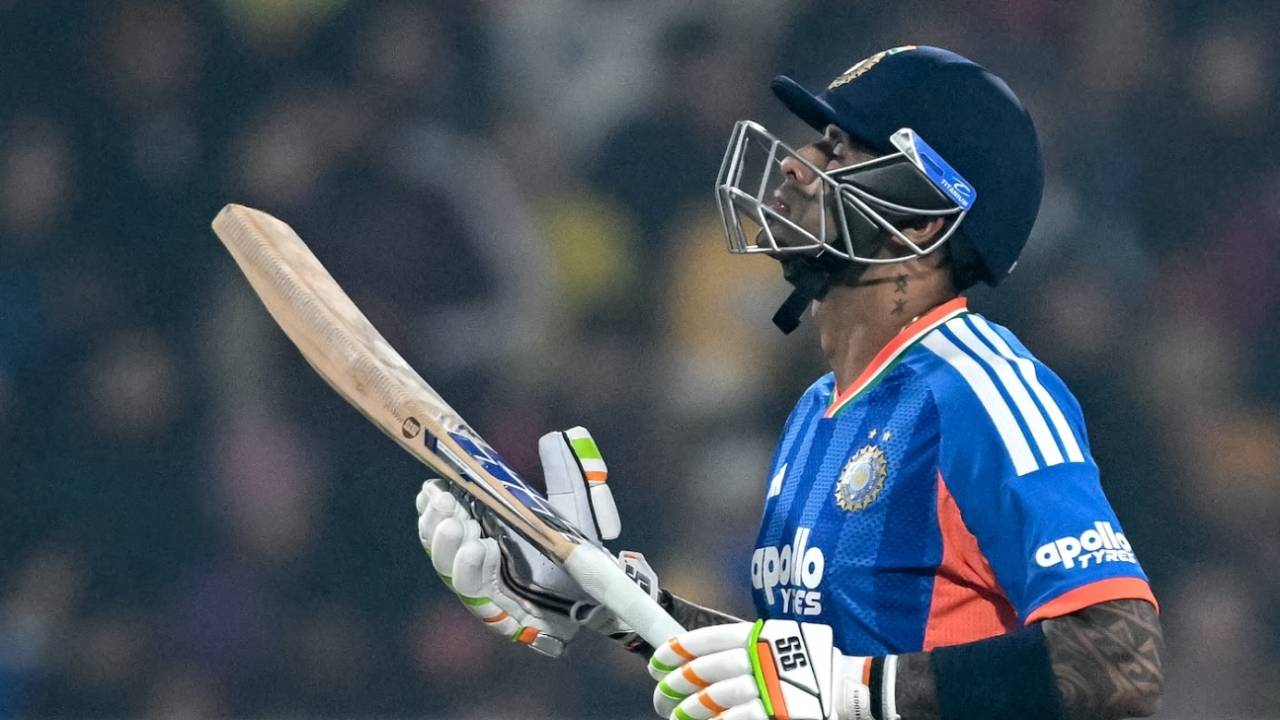
Suryakumar Yadav's scores this series: 5, 12, 5, 12 • AFP/Getty Images
Not out of form, but out of runs.
You've heard this a few times from India's T20I captain Suryakumar Yadav over recent months. He said it during the Asia Cup post-tournament press conference in September, when most minds were elsewhere. He said it again on Sunday, at the post-match presentation of the third India-South Africa T20I in Dharamsala.
"I've been batting beautifully in the nets, I'm trying everything that I can, what's in my control," he said. "When the runs have to come they will definitely come, but yes, I'm looking for runs. Not out of form, but definitely out of runs."
Related
'I know what to do' - Suryakumar vows to return to form ahead of T20 World Cup
Leaving Gill out: did India pivot for the right reasons?
Stats - Hardik's 16-ball fifty, Varun's love affair with South Africa
Tilak, Hardik, Varun seal T20I series win for India
Suryakumar: 'I am not out of form, I am out of runs'
On Friday night Suryakumar remained out of runs during the fifth T20I; he was out for 5, which extended his stretch of T20I innings without a fifty to 22 innings. In that period, he has averaged 12.84 and struck at 117.87.
Suryakumar is right that there's a difference between being out of form and out of runs, particularly in the high-variance environment of T20s. But there have been enough signs over the last few months that Suryakumar's run of low scores isn't just down to the randomness of high-risk batting.
His latest dismissal, for instance, conformed to a set of observable patterns.
For one, it came off a fast bowler, Corbin Bosch. During this lean run, Suryakumar has done okay against spin: a strike rate of 132.43, and an average of 98.00 with only one dismissal. Against pace, however, his numbers have been wretched: 18 dismissals in just 133 balls, an average of 8.11, a strike rate of 109.77.
And the manner of dismissal may have given you a sense of deja vu. A weak, airy drive, a catch at mid-off. Something similar happened against Shaheen Shah Afridi during the Asia Cup final. If he was early on a drive on that occasion, he lost his shape while looking to chip over the infield on Friday, failing to move his weight into the shot, lifting his head too soon.
The same lack of weight transfer had been evident even in the first T20I of this series, in Cuttack. Then, he had popped up a catch off the leading edge while looking to whip Lungi Ngidi into the leg side. Then, too, Suryakumar had lifted his head as he played his shot. The ball stopped on him, yes, and straightened off the deck, but he may have been in a better position to survive it, or score runs off it, had he got his head over the ball.
Technical errors, of course, can occur on other days and not cost batters their wicket. With Suryakumar, however, the broader numbers suggest they haven't just been creeping in occasionally but often enough to curtail his output significantly.
The above graphic tells a story. Suryakumar is renowned for his ability to access the areas behind the wicket, but at his best he is a true 360-degree player, as capable of hitting sixes down the ground or over extra-cover as he is of scooping behind the wicket. Until his last half-century, the 35-ball 75 when India plundered 297 against Bangladesh in October 2024, Suryakumar had scored rapidly against pace in all directions.
Since then, his strike rates against pace have dropped everywhere, but while he's still been scoring at close to two runs a ball when he hits behind the wicket, his strike rate in front of the wicket has plummeted to an alarming 86.88.
The recent pattern of dismissals while not seeming to get his weight moving into the ball, then, may point to a broader issue in Suryakumar's game. The timing of a batter's weight transfer is crucial in generating power and the desired degree of elevation while hitting in front of the wicket, and for whatever reason, it seems to be going awry for Suryakumar.
It has to be remembered, of course, that he's always driven and lofted the ball in an unconventional way against pace; some of his most jaw-dropping shots over mid-off or extra-cover have come when he's been leaning or even jumping backwards (this picture says it all). The issue may not be the fact that he's lifting his head while playing his shots but when it's happening, possibly a fraction of a second too early.
Whatever the issue is, it's given fast bowlers the one thing they never had when Suryakumar was in his pomp: a clear plan of where to bowl to him. During this lean spell, his numbers against the fuller lengths (full-toss, yorker, full, good length) while facing pace have been the stuff of nightmares: a strike rate of 91.25, and an average of 4.86 with 15 dismissals in 80 balls. Yes, you read that right. Four point eight six.
It's pretty clear that Suryakumar isn't just out of runs.
He is, of course, one of India's greatest-ever T20 players, so it would be foolish to bet against him getting back into rhythm. All it takes, sometimes, is one little tweak in stance or trigger movement, and suddenly everything feels natural again.
But this horror run couldn't have come at a more critical time. Suryakumar is 35, and he's India's T20I captain and a key batter at No. 3 or 4. The T20 World Cup is so close that the selectors are expected to announce India's squad on Saturday.
Suryakumar will be part of that squad, of course, and will be its captain. Of that there's no doubt. But with only five more T20Is -- plus a couple of warm-up games -- remaining before India begin their World Cup campaign, he doesn't have a whole lot of time to turn things around.
Karthik Krishnaswamy is an assistant editor at ESPNcricinfo