
Speed or swing? How about both?
Most fast bowlers wish they were skilled in both arts. And though physics and genetics play a role in determining who gets what, it's not impossible to achieve the golden combo

Aakash Chopra
07-Oct-2010
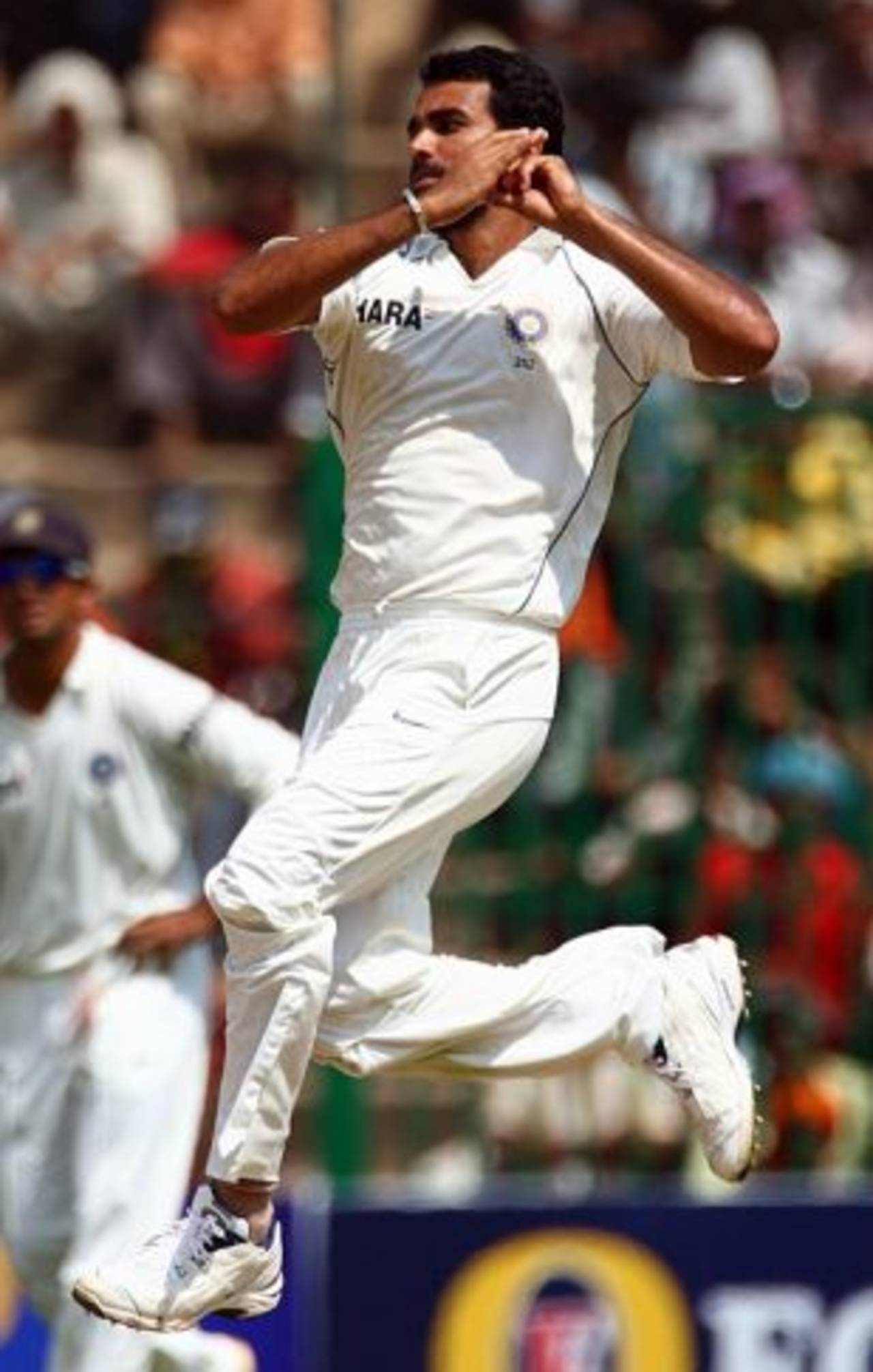
Zaheer Khan: the position of the wrist behind the ball helps him swing it • Getty Images
Mitchell Johnson, despite clinching a five-for in the first Test in Mohali, might happily concede some of his pace in exchange for being able to get the ball to swing. He was candid enough to confess his inability to swing it consistently. Then again, Praveen Kumar, who swings the ball appreciably, probably longs to add those few extra miles of pace.
The combination of pace and swing is an enviable one and very hard to achieve. If swinging the ball is a difficult skill to acquire, bowling quick has a lot to do with genetics. But just like Johnson discovers that crucial swing every now and then before losing it again, it's possible to increase one's pace - though you can only do so to a certain extent before hitting your threshold. So what makes the ball swing? And how does one bowl fast?
Swing
While science confirms that shine plays a huge role in determining the direction in which the ball swings, there's still only one method to swing the ball when it's new. Since both sides are equally shiny, the bowler's wrist and seam position dictate the ball's path after release. The ball must be delivered with an upright seam position and enough backspin to ensure that the seam stays straight when it hits the ground. If the wrist is not behind the ball, or has fallen sideways, the ball will not travel correctly.
While science confirms that shine plays a huge role in determining the direction in which the ball swings, there's still only one method to swing the ball when it's new. Since both sides are equally shiny, the bowler's wrist and seam position dictate the ball's path after release. The ball must be delivered with an upright seam position and enough backspin to ensure that the seam stays straight when it hits the ground. If the wrist is not behind the ball, or has fallen sideways, the ball will not travel correctly.
You'll notice this difference in the actions of Zaheer Khan and Ishant Sharma. While Zaheer's wrist is firmly behind the ball at the time of release and imparts enough backspin, Ishant's wrist falls sideways and prompts the ball to tilt heavily towards the leg side upon release.
Ideally you should point the seam in the direction in which you want it to swing. To bowl an outswinger, tilt the seam slightly towards first slip; for an inswinger, towards leg slip.
Most bowlers alter their point of release to suit the swing they are trying to achieve. An outswing bowler like Matthew Hoggard maintains some distance between his ear and the bowling arm, making his action slightly round-arm, while Javagal Srinath, an inswing bowler, used to keep his arm as close to his ear as possible.
Once the shine on one side becomes prominent, the air pressure starts to assist the swing. The ball moves from high static pressure, which is the shinier side, towards low static pressure - the rough side. There's an early separation of air at the shiny surface, which makes it act like a ramp, pushing the ball towards the direction the rough side is facing. But you still need to maintain the correct wrist and seam position for swing.
The dynamics change once the ball gets old and starts to reverse. There has been a lot of talk about how one side gets heavier thanks to the application of sweat and saliva, which supposedly makes the ball swing towards the heavier side. But science doesn't buy that theory. According to research, when the ball reaches a particular stage, the rough side acts like a ramp and makes the ball move in the direction the shiny side is facing.
Science may explain the phenomenon, but the fact remains that reverse-swing, if executed properly, is very difficult to negotiate. While the seam position is a giveaway when the ball is new, it's of not much help to a batsman facing the old ball, because the same rules don't apply. Reverse-swing is truly effective when the ball swings very late, for which the bowler must position the seam opposite to that for a new ball. Wasim and Waqar were masters of this art.*
Speed
Swing may be difficult to master but speed is tougher to generate. For starters, everybody has either the fast-twitch fibres (white) or slow-twitch ones (red) in their body. These determine whether you can be a quick bowler, like Brett Lee, or a medium-pacer, like Praveen. While fast-twitch fibres give you a definite edge, there are other factors that help an individual generate pace.
Swing may be difficult to master but speed is tougher to generate. For starters, everybody has either the fast-twitch fibres (white) or slow-twitch ones (red) in their body. These determine whether you can be a quick bowler, like Brett Lee, or a medium-pacer, like Praveen. While fast-twitch fibres give you a definite edge, there are other factors that help an individual generate pace.
The force generated from the run-up, the landing, the hip movement, the shoulder rotation and the wrist movement is translated into the speed of the ball. The more aligned the movements, the better the outcome
First, a proper run-up. A bowler must accelerate as he gets closer to the stumps, while keeping both arms close to the body (close levers ensure no wastage of energy).
Second, the momentum generated by the run-up is transferred to the jump. That's why most genuine quick bowlers - Imran Khan, Brett Lee, Malcom Marshall - have a reasonably high jump.
Third is the landing. When the front foot hits the ground, the force generated is transferred to the hip before moving upwards. The bowler rotates the shoulder, which uses the force it receives from the movement in the hip. This force is then transferred to the wrist. The result: the force generated from the run-up, the landing, the hip movement, the shoulder rotation and the wrist movement is translated into the speed of the ball. The more aligned the movements, the better the outcome.
Your fibres don't limit you, either. I've seen people increase their speed as they gain power and better alignment. Ajit Agarkar is one such player who started as a medium-pacer (he even had the wicketkeeper standing up to the stumps in Under-16 cricket) but grew into a genuine quick.
From the start of the run-up to the end of the follow-through, it's important to keep the body aligned in the direction of your target - the batsman. The bowler must stay as close to the stumps as possible after delivering, without getting into the danger zone, while moving towards the batsman. A lot of bowlers, Zaheer and Praveen among them, are guilty of either having no follow-throughs or very limited ones, while others tend to fall towards the off side, killing the momentum and with it the speed.
A bowler must also be careful about the order in which his limbs move in his action. If the shoulder begins to move before the hip has completed its action, the hip will stop contributing to the building up of momentum.
Swing makes a bowler feel like a magician, someone who can get the ball to move in the air at his command, while speed feeds his hunger to be ferocious. There's no better sight for a quick bowler than seeing his prey, the batsman, jump around with fear in his eyes, not knowing which way the ball will move or how fast it will get there. But as exciting as that may sound, it's equally difficult to master both crafts.
Former India opener Aakash Chopra is the author of Beyond the Blues, an account of the 2007-08 Ranji Trophy season. His website is here and his Twitter feed here