
The ignorant Olympians
In 1900, Great Britain won the only Olympic cricket tournament to have been held - but they were totally unaware they had even competed in the Games

Martin Williamson
28-Jul-2012
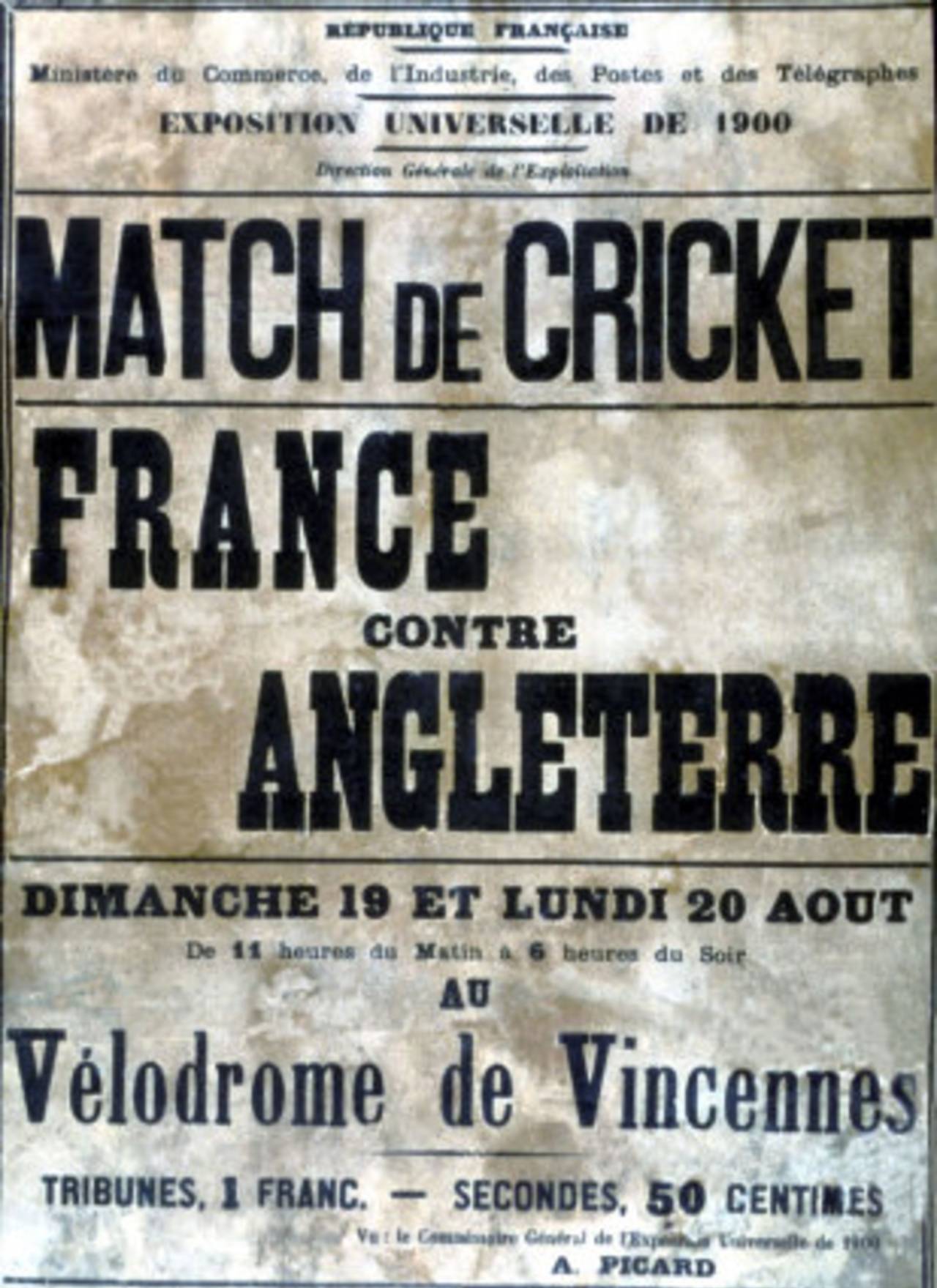
A handbill advertising the match. Note the lack of any reference to the Olympics and that the Great Britain team is referred to as "England" • PA Photos
Cricket and the Olympics might appear to be unlikely bedfellows, but it was one of the original sports listed in the provisional Olympic programme, Des Jeux Olympiques de 1896, published in 1895. Closely identified as being the archetypal play-hard-but-fair game, cricket fit almost perfectly with Baron Pierre de Coubertin's Olympian ideal.
That a Frenchman would want cricket in the Games was not as surprising as it may seem. The seeds of de Coubertin's brainchild had been sown when in 1890 he attended the Much Wenlock games in Shropshire - widely considered the birthplace of the modern Olympics - where cricket was one of the featured events.
At the 1896 Games in Athens it was intended that cricket would be included, but a lack of entries meant plans were quietly shelved. Four years later in Paris, four teams entered - Great Britain, France, Belgium and Holland - but in the event, only one match was played, between Great Britain and France. Holland and Belgium had originally been touted as co-hosts for the second Olympiad but those plans faltered and the two countries' entries went the same way.
It was symptomatic of the confusion surrounding the Games - the Olympics at that time were a far cry from the slick modern bonanza. Events took place between May and October at 16 different venues, and the word Olympics was rarely used. The 1900 Games were referred to as part of the Great Exposition or the World's Fair and no official medals were awarded - winners got trophies or medallions. One event, fencing, was all professional, with a cash reward for the winner.
The press that bothered to cover events referred to them as "International Championships", "International Games", "Paris Championships", "World Championships" and "Grand Prix of the Paris Exposition". De Coubertin was reported to have told friends: "It's a miracle that the Olympic movement survived that celebration".
The eclectic nature of the schedule underlines the rather haphazard nature of the entire enterprise. Many events made their first and last Olympic appearances in Paris, such as motorcycle racing, ballooning, croquet, pelota, swimming obstacle race, underwater swimming, and of course, cricket. To this day, what actually constituted Olympic events remains in doubt as there were hundreds of competitions associated with the World's Fair. Perhaps test events such as fire-fighting, live pigeon-shooting and cannon-firing never really had a chance.
The Great Britain cricket side was not a nationally selected XI but a touring club team, Devon & Somerset Wanderers. This was not unusual, as club sides represented GB in many other events: the rugby competition was won by Moseley Wanderers, their one match played on a one-day visit to France, the football by Upton Park FC; and Osborne Swimming Club swept all before them in the water polo.
Devon & Somerset Wanderers were a touring side formed six years earlier by William Donne (who played in the Olympic match) and consisting largely of players from Castle Cary Cricket Club, five of whom played in the match, and former pupils of Blundell's School. Qualification was simply based on who was available to take a fortnight off to travel to France. The 16-man Wanderers headed across the Channel for a three-match jaunt, starting with the game against France and continuing with two one-day matches (both of which they won).
The French side was anything but, formed largely of expat Englishmen, and was selected from two Paris-based teams - Union CC and Standard Athletic. The latter had been formed in 1890 by English craftsmen who had moved to Paris a year or so earlier to work on the construction of the Eiffel Tower.
The two-day "international" took place at the impressive Velodrome de Vincennes, a 20,000-seater banked cycling track, which also hosted the football, rugby, cycling and gymnastic events, and started on Sunday, August 19, 1900. The crowd consisted of a dozen or so bemused gendarmes. Potential spectators had hardly been encouraged by an explanation in La Vie Au Grand Air, the official publication of the Games, which described cricket as "this sport without colour to the uninitiated".
The British side had arrived in Paris the previous day, and after one night at the Hotel des Trois Princes, travelled to the stadium. It was agreed by the captains that the game would be 12-a-side. This caught the printers of the scorecards on the hop, and the extra name had to be added by hand. Even if they did not realise this was an Olympic event, the British managed to avoid embarrassing the Olympic ideal by fielding an all-amateur side and leaving David Jennings, who played for Exeter as their professional, on the sidelines.
Great Britain batted first and scored a creditable 117, largely thanks to 23 from Charles Beachcroft, who opened for Exeter, and the Old Blundellian Frederick Cumming, who top-scored with 38. France were then bowled out for 78. The British scored 145 for 5 second time around, with fifties from Beachcroft and Alfred Bowerman, setting the hosts a target of 185. In the event, this proved way beyond them, and they were bowled out for 26, with Montagu Toller, who had played county cricket for Devon in 1897, taking 7 for 9.
The winners were awarded silver medals, the French bronze ones - both XIIs also received miniature replicas of the 11-year-old Eiffel Tower.
The victorious team's journey back to the hotel was eventful. The driver of one of the two coaches had become rather caught up in the day's events, had consumed far too much alcohol, and had to be driven back inside his own carriage. The other, apparently in a similarly excitable state, crashed his coach, causing minor injuries to some of the passengers.
And so ended the competition. Neither side seemed aware that they had taken part in the Olympics, and the match was only retrospectively formally recognised as being an Olympic contest in 1912, when the International Olympic Committee met to compile the definitive list of all events in the five modern Olympiads up to that point. As a result, the medals awarded were upgraded to gold and silver. By the time of the St Louis Games in 1904, cricket had been forgotten.
The newspapers at home completely ignored the match, although a few local papers in Devon did carry reports.
The Wanderers finished their tour but were left less than impressed with the French - described as "too excitable to enjoy the game", according to one contemporary journalist, who added that "no Frenchman could be persuaded to play more than once. A cricketer in France is a stranger in a strange land looked upon with mingled awe and contempt by the average Frenchman."
What happened next?
- In 2008 a Devon newspaper launched an appeal to try to find any of the medals awarded at the event. None were forthcoming
- In July 2012, Castle Cary hosted a French side in a rematch of the 1900 game. The visitors also played Old Blundellians
Is there an incident from the past you would like to know more about? Email us with your comments and suggestions.
Martin Williamson is executive editor of ESPNcricinfo and managing editor of ESPN Digital Media in Europe, the Middle East and Africa