
India opens Pandora's ODI Box
They were the slowest country to embrace the one-day game, but they more than made up for it in the years that followed

Martin Williamson
Oct 20, 2012, 3:26 AM
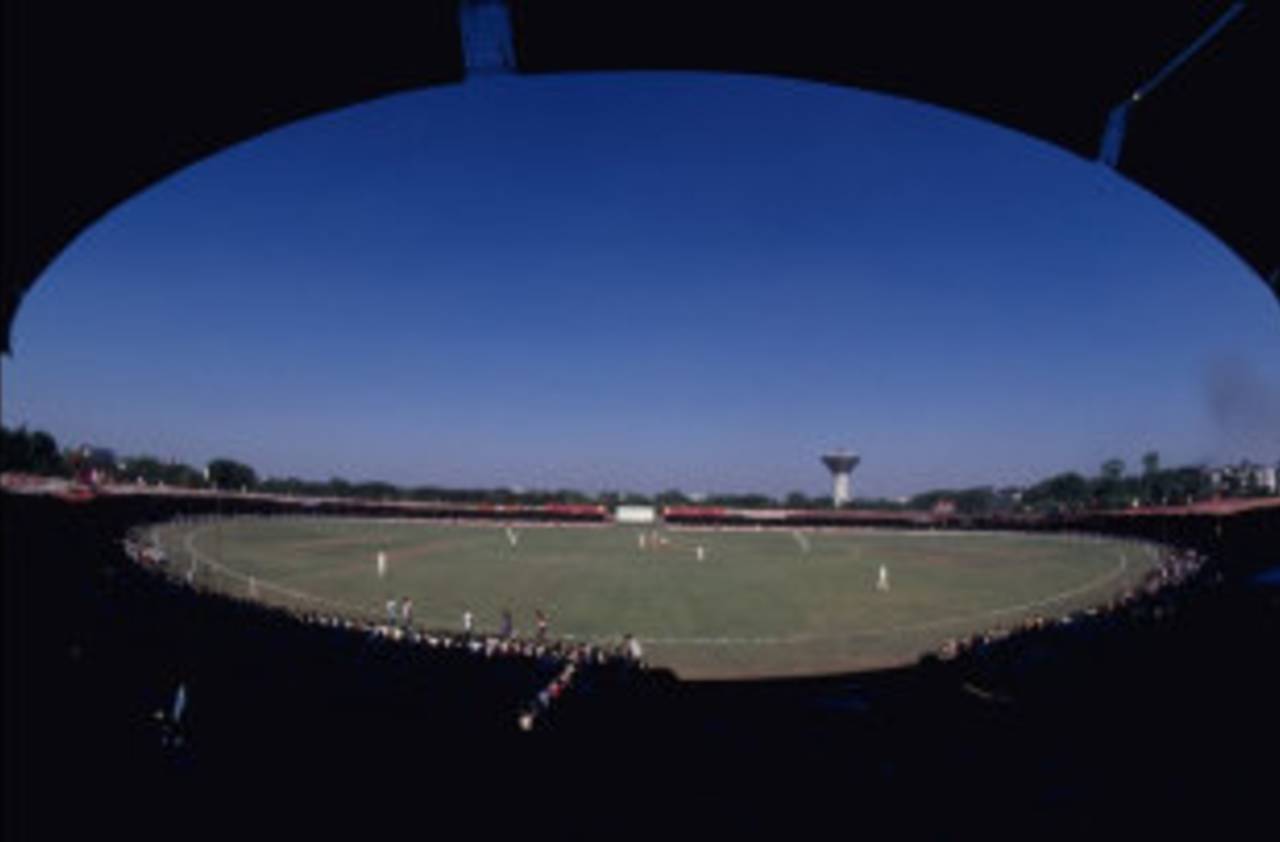
The Sardar Vallabhai Patel Stadium in Ahmedabad during the first ODI played on Indian soil • PA Photos
India's victory in the 1983 World Cup was one of the game's watershed moments, representing the start of a shift in the balance of world cricket towards the subcontinent, as well as marking the moment when one-day cricket truly usurped Tests as the most popular, if not pure, form of the game.
Until that point one-dayers were often seen as secondary to Test series, but a lucrative sideshow nevertheless. England were the early adopters, scheduling short ODI series alongside the regular summer tours from 1972, and New Zealand and, half-heartedly, Australia also tried the format out. It was the advent of World Series Cricket in 1977 that broke the dam, and by the end of the decade everyone was in on the act. Except India.
India's failure to take the format seriously was there for all to see on the opening day of the inaugural World Cup in 1975, when Sunil Gavaskar ground out 36 not out in 60 overs against England at Lord's as his side made no attempt to chase down a stiff target. The BCCI put in a bid to stage the 1979 tournament but it was not taken seriously nor was it serious. At that time, the logistics of such an event in such a massive country were unthinkable.
While the Indian board was willing to play one-dayers away from home, it refused to entertain the idea of series in India. Perhaps inevitably the reason was simply one of finances. Test matches in India attracted massive crowds - 60,000 turned up to watch under two hours of the dead final day of the Calcutta Test in 1976-77- and the board feared if it opened Pandora's box and revealed the shorter form of the game, the public would stop flocking to the five-day games. As it happened, those concerns were justified.
By the time England toured India in 1981-82 the pressure on the BCCI to bow to the inevitable was too great. After two World Cups the Indian public wanted to see limited-overs matches and the English also pressed for some games. So three ODIs were scheduled, dotted around the six Tests.
The tour was blighted by controversy before it had even begun and for a time it seemed it would be cancelled, as the authorities objected to the presence in the England squad of players with South African connections. Even when that was sorted there were ongoing rows over umpiring, Geoff Boycott quit midway through, and the series ended with news breaking of a rebel England visit to South Africa.
England arrived in Ahmedebad late on November 24 after a tiring journey from Baroda but boosted by victories in their opening three matches. No sooner had they checked into their hotel than the England management were at loggerheads with the BCCI officials who handed them the playing conditions.
Faced with the problem of early-morning dew, England wanted to play 45 overs; the BCCI insisted on 50. England wanted fielding restrictions throughout; the BCCI wanted them for 15 overs only. England wanted the day split into three two-hour sessions; the BCCI wanted two three-and-a half hour sessions. The BCCI won out in every case.
"We put forward our views," shrugged tour manager Raman Subba Row. "But at the end of the day we're playing in India and we have to do as the board says." England captain Keith Fletcher, who had a forgettable trip, added: "We know where we stand. We've just got to go out there and get on with it."
"It is the first occasion that the Indians have staged a limited-over match between two countries," the Times' correspondent noted. "But they have not been prepared to accept advice from the tourists despite their great experience of this type of cricket."
The next day the teams assembled at the Sardar Vallabhbhai Patel Stadium for India's inaugural home ODI. It was to be the only international fixture held there. For Madhav Gothoskar, one of the umpires, it was also his first and last taste of the international game. More than a quarter of a century later he told India Today how he watched crowds packing in under tents erected over the ramshackle stands. "They wouldn't stop coming. Soon there were people sitting inside the boundary line."
What they got hardly set the pulses racing. A slightly delayed start gave England almost what they wanted - a 46-over match - and India began cautiously on a very green track as Ian Botham bowled three successive maidens. In his fourth over he bowled Kris Srikkanth for a debut duck, and in the next over Bob Willis had Sunil Gavaskar caught at slip.
Thereafter Dilip Vengsarkar (46) led a stodgy recovery as India plodded to 156 for 7. There was brief amusement when a drive from Syed Kirmani disappeared down a drainage hole and none of the England side would put their hand down to retrieve it, leading to a delay while a volunteer groundsman was summoned
England made a cautious start but after reaching 43 for 1 they slipped to 61 for 4, and the home crowd started to sense their side was back in the match. But Mike Gatting, aided by Fletcher and then Botham - who finished proceedings by sweeping and pulling Roger Binny for successive sixes - steered England home with 13 balls in hand.
It was an inauspicious beginning but there was no turning back. The Test series was closely fought but numbingly dull in terms of both over rate and run rate, as India sat on a lead they established in the first match. Phil Edmonds reckoned that the decision of some to throw in their lot with the rebel South Africa tourists was not so much because of the money but because they were "bored to the soul with Test cricket after that tour". Nevertheless, the crowds flocked to the matches and an estimated 394,000 people watched the Calcutta Test.
Wisden's review of the series proved prescient. "It is also to be hoped that the Indian Board recognise the need to put some ginger in their pitches before their crowds start losing interest. There was little sign of that on this tour; but with the increasing popularity of one-day cricket, bolstered by India's unexpected 2-1 victory in the one-day series, it could happen."
What happened next?
- India bounced back to win the second and third matches to take the one-day series 2-1
- By the time Pakistan visited India two years later, crowds for ODIs were massive but the Tests were poorly supported with the Times noting the Indians had clearly decided they "preferred the instant version of the game".
Martin Williamson is executive editor of ESPNcricinfo and managing editor of ESPN Digital Media in Europe, the Middle East and Africa