Cricket regulations that could do with a tweak

What's wrong with mankading?

The laws allow it, so why should umpires ask the fielding captain to reconsider appeals for such run-outs?

Brydon Coverdale

February 10, 2013

Comments: 93 | Text size: A | A

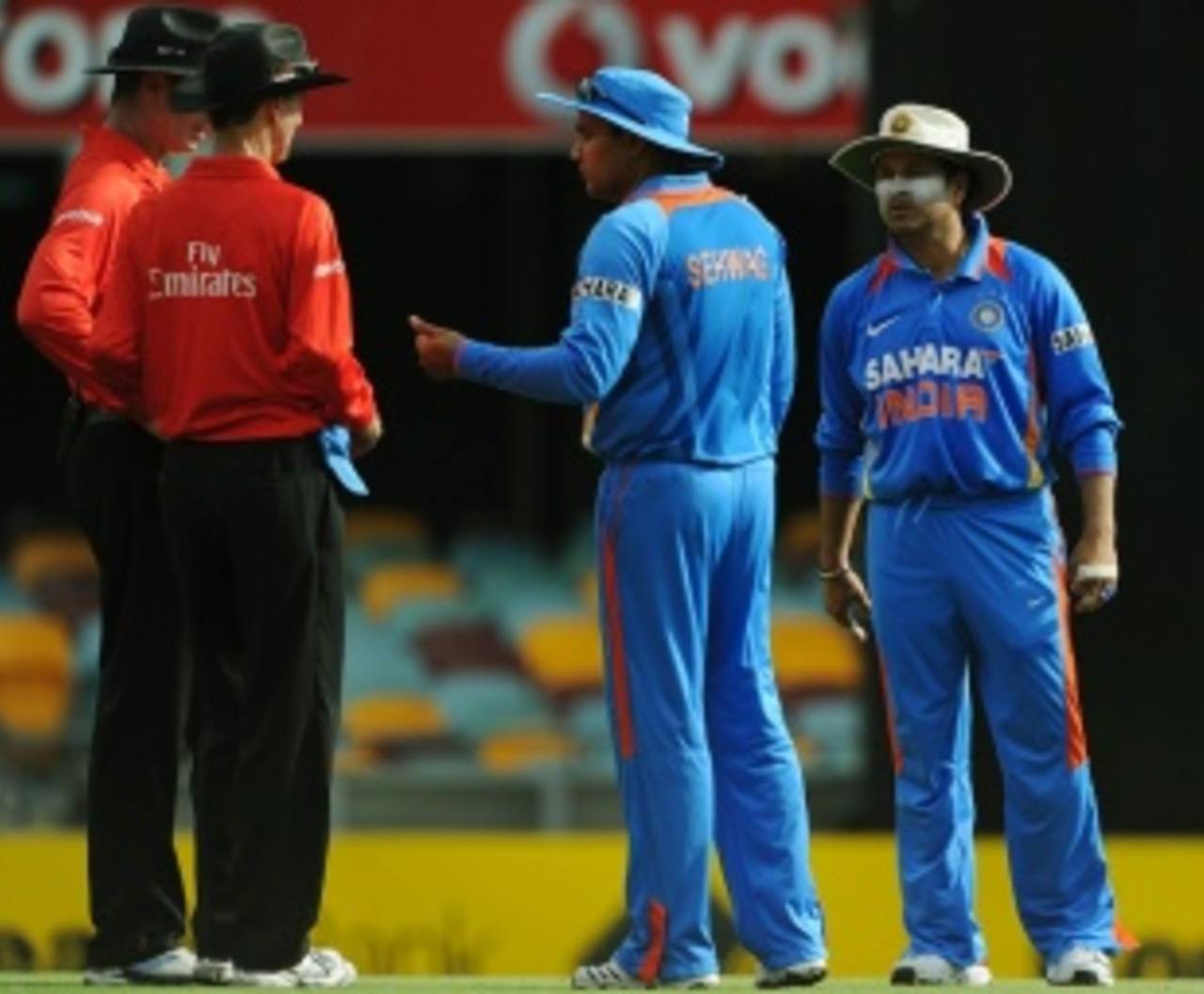
Virender Sehwag withdrew R Ashwin's appeal for a run-out against Lahiru Thirimanne, who was backing up too far at the non-striker's end before the bowler delivered the ball, India v Sri Lanka, CB Series, Brisbane, February 21, 2012
The rule book considers mankading legit, so the spirit of cricket doesn't need to come into the picture © Getty Images
Enlarge

Remember that time when Kevin Pietersen danced down the pitch to Shane Warne and was stumped, and the umpire asked Ricky Ponting to withdraw the appeal? Of course you don't, because it didn't happen, and the very idea of it happening is absurd. Why, then, do umpires continue to pressure fielding captains to reconsider appeals for the so-called Mankad dismissal, the act of a bowler running out a non-striker who is backing up?

How are the situations any different, really? In both cases the batsman is attempting to gain advantage, in one by reaching the pitch of the ball and negating spin, in the other by reducing the distance he must cover to complete a run. A wicketkeeper who stumps a batsman is lauded for his sharp work, yet an eagle-eyed bowler who mankads is usually condemned as unsporting.

In 2011, the ICC made it easier for bowlers to effect such a dismissal. Previously the bowler had to take the bails off before entering his delivery stride. This is still the case under the MCC's Laws of Cricket, but the ICC adapted its playing conditions to allow the act "before releasing the ball and provided he has not completed his usual delivery swing". It was a clear and deliberate move to keep batsmen accountable.

But umpires have undermined the regulation by victimising bowlers who are only trying to stop batsmen sneaking an advantage. Consider these two recent examples.

Last February in an ODI at the SCG, Lahiru Thirimanne continually left his crease far too early. R Ashwin warned Thirimanne and when the batsman kept doing it, Ashwin ran him out. Instead of raising his finger, the umpire, Paul Reiffel, consulted his square-leg colleague and asked India's captain, Virender Sehwag, if he wanted to go through with the appeal.

In doing so, Reiffel implicitly suggested Ashwin's act of removing the bail was underhanded. It told the crowd India were borderline cheats, made Thirimanne think his behaviour was okay, and placed undue pressure on Sehwag, who ended up withdrawing a legitimate appeal. Thirimanne batted on, continued to back up unfairly, scored 62 and set up a Sri Lankan victory.

Later in 2012, Surrey's Murali Kartik mankaded Somerset's Alex Barrow during a County Championship match. Like Ashwin, Kartik had warned the batsman, though he wasn't compelled to do so. Still, the umpire, Peter Hartley, wasn't happy. He asked the fielding captain, Gareth Batty, three times if he would withdraw the appeal. Rightly, Batty refused, and later Surrey were booed off the field.

Reiffel and Hartley should simply have raised a finger, as they would for any other run-out, but instead they added to the ill-feeling by suggesting the bowler was in the wrong. The ICC's playing condition 42.11 explicitly states that a mankad is fair. An additional clause should be added to state that an umpire must not consult the fielding captain before making his decision, unless the conversation is instigated by the captain.

Certainly a mankad is no less fair than when a striker's straight drive rockets through the bowler's hands and hits the stumps with the non-striker out of his ground. Of course, umpires rightly treat that as they do a regulation run-out. Just as they should with the mankad.

Brydon Coverdale is an assistant editor at ESPNcricinfo. He tweets here

RSS Feeds: Brydon Coverdale

© ESPN EMEA Ltd.

Posted by Rowayton on (February 12, 2013, 4:24 GMT)

I reckon Mankading is fine; but I think that sometimes as an umpire you can play dumb and give a captain time to reconsider. Example - I was umpiring a fairly ill tempered game. Batsman batting out of his crease hit the ball back to the bowler a couple of times - each time the bowler not only threatened but threw the ball back in the general direction of the stumps. The second throw was a bit close to the batsman and he hit the ball away (this, incidentally, was in a fairly good standard of cricket). Fielding side appealed for obstructing the field. Umpire (me) said to the fielding captain, 'Sorry I didn't hear what they said. What was it?' Captain said, 'no they didn't say anything'. Actually, I'm still not sure what the right decision would have been if I'd had to make it. Any takers?

Posted by Mad_Hamish on (February 12, 2013, 2:26 GMT)

something being legal isn't the same as it being sporting. I don't have an issue with the umpires asking the fielding captain if they want to withdraw the appeal for a Mankad runout. As the captain is responsible for ensuring that the game is played in the correct spirit under the laws of the game it's fair enough that he should be asked on a Mankad because rightly or wrongly there is a feeling that it's sharp practice (I don't see how anyone can possibly complain after a warning and especially if it's a big backup I'm o.k. with not issuing a warning) I will point out that the requirement that it was only a recent law change that restricted when the bowler could mankad. Somebeing being legal isn't the same as it being right to do, again up until fairly recently there was nothing illegal about bowling a beamer (full toss at the head). The only rule it could have fallen under was about intimidatory bowling. However bowling beamers has always been considered to be wrong.

Posted by   on (February 11, 2013, 23:08 GMT)

If the runner leaves the crease early they should be run out, the laws of cricket make it explicit that this action is achieving an unfair advantage and that the bowler is within their rights to attempt a run out. Warnings are neither necessary nor desirable.

Posted by Utpal-Jadia on (February 11, 2013, 21:55 GMT)

It should be considered as OUT...

However, I was wondering how should the wicket be recorded -- in particular, which ball of the over this wicket fell ?

If this happens on the very first ball of the innings, will it be considered as 0/1 at 0.0 over. Just curious to know...

Posted by enjoycricket1 on (February 11, 2013, 20:54 GMT)

One rule that I would change is that if the fielding side hit the wicket they cannot be penalised with over-runs when going for a run-out. I think it is the fielding side should not be punished for a good bit of fielding. Sure if they miss the wicket then over-runs are allowed.

Posted by BnH1985Fan on (February 11, 2013, 18:55 GMT)

As someone who has lived for over 25 years in North America, i can't help draw parallels between baseball and cricket. Both games involve the use of a pitcher / bowler, a batter / batsman, and fielders. But while baseball is a pitcher-centric game, with almost all advantages going to the pitcher, cricket is diametrically opposite, with most advantages stacked against the bowler. There is suggestion from readers that 'mankading' ought to be skill where the bowler fakes the move to get the non-striker out. I feel if it is within the laws, then the bowler ought to use it to help his team (the runout does not help the bowler but does help the team). As a further parallel, if a pitcher fakes the delivery in baseball, the umpire calls it a balk and the runners advance. It is a relative rarity in the game, but, does happen every now and then.

One thing we should not do is give even more advantages to the batsman. It is quite boring to see a game go on for 5 days with no outs!

Comments have now been closed for this article

FeedbackTop
Email Feedback Print
Share
E-mail
Feedback
Print
Brydon CoverdaleClose
Brydon Coverdale Assistant Editor Possibly the only person to win a headline-writing award for a title with the word "heifers" in it, Brydon decided agricultural journalism wasn't for him when he took up his position with ESPNcricinfo in Melbourne. His cricketing career peaked with an unbeaten 85 in the seconds for a small team in rural Victoria on a day when they could not scrounge up 11 players and Brydon, tragically, ran out of partners to help him reach his century. He is also a compulsive TV game-show contestant and has appeared on half a dozen shows in Australia.

    What makes players cheat?

Aakash Chopra: Getting away with deceit can provide a certain high. For some, the rewards of cheating will always outweigh the potential consequences

    'Srinivasan's position hopelessly untenable'

Sharda Ugra, Jayaditya Gupta and Nitin Sundar discuss what the BCCI can do to clean up the system

    In Root, England have something special to savour

Mark Nicholas: With a mix of David Gower, Graham Thorpe and Michael Vaughan, Joe Root can capture hearts and minds

And the game changed for ever

Wisden Almanack: From Grace to the IPL: in its 150th edition, Wisden looks at the most seminal events in cricket

The honorary son-in-law

Cricket News Hurl: This week we look at how painful it is to have relatives, and to be an IPL franchise, but how great it is to be an Australian female cricketer right now

News | Features Last 7 days

Him against the world

Even at the height of his success with the national side, Sreesanth was a lonely cricketer who felt hard done by

All fizz, no kick

Mumbai Indians still have a better head-to-head record against Chennai Super Kings, but once again on the big occasion, they came second

Spirited Sunrisers exceed expectations

Sunrisers began this tournament as one of the underdogs, but fought impressively to reach as far as the Eliminator

Vijay slips, Ashwin does a Sahara

Plays of the day from the IPL qualifier between Chennai Super Kings and Mumbai Indians in Delhi

Another season in the bottom half

With some of their big names stumbling this season, Kings XI Punjab were rarely serious contenders for a playoff place

News | Features Last 7 days
Sponsored Links

Safe & simple online money transfer. Apply Now!

Available now at Cricshop