


Root 75 sets up series-levelling win after spin-heavy England limit Sri Lanka
Partnership between Root and Brook key as visitors knock off requirement on slow surface
Madushka Balasuriya
24-Jan-2026 • Updated 10 hrs ago
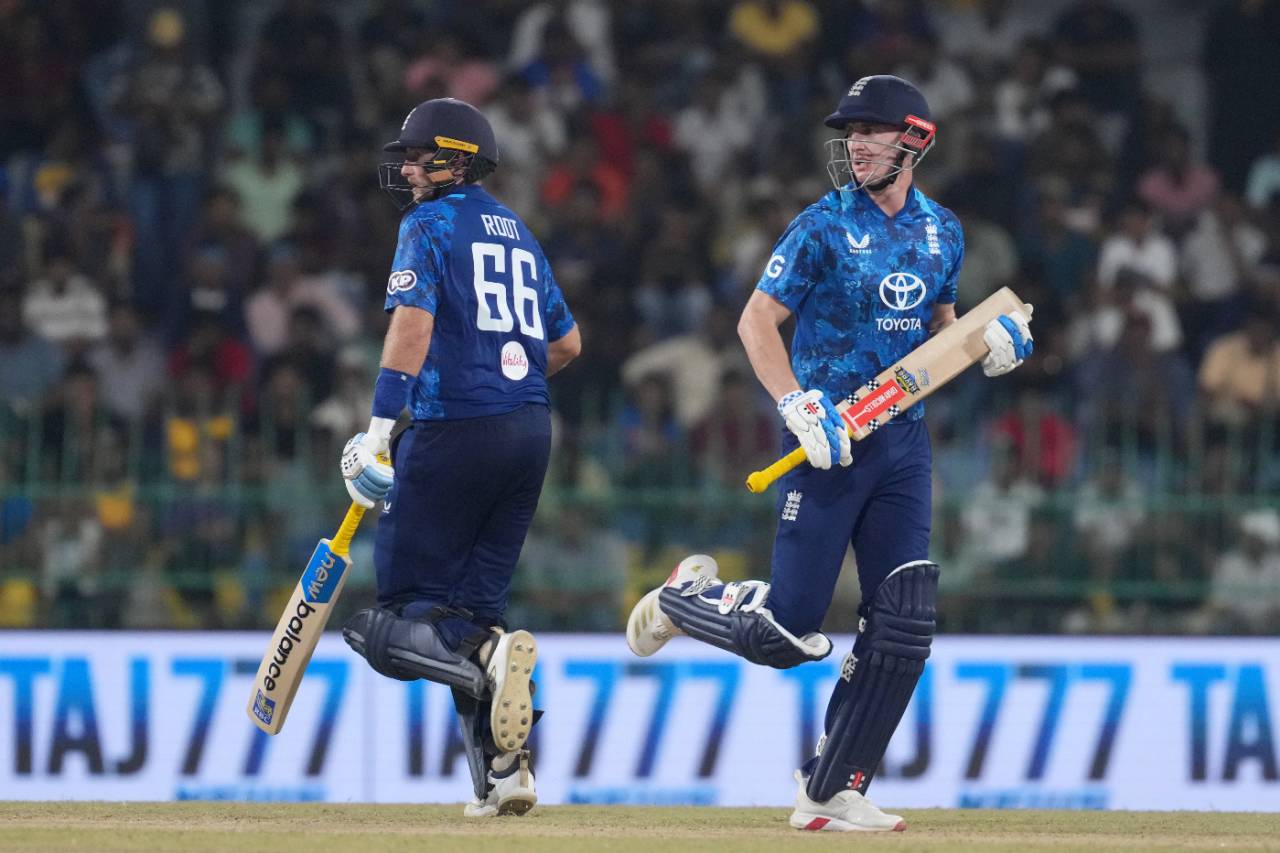
Harry Brook and Joe Root were the key partnership in England's chase • Getty Images
England 223 for 5 (Root 75, Brook 42, Dhananjaya 2-37, Vandersay 2-45) beat Sri Lanka 219 (Asalanka 45, De Silva 40, Root 2-12, Overton 2-21, Rashid 2-34) by five wickets
Joe Root struck his 45th ODI fifty and with it helped England snap an 11-match losing streak away from home, as they won the second ODI against Sri Lanka in Colombo by five wickets and with it levelled the three-match series at 1-1.
Root was unable to see the game to a close, falling to an Asitha Fernando yorker with just 42 to get off 57 deliveries, but by that point - with England batting all the way down - it would have required a collapse of epic proportions for Sri Lanka overturn the result.
Even so, faint embers of hope were lit when the set Harry Brook (42 off 75) was trapped lbw by the impressive Jeffrey Vandersay shortly after. However, a couple of meaty blows from Jos Buttler ensured there would be no fairytale resurgence afoot for the boisterous home support as England romped to victory with 22 balls to spare. Buttler remained unbeaten on 33 off 21.
But while Root's 75 off 90 was instrumental in England's win, that he was allowed to play such risk-free cricket - highlighted by a control percentage hovering around 90 - was down to the excellent team display with the ball and in the field.
No less than eight bowling options were used - six of them spin - as England gave Sri Lanka a taste of their own medicine, producing 40.3 overs of spin bowling and thereby breaking their previous record of 36. That came in Sharjah in 1984-85, when Norman Gifford captained England at the age of 44, and took four wickets. The team wore black armbands during the first ODI after his death last week.
The successes were spread out this time, with Adil Rashid, Jamie Overton and Root picking up two apiece, the latter with the final two balls of the innings. There were also wickets for Liam Dawson, Rehan Ahmed and the returning Will Jacks.
Several Sri Lankan batters got starts, but none was able to pass fifty. Charith Asalanka's 45 off 64 and Dhananjaya de Silva's 40 off 59 headlined, but England's attack kept a firm lid on proceedings throughout.
With the target a good 50-runs shy of what they had fallen short of in the first game, from the outset England's chase had less pressure surrounding it and it showed in their approach with the bat.
Rehan, who had been promoted to the top of the order with the injury-enforced absence of Zak Crawley, and Ben Duckett kept scoreboard ticking along early; the pair largely content with just surviving and picking up singles - this despite Rehan's supposed remit to go after the attack - highlighting the difficulty of scoring on an extremely dry and sticky surface at the Premadasa.
Rehan eventually fell, castled by a surprise inswinger from Dhananjaya, but that would end up being the Sri Lanka's sole respite for quite some time.
Duckett, having survived several nervy moments early in his innings, eventually settled into a nice rhythm alongside the unflappable Root, as the pair stitched together a stand of 68 off 67 - given the conditions this was positively rapid. And much of it owed to Root, who was proving incredibly adapt at turning over the strike with ease, as Duckett duly followed suit.
It was Vandersay that managed to break the stand with a sharp turning legbreak that cramped an attempted cut from Duckett to crash into the stumps, and shortly after Jacob Bethell slapped one low to Asalanka at short cover.
Sri Lanka might have sensed an opening, but the door was once more firmly shut and it was here England killed the chase. With Root ticking along nicely, and belying the turn and slow nature of the pitch, Brook played the ideal supporting hand as the pair put on the game's best partnership - one which in the end secured the win.
Sri Lanka's innings had earlier failed to really going as they eventually parked themselves at a middling total of 219, bowled out in 49.3 overs.
"Keeping the stumps in play," was Brook's refrain, speaking after losing the toss, and on an uber-dry surface with boundaries square and behind mostly protected, the onus was on the Lankan batters to use their feet in order to access extra cover and deep midwicket.
That sort of strokeplay however proved detrimental to the Lankan cause with four of their top five falling in their attempts to take on the boundaries in front of square. Kamil Mishara sought to bring some impetus to the innings after a miserly early burst from the England seamers, but his attempted lashing cover drive could not clear Duckett in the circle, who held on at the second attempt.
Pathum Nissanka, who had patiently waded through the opening powerplay when the scoring rate sat below four an over, then sought to capitalise on his added time in the middle, but only managed to loft an inside-out drive to long-off.
Later on in the innings, Dhananjaya whacked one low to Root at midwicket, before the set Asalanka found deep midwicket with a slog sweep.
And arguably Sri Lanka's best batter at accessing those regions, Kusal Mendis, had earlier run himself out after grinding for 26, having cut one straight to point and absentmindedly set off for a single. The throw from the fit-again Jacks was pinpoint and found Mendis easily short as he sought in vain to fling himself back to safety.
While there were promising stands in-between, notably a 42-run effort between Nissanka and Mendis and 66 between Dhananjaya and Asalanka, none of the batters involved were able to push on and up the rate of scoring over any concerted period of time.
Pavan Rathnayake's 29 off 34 also showed promise, but he fell foul looking to clear the straight boundary as he sliced one to long-off, and in the process an energetic Khettarama crowd was silenced.
Dunith Wellalage once more looked enterprising during a late cameo, but his 20 off 19 was far less damaging to England's cause than had been the case in the first ODI. The frustrating nature of Sri Lanka's innings was illustrated by the fact that five batters scored at least 25 and faced at least 30 deliveries, but the highest score remained Asalanka's 45.