
League of local heroes
The KPL could change the process of talent-spotting in Indian cricket and spread more wealth to a larger section of cricketers

Siddarth Ravindran
23-Sep-2009
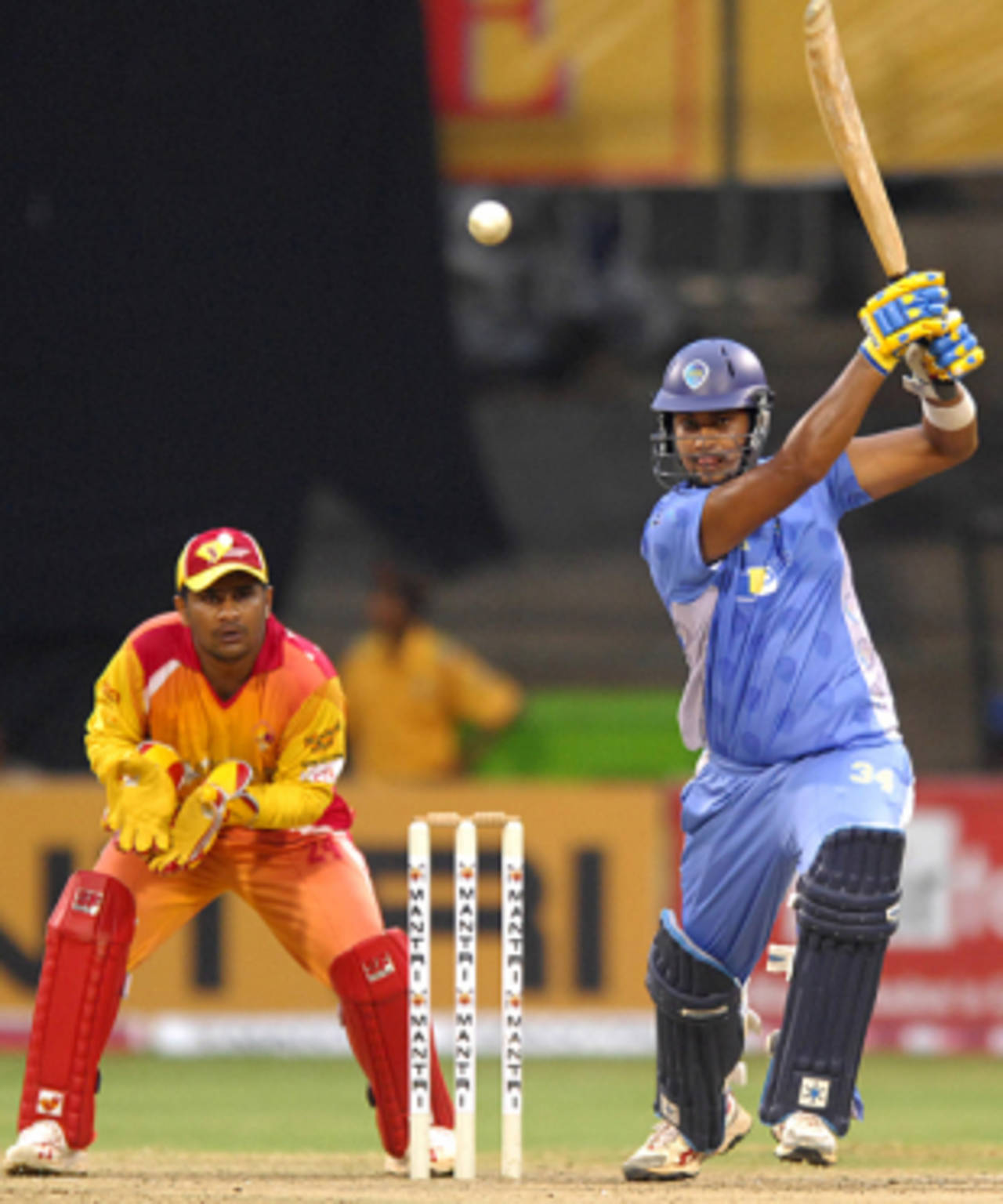
The tournament, with 120 players involved, provides much-needed exposure to reach the next level • ESPNcricinfo Ltd
A couple of months ago, a group of cricket officials, businessmen, politicians and the odd impresario put the finishing touches to a Twenty20 tournament, the Karnataka Premier League. Like its inspiration, the IPL, it would be franchise-based, but there the similarities between the two ended. Where the IPL had the best global talent to choose from, and the country's finest stadiums to stage the tournament in, the KPL seemed to have the makings of a dud: it lacked the stars from the national team (or even, following a BCCI diktat, any players from outside the state) and so would be seen primarily as domestic cricket; there was no fat television deal to bankroll it; and it was born in recessionary times, unlike the IPL, which was clearly a product of the boom days. Nor did it help that Anil Kumble and Javagal Srinath, two of Karnataka's biggest names of recent times, came out against the way the idea was implemented.
Yet, as the first season (if a fortnight can be called a season) winds down with the final on Tuesday night, there's reason for optimism, if qualified. The fans have turned out (as many as 8000 for the game between the two Bangalore teams on a Sunday), sponsors have stumped up big bucks [Mantri Developers, the title sponsors, will plough in 11.11 crore ($2,306,400) over five years], and the ripples of interest have spread far beyond Karnataka's borders.
And so the stakeholders - those cricket officials, businessmen, politicians and the odd impresario (who are now also franchise owners, commentators and KPL organizers) and the players - have fairly satisfied smiles as their varied interests have been served.
For Mohiuddin Bava, a member of the Congress party in the coastal city of Mangalore, buying the local KPL franchise instantly increased his profile in his constituency and helped him spread his message. You'd think his team, Mangalore United, is named after the more famous Man U; it isn't. In the recent past, Mangalore has been riven by communal tension and violence, which Bava hopes to ease through the KPL. "Cricket will be a ladder to bring back harmony in the society," he says, a point emphasised by his team's slogan, "Cricket for unity."
It's a different ball game for the Brigade Group, a Bangalore-based real-estate major. To begin with, the expenses involved are relatively small change - they shell out about Rs 1.4 crore (US$291,000) a year for the most expensive franchise, the Bangalore Brigadiers. Their campaign to promote their team includes billboards, a snazzy website, a Facebook group to connect with fans, and several big-name team sponsors. They've gone about it with a corporate thoroughness: The first day of the KPL saw groups of supporters sporting Bangalore Brigadiers T-shirts.
"We did our math, we knew that it was not going to be a profit-making venture, we are fine with that," says Anil Thomas, the franchise's deputy CEO. "As of now it is the Bangalore Brigadiers that is building a fan base. At some point the association with the Brigade group will get stronger.
"The Udaya network [the KPL's broadcasters] have a big chunk of the state's population watching them, and it is a good opportunity for us to use that as a brand vehicle to publicise our company's work. It's not the immediate objective, though, which is for the team to do well."
Money is probably not the motivation for Robin Uthappa either. He is the league's most expensive player, but his Rs 325,000 ($6750) salary is a fraction of the US$800,000 he earns in the IPL. It is more a chance for him to tune-up his Twenty20 game before the Champions League. "I am just looking at it as an opportunity to work on my Twenty20 skills," he says, "and to get more Twenty20 experience under my belt."
Twenty20 experience is something Indian players are short on, with opportunities restricted to the IPL or the ICL. Even Ranji players like batsman KB Pawan, a regular with the Karnataka side for the past two seasons, have played little Twenty20. "This is my first experience actually," Pawan says. "There are some club-level matches, and if you play for institutions you may get to play two or three Twenty20 tournaments a year; otherwise you won't get any Twenty20 matches."
Playing under floodlights with a crowd egging him on (or barracking him) is a novel experience for him. "Initially everybody felt the pressure because of the crowd watching them. It's important for a player to learn to control himself and learn how to handle the pressure - that's what I'm looking for from the KPL."
Further down the pecking order the returns can be more dramatic; the tournament, with 120 players involved, provides much-needed exposure to reach the next level. Mangalore's R Jonathan's big hits became a talking point, and left-arm spinner Narayanan Vinu Prasad, who played one match for Karnataka last season, has made a case for his re-selection by taking 10 wickets at a miserly economy-rate of 4.97.
It could also be a springboard to the lucrative IPL, where a couple of good performances can take an unknown player higher up the ladder, as happened with Manish Pandey, the first Indian to score an IPL century. "Of course, we [franchises] all are [scouting]," says Joy Bhattacharya, team director of the Kolkata Knight Riders. "If anyone tells you they are not watching… well, they are looking at games, looking at opportunities, looking at anyone whom they think will make a difference."
Amrit Mathur, chief operating officer of Delhi Daredevils, is one of those who says he isn't watching. "I don't think we have made the effort to look at the performances, at least not this year," he says. "Ideally, if players from outside the state are allowed to compete, the quality will be higher and one will get a better sense of a player's quality."
"About 90% of cricketers give up the game at the age of 18 because of family pressure or to pursue academics. Of the remainder another 90% drop off at 21, and 90% more at 24 because their hopes and aspirations aren't met. The KPL intends to check that trend by giving a huge number of cricketers a reason to keep hoping, and to stay in the game."Charu Sharma, TV anchor
That, though, is getting ahead of the game for Charu Sharma, the TV anchor who has brought his IPL experience - he was CEO of Royal Challengers Bangalore in the first season - to help set up the league. More important than being a supply line for either the IPL or the Ranji Trophy, he says, the KPL needs to be a "hopeline" for the state's cricketers. "About 90% of cricketers give up the game at the age of 18 because of family pressure or to pursue academics. Of the remainder another 90% drop off at 21, and 90% more at 24 because their hopes and aspirations aren't met. The KPL intends to check that trend by giving a huge number of cricketers a reason to keep hoping, and to stay in the game."
How the league was built
The KPL took shape when the sports-marketing firm Frontiers Group, which owns in-stadia advertising rights to most of India's big stadiums, approached the Karnataka State Cricket Association (KSCA) with the idea. Once the KSCA was sold on it and went public with it, things moved at breakneck pace. Over the next 45 days the franchises were sold, an IPL-style auction of players was held, and sponsors came on board. On September 9 the first ball was bowled at Bangalore's Chinnaswamy Stadium.
The KPL took shape when the sports-marketing firm Frontiers Group, which owns in-stadia advertising rights to most of India's big stadiums, approached the Karnataka State Cricket Association (KSCA) with the idea. Once the KSCA was sold on it and went public with it, things moved at breakneck pace. Over the next 45 days the franchises were sold, an IPL-style auction of players was held, and sponsors came on board. On September 9 the first ball was bowled at Bangalore's Chinnaswamy Stadium.
Among the challenges in that period was getting a broadcast deal in place, which Sharma says was the "hardest nut to crack". With interest in the tournament likely to be limited to Karnataka, regular sports channels that beam nationwide weren't likely to be interested, and there were no local sports channels. "However good the cricket was, it was unlikely to be relevant to someone in, say, Guwahati," he says. "So we needed a strong local television partner, and there was none dedicated to sports."
To solve the problem, the KSCA decided to produce the feed themselves and signed up with the Udaya network to telecast the matches on its news channel. Unlike the IPL, which was driven by the billion-dollar deal with Sony, there was little money involved here; instead, the franchises were compensated with 3500 seconds of free airtime each (called Franchise Commercial Time or FCT).
The decision to go with the franchise system drew some flak, notably from Kumble and Srinath, who both wondered why the KSCA needed external financial support to run the league when it receives a grant from the BCCI. Kumble was typically blunt: "In its current form, it would allow a backdoor entry into the KSCA for people not passionate about cricket," he said. Sharma, though, defends the concept. "Why not raise the same question about the IPL?" he asks. "What is the harm if the KSCA brings in eight partners who are interested in promoting cricket and unearthing talent?"
One of the downsides of bringing in franchises is the need to manage them, and meet their expectations. "We are unable to sell the FCT because of the delay in getting the TV deal in place," says Joseph Hoover, CEO of the Belagavi Panthers. "This has hit us badly, we are not even getting 50% of what we expected in terms of revenues. We are hoping the KSCA will be large-hearted and offer us a bigger portion of what they earn."
So what does the KSCA earn from the KPL? Its two main sources of income are from the sale of franchises (about Rs 7 crore [$1,450,500] a year), and from sponsors (the bulk of it, about Rs 2.22 cr [$461,000] a year, from the title sponsors, Mantri). Their biggest expenses include the marketing of the tournament, producing the TV visuals (about Rs 2 crore [$415,300]), and the actual running of the tournament (including a costly three days when the whole bandwagon moved to Mysore, the other venue).
It costs something in the region of Rs 1.5 crores ($311,500) a year to run an average KPL franchise. While the KSCA will provide them some revenue, the franchises will have to recover most expenses on their own, by selling FCT (which, at most, will net them about Rs 10 lakh) and by bringing on board sponsors.
Is such a model, with so much of the onus on the franchises, viable? Mathur thinks so. "Obviously if there is [big] TV money, it's a huge, huge bonus, but I think even without that it can survive and do well," he says. "The Twenty20 format is very strong, the product is terrific in terms of three hours of aggressive cricket, but what will differentiate between a successful and unsuccessful tournament will be the quality of cricket."
The cricket itself has been of a decent standard so far. Batsmen have been innovative - NC Aiyappa, one the quickest bowlers in the tournament, watched the Bijapur Bulls' Praveen Kumar play a Dilshan-like scoop off him - and the bowlers are learning to deal with permanently aggressive batsmen. The big letdowns have been the fielding - boundary-fielders spilling skiers has been a common sight - and the players' fitness.
Bring on the next season
With the first season done, the KPL will look at building on it. One option is to take the game to the smaller cities in the state, given the success of the Mysore leg of the tournament. Mysore usually has to be content with one Ranji game a year, and fans there had never seen a high-profile Twenty20 match. Adding to the novelty factor was the IPL-style razzmatazz - foreign cheergirls and traditional dollu kunita folk dancers rooting for the home side, film songs and team anthems blaring at intervals, and a newly installed giant screen. A 3500-strong, vocal, partisan crowd packed Mysore's Gangothri Glades stadium for the game between the home team and the Bangalore Brigadiers, creating an atmosphere rivalling - in decibel level and colour, for sure - an international match.
With the first season done, the KPL will look at building on it. One option is to take the game to the smaller cities in the state, given the success of the Mysore leg of the tournament. Mysore usually has to be content with one Ranji game a year, and fans there had never seen a high-profile Twenty20 match. Adding to the novelty factor was the IPL-style razzmatazz - foreign cheergirls and traditional dollu kunita folk dancers rooting for the home side, film songs and team anthems blaring at intervals, and a newly installed giant screen. A 3500-strong, vocal, partisan crowd packed Mysore's Gangothri Glades stadium for the game between the home team and the Bangalore Brigadiers, creating an atmosphere rivalling - in decibel level and colour, for sure - an international match.
While the lack of infrastructure in the districts remains a problem, the KSCA realises the need to move more of the tournament outside Bangalore, which hosted all but six of the 31 games this season. "We are planning to go, from the next edition onwards, to other locations in Karnataka," Srikantadatta Wadiyar, a descendant of the Mysore royal family and current KSCA president, says. "The idea is to ultimately take it to the respective locations and zones [of the franchises]."
He is also hopeful of getting some players from outside the state to feature next year. "This year it was not possible, but next year we shall plan in advance and try and get something organised, but the tournament basically has been marketed as an event 'for Karnataka, by Karnataka, of Karnataka'."
The franchises are also looking ahead to the next season. Mangalore has announced its plans to start an academy to spot and groom talent. Belgaum is looking at providing equipment and forming teams within its catchment area, and holding intra-zone tournaments. "We are committed to four tournaments a year in Belgaum," Hoover says. "We will club some areas together and make a team; we plan to have five or six such teams, who will then face off against each other."
If the franchises stick to their promises, it will go a long way towards achieving the KPL's goal of expanding the game in the rural districts. The league has managed to get people to the grounds to watch domestic cricket ¬- uncommon in India: the Chinnaswamy Stadium wore a deserted look during the final of the Corporate Cup, which finished just days before the KPL, despite the presence of crowd-magnets like MS Dhoni and Yuvraj Singh. If other states decide to replicate the KPL, the KSCA's gamble could end up revolutionising the manner in which talent is spotted in Indian domestic cricket, besides multiplying the number of players involved in the game at a high level.
Siddarth Ravindran is a sub-editor at Cricinfo