
Hallowed and much covered
On the wealth of writing about the most storied cricket ground there is

Suresh Menon
03-May-2009
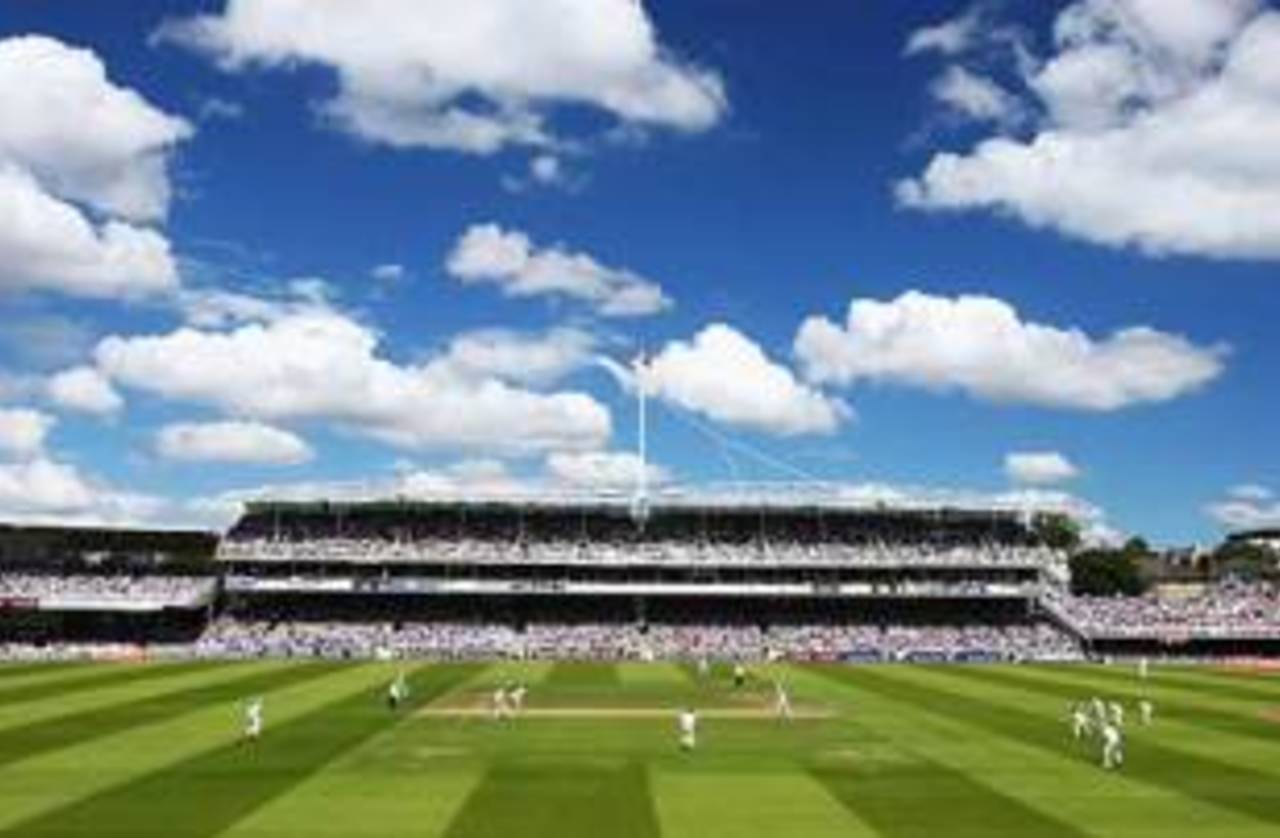
On a perfect day, somewhat politically incorrectly nowadays, the Mecca of cricket • Getty Images
For so long has Lord's been a symbol of everything good or everything bad about English cricket (depending on whether you looked at it over your left shoulder or right) that we tend to forget it is a cricket ground. And in the manner of cricket grounds, is likely to be loved by fans for a variety of reasons that often have nothing to do with the game. In 1946, Pelham Warner, began his book Lord's thus: "Many who are not familiar with cricket believe that the name Lord's has some connection with the peerage: nothing could be farther from the truth." But it was a happy coincidence, and the establishment made the most of it.
Lord's has been much written about. Benny Green has published an anthology of writings on Lord's that is over 450 pages long - and that was nearly a quarter of a century ago.
As Tim Heald points out in My Lord's: A Celebration of the World's Greatest Cricket Ground, "Ever since [Lord's] stopped being a vegetable garden and turned to cricket in 1887, it has been lauded in prose and verse. Many of these celebrations are rather awful, but some are classics of their kind." Geoffrey Moorhouse's Lord's belongs to the latter category, both because Moorhouse writes better than most, and because he brings to his job a perspective that is often missing in the worshipful tones of those for whom every prospect pleases. "The impressiveness of Lord's is compounded of several things," says Moorhouse, "quite apart from its history and associations."
The history and associations have not always impressed even the knowledgeable. Sunil Gavaskar, for one, has said that Lord's left him cold, which, in the years when the MCC ruled cricket and England told the world what to think about the game, was a brave thing to do.
In the nearly two decades since England (and Australia) lost their veto, and the power base of the game shifted towards Asia, and more specifically India, it has become politically incorrect to say anything nice about English institutions. This is reverse snobbery, and just as pathetic. Lord's has been demoted from being the cricket ground to a cricket ground.
"Chief among the charming characteristics of Lord's," wrote JM Kilburn, "is its dignity. To sit at Lord's is to share in substance and so become a man of substance yourself."
It doesn't take much imagination to talk of "the hallowed turf". I was young enough and non-cynical enough to feel a thrill when I first stepped on to the turf many years ago as a reporter. You could make a meal out of the ground's famous slope and the over-zealous gatekeeper and so on, but history has a way of trumping current events.
"Chief among the charming characteristics of Lord's is its dignity. To sit at Lord's is to share in substance and so become a man of substance yourself."JM Kilburn
That is why one of the best introductions to the ground is Heald's book mentioned above. My Lord's - the title makes it a personal, intimate thing rather than the cold institution portrayed by some writers. And the list of homage-payers - from Harold Pinter and Hilary Mantel to Stephen Fry and Michael Green - brings just the right mix of awe and irreverence. The regulars are there too: Jim Swanton, John Arlott, John Woodcock, Alan Ross, Simon Raven.
Michael Davie writes about the time he brought Groucho Marx to watch cricket and how, as he started to explain that one of the teams was fielding, Marx cut in with, "Didn't he write Tom Brown's Schooldays?"
Fry begins with a line that is straight out of Marx, with its combination of the sublime and the ridiculous: "Lord's. The very name is an anagram of 'sordl'!"
Be elegant without being too elegiac was Heald's instruction to his writers, and they have complied. Stories of dodging gatekeepers, of avoiding boring friends, of watching Denis Compton and Bill Edrich, of attempting to take pictures on the sly (this by Patrick Eagar), of Brian Johnston's announcement of Jim Swanton being elected Pope - all these make this one of the most readable collections on what was once called the Mecca of cricket (perhaps it is now politically incorrect to say that too).
Philip Howard tells us how Lord's has "left its mark on the national lexicon as well as on the national character". After all, the ground might just as easily have been called Winchilsea's, Lennox's or Richmond's after one of the other collaborating founding fathers. We can say "What's in a name?", but can you imagine so many paying homage to a ground named "Winchilsea's"?
Suresh Menon is a writer based in Bangalore