
From one-man bands to world-beating team
English cricket used to be about lone talents shining forth despite the chaos of the system. Now, though, it's all about the collective

Andrew Miller
18-Aug-2011
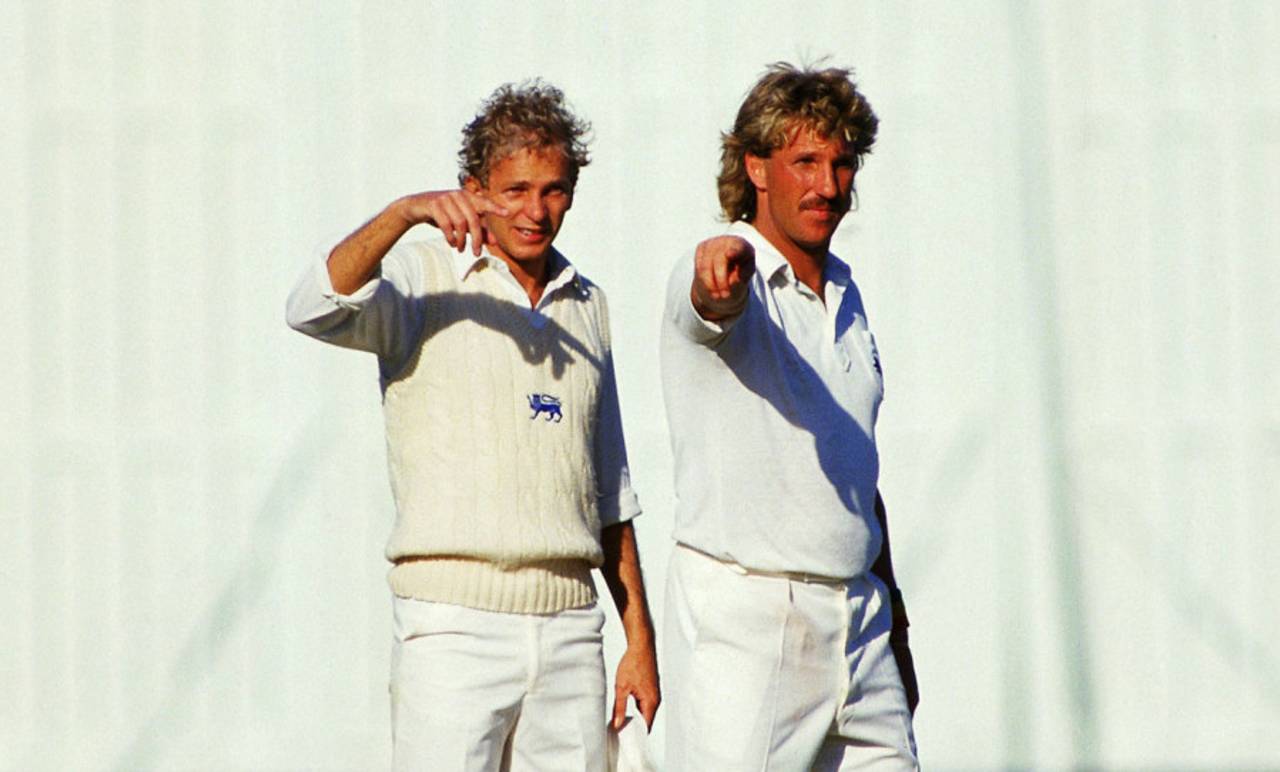
The greatness of players like David Gower and Ian Botham ran counter to everything that currently makes the national team tick • Getty Images
What on earth must Graham Gooch make of all this English success? I mean, honestly, deep down, beyond all the satisfaction he can take for the success of his charges and the explosion of "daddy hundreds" during his time as England batting coach?
At some stage in the next few months, and maybe even this week, Alastair Cook will first equal and then surpass his mentor's England tally of 20 Test centuries, while others such as Kevin Pietersen and Andrew Strauss are closing in as well. But whereas Gooch had to battle on into his 40s to rack up such a tally, his protégé Cook looks set to do so a full three years shy of his 30th birthday.
When asked about this prospect during his Edgbaston epic last week, Cook conceded it would be a "shame" to overhaul the great man - a curious choice of words, even allowing for the hero worship that has been a part of the rise of Essex's latest batting superstar. Presumably such sympathy was not to blame for Cook's failure to emulate Gooch in becoming England's first triple-centurion since that 333 against India in 1990, but nevertheless his reticence touched on a curious truth about the English cricketing psyche.
The greatness of Gooch - and David Gower, Ian Botham, and even, if you encounter an England fan of a very particular vintage, Mike Atherton and Alec Stewart - was a greatness that ran counter to everything that currently makes the national team tick. It was a greatness that enabled them to stand aloof from the chaos that constituted English cricket in the 1980s and 1990s, and carve themselves a niche in spite of every imaginable obstacle.
It's a different world these days. Everyone with England ambitions is obliged to buy into the wider team ethic, whether it's Samit Patel being barred from selection until he shows a willingness to adhere to the squad's exacting fitness standards, or a Star Wars-masked Graeme Swann leading the celebrations after England had risen to No. 1 in the world rankings - the sort of celebrations that simply wouldn't have happened 20 years ago, when many of the players would have to drive off to a county one-day game in the hours after a match had been completed.
"No individual is bigger than the team," is the message that Andrew Strauss was repeating on the eve of the Oval Test, but back in the day, the few players who did stand out did so precisely because they were bigger than the team - and out of necessity, given the circumstances in which they were operating. These men were giants among pygmies, tough cookies in a pack of endlessly battered biscuits; players who were able to make their mark on the English game even while most of their contemporaries were being crushed by the iniquities of an outdated and outclassed system.
If it wasn't the brilliance of their opponents that cut these players down to size - from the Windies pace quartets, via Wasim and Waqar, and on through McGrath and Warne - it was the ineptitude of their team-mates, who lacked the skills or gumption to put up a stiff enough fight. Failing that, the whims of the selectors would generally be to blame, for churning through, say, 29 players for a six-Test Ashes series in 1989. Or ditching, say, a spinner for collecting four wickets at 80.25 in the first three Tests of a series.
However, towering above all else would be the sheer lunacy of the English domestic structure, in which the success of the England team was at all times secondary to the requirements of the counties, who, until the advent of central contracts, owned the players' registrations. A batsman such as Atherton would play twice as many Championship games for Lancashire as Tests for England in any given season (12 to six in 1995), and if a fast bowler such as Angus Fraser failed to do likewise for Middlesex, it was inevitably because he had gone down injured in the process.
"No individual is bigger than the team," is the message that Andrew Strauss was repeating on the eve of the Oval Test, but back in the day, the few players who did stand out did so precisely because they were bigger than the team - and out of necessity given the circumstances in which they were operating
Such a cocktail of mismanagement made cricket-watching in the 1980s and 1990s a very different experience to that which is rapidly becoming the norm in the 2010s. "The days of English cricket being a bit of a laughing stock have gone, and hopefully they have gone for good," said Strauss at The Oval. "It is for all sorts of reasons, not just our play on the park but also because the structure and the set-ups have improved dramatically. We have always had very good players in England. Now the structure makes it easier for us to get the best out of them."
This week the overwhelming expectation is that England will complete their fourth win out of four in the series, and so condemn India to their first series whitewash against them since 1974. And if that does indeed come to pass, it will be England's 20th victory in the two and a half years since Strauss and Andy Flower were thrown together as a partnership, in the wake of the KP-Moores debacle.
Aside from being a neat landmark in itself, that total would equal the number of victories that England managed in the whole of the 1980s, and one more than they achieved in a particularly bitter 10 years from 1986 to 1996 (or Tetley Bitter, to namecheck the England sponsors who became synonymous with failure in the early 90s). In that period the decline of the toughest cookie of the lot, Botham, created a personality vacuum that only the dogmatically driven Gooch came close to filling during his three years as captain from 1990 to 1993.
Aside from the runs he scored, however, Gooch's era is best remembered for his falling out with Gower - a clash of ideologies that summed up the sport's failure to bring a professional rigour to an essentially amateur set-up. To watch him now in the nets, beasting and cajoling his young charges from dawn to dusk, is to be reminded that Gooch had the right idea all along, that playing for England was a privilege that demanded a heightened level of responsibility. And yet, such were the muddled priorities of the era - as well as the delightful quirkiness of Gower's Tiger Moth escapade, which left their relationship beyond salvation - that it was Gooch who ended up being painted as the villain and killjoy.
The directionless fiasco of the national team made for a peculiarly solipsistic viewing experience, with England's fans often finding themselves rooting for one particular favoured player rather than the collective shower, because that at least might enable a measure of glory before the onset of inevitable defeat. In times of duress, when England were 45 for 4 in the follow-on, it would be an improbably rewarding consolation to know that your personal hero was still there fighting the good fight.
At the same time, such an ingrained pessimism arguably made the high days higher. You did not need to own a new-fangled satellite dish to feel every glorious moment at Sabina Park in 1989-90, or at Adelaide five years later, while Gooch's astonishing 154 not out at Headingley in 1991, in which he carried his bat for 61% of England's total, epitomises to this day the era to which it belongs. Had that particular individual not been bigger than both his team and his opponents, the match would not have been a contest, let alone a triumph.
If cricket is a game of partnerships, then the lesson of that era is that too many of England's greats were left to man the fort alone - and when you glance down the list of top Test run-scorers, you can always spot an Englishman for the paucity of his batting average. There are mitigating circumstances - in particular the juiciness of English wickets - but nevertheless Gooch's mark, 42.58, is some 10 points lower than most of the names with whom he has been immortalised, while Alec Stewart - who finished his career as most defeated player in Test history with 54 losses in 133 games - is the only man in the top 20 to average less than 40.
Such slim pickings are a world away from the situation now facing England's finest, and by extension their supporters. Within the next few years, with Cook, Pietersen and Strauss all on the march, there could well be a host of contemporary names vying for Gooch's England record of 8900 Test runs, and sporting averages more befitting of the company they'll be keeping. Somewhere along the way, the exquisite torture of hope that epitomised the 1980s and 90s has been replaced by the dull thud of expectation. It's a thud that sounds much like the thwack of tired leather on broad willow in an England nets session near you.
Andrew Miller is UK editor of ESPNcricinfo