
Geoff Boycott's Indian bore
As the England opener showed, there are occasions when the score itself is less important than the way the runs are accumulated

Martin Williamson
22-Sep-2012
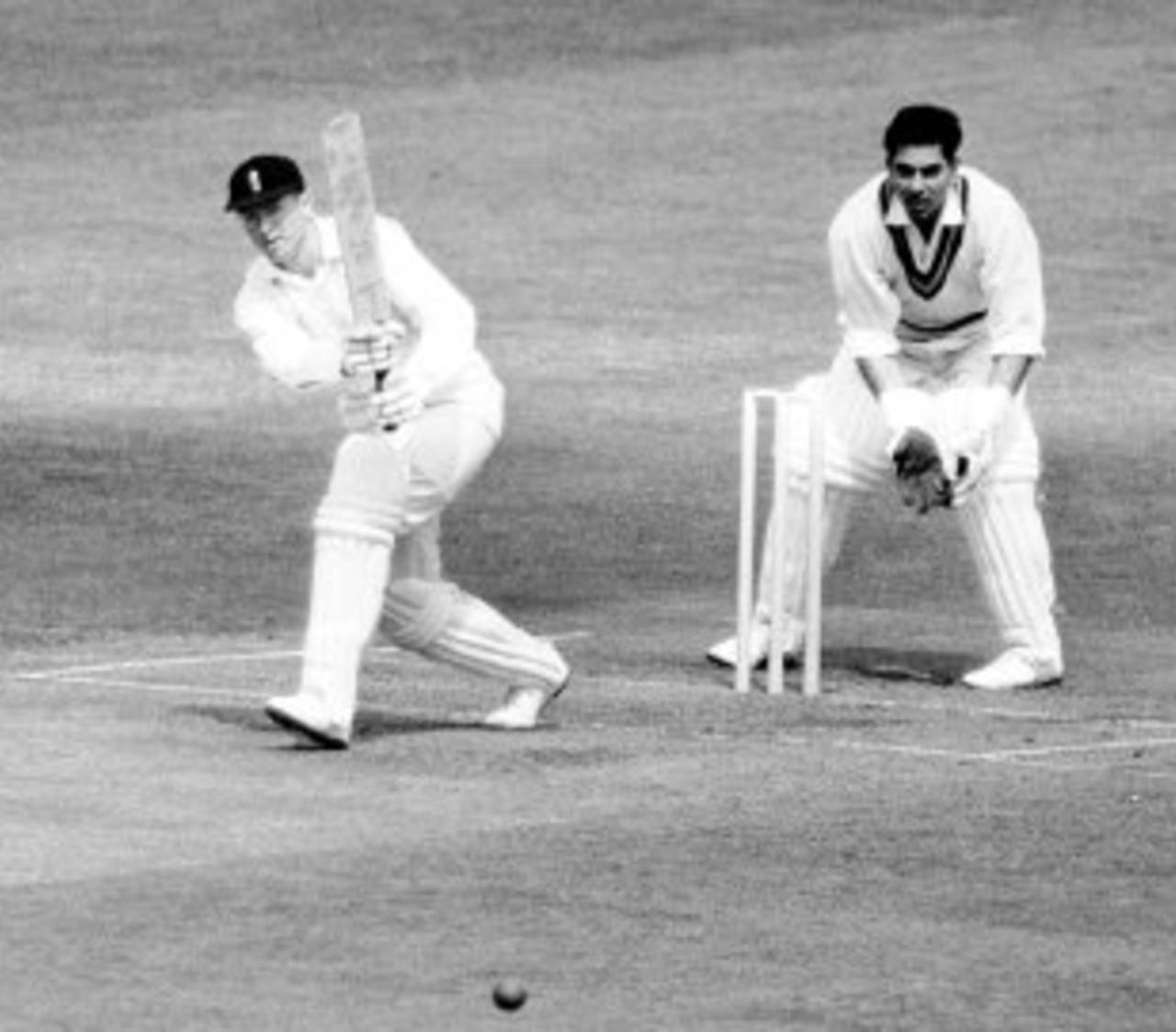
A rare attacking shot from Geoff Boycott on the first day of the Headingley Test, where he scored 106 in six hours. "I had shown that I had the character to stick with it," he later wrote • PA Photos
Scoring a Test hundred is the highlight of many players' careers; a double-century is an even more cherished landmark. But there are occasions when the score itself is less important than the way the runs are accumulated. When Geoff Boycott made 246 against India in Leeds in 1967, his achievement was not greeted with any pleasure - certainly not by those who had paid to watch it - and instead he faced the opprobrium of the media, and ultimately the chop from the England selectors.
Boycott's crime - not for the first or last time - was the tortuous way he batted on the first day, when in six hours he scored 106 not out. He had set out, noted an exasperated John Woodcock in the Times, to be there at the close, regardless of his responsibilities as a public entertainer.
Boycott had come into the Test in wretched form - his previous nine innings had produced 124 runs, including his only pair in county cricket - and there were many who were surprised that he was included in the first place. All the more so as the England selectors had said at the start of the summer that they expected a brighter approach to the game.
In front of a small crowd of around 5000 on his home ground, Boycott reached lunch on 25; he went 45 minutes without scoring midway through the session, and in the hour before the interval he managed eight runs. Between lunch and tea he made 50, and he added another 31 in the last session.
His critics had further ammunition from the fact India had lost two bowlers - Rusi Surti, who was struck on the knee, and Bishan Bedi, who pulled a thigh muscle - long before the close and neither bowled again in the match. "It was more of an occupation than any innings," Woodcock noted. "A defenceless army was hunted down," he wrote of India's weak attack. "Low birds were blown to pieces."
"He would have bored the spectators a good deal more had he not been a Yorkshireman," observed Gordon Ross in Playfair Cricket Monthly. "Perhaps it was as well that the match was not being played at Old Trafford. Every cricketer on the ground winced when he played a full toss or half-volley back to the bowler."
Writing in the Daily Mirror, Brian Chapman said that cricket could "not afford to put in the shop window a joyless effort of this sort… nobody but Boycott could be blamed".
"I didn't expect praise for my first-day performance," Boycott wrote. "It was a grim-looking innings and I didn't need anybody to tell me that. But I had shown that I had the character to stick with it. The alternative was to give me wicket away and return to the anonymity of the dressing room. I was never conscious of the time factor... but when you are in bad nick you never seem to get half-volleys. And when you do play a shot, the ball always seems to hit fielders."
"In different conditions," explained Brian Close, England's captain, "such tenacity would be hailed as a masterly exhibition of the bulldog spirit. But on this first day of a Test, it was being viewed in a different light."
On the second day Boycott was more attacking, adding another 140 runs in a little under four hours. The press were uncertain whether that was enough to erase the memory of what had gone before. And Boycott himself denied that the criticism in the media had led to him changing his approach. "The undramatic fact was, I was happy to have got through the first day," he said. "I'd had a good night's sleep and felt considerably more relaxed in the knowledge that the runs were on the board."
A story was circulating that Boycott had been ordered to accelerate by Close at tea the previous afternoon. Both denied that, and indeed, when Close eventually declared, he made a point of publicly putting his arm round Boycott, "making it obvious," as The Sun noted, "that he was not dissatisfied with either his team or his No. 1 batsman."
It later transpired that a selector had instructed Close to speak to Boycott, but he had not done so. Boycott finished on 246 not out, made in 573 minutes off 555 balls. It was to be his highest Test score, and the highest first-class innings of a wet summer.
England wrapped up a six-wicket victory on the fifth day, after making India follow-on, but Boycott did not open the innings, nor did he even get to the middle as he had a twisted an ankle when he had trodden on the ball while fielding, and Close decided to keep him in reserve.
England's selectors met the following Friday to pick the side for the Lord's Test and few were surprised that they chose to drop Boycott. They had done the same to Ken Barrington - who ironically dominated a second-wicket stand of 139 with Boycott on the first day at Headingley - only two years earlier.
Close, who sat in on the meeting, later wrote that he had wanted to retain Boycott but was outvoted. "In view of the precedent created when Barrington was dropped, we had no alternative," he shrugged. Boycott was less than amused and said he thought it was obvious that Close "did not go in to bat for me". The selectors rubbed salt in the wound by explaining that Boycott had not been dropped for low scoring but for selfish batting.
Close told the media that Boycott was "good enough to take it and to bounce back to become an even better player". Sadly, it was not so straightforward and Boycott admitted that "the stigma of being dropped by England, apparently for selfishness, was to mark the rest of my career".
Close waited until the Sunday morning before telling his county colleague he had been dropped, admitting: "It was a bit difficult." To add to his problems, the pair of them shared a car to a friendly match they were playing in near Bristol.
Boycott did reply in the only way he knew how. While England were beating India at Lord's, he amassed 584 runs in four innings, during which time he was dismissed just once.
He was recalled for the third and final Test, at Edgbaston, but said the atmosphere was strained, especially with the selectors, and he felt under pressure from the off. "I was terrified in case I played a maiden over," he noted. "I felt as if the whole press box was waiting for me to play a defensive stroke."
Instead, he decided on a policy of all-out attack - "I was going to ping the ball like nobody's business" - and was stumped charging down the pitch to Bedi. "I had made 25, a significant blow for brighter cricket." In the second innings he was bowled by Venkataraman Subramanya - "a piddling medium-pacer about as formidable as I was" - for 6.
What happened next?
- Boycott made only one more appearance in the summer, but was recalled for that winter's tour of the Caribbean, where, freed from the media spotlight, he once again found his touch
- Close was sacked as England captain at the end of the season for controversial time-wasting in a County Championship match
Bibliography
The Cricketer Various
Playfair Cricket Monthly Various
Boycott The Autobiography Geoff Boycott (Corgi 1987)
Brian Close Alan Hill (Methuen 2002)
Martin Williamson is executive editor of ESPNcricinfo and managing editor of ESPN Digital Media in Europe, the Middle East and Africa