| Series | Countries | Live Scores | Fixtures | Results | News |
Features
|
Photos | Video & Audio | Blogs | Statistics | Archive | Games | Mobile | ||||||||||||||||||||
|
If you're a fan of spin and swing, you could do worse than become a fan of women's cricket

Sanjay Manjrekar
February 16, 2013
![]()
|
|||
|
Related Links
Series/Tournaments:
ICC Women's World Cup
|
|||
For the last couple of weeks I have been watching and commentating on a different kind of cricket, where I have had to bite my tongue while saying things like "Bowled him!" Barring that, commentating on the ICC Women's World Cup has been a thoroughly enjoyable experience.
No serious comparisons can be made between men's and women's cricket, for various reasons, but watching the women's game up close has been instructive for me - for its contrasts with the men's game, and what it tells us about the evolution of the men's game.
It has been truly gratifying for me as a cricket follower to see some real spin and swing being bowled. As a rule, women seem to swing the ball more than men do, and they also do not need turners to spin the ball - all they need is a 22-yard cricket pitch. This, of course, is not to demean the men in any way, but it raises the point of how swing and spin are less and less evident in the men's game now.
The pitch at the Cricket Club of India, where the World Cup games were held, was hard and bouncy, covered by a thin layer of grass. With matches starting at 9am, our pitch reports always suggested bowling first as the obvious option after winning the toss, and spoke of how it was going to be a seamer's delight. And each time it startled me how the spinners extracted spin from the pitch, even when they were bowling first. No way would the men have found spin on that surface at that hour.
There are two simple reasons for this: female spinners flight the ball more and bowl it a lot slower than men do, with their average speed being around 65-70kph. Male spinners generally bowl around 80kph, and their trajectory is much flatter. This is why women can find turn even on a pitch with no soil exposed, to get the spin advantage.
There was a time when men used to flight the ball like the women do today, but we all know why that does not happen anymore.
One, with increasing amounts of limited-overs cricket being played, the batsmen's mindset has changed completely. Hitting the ball in the air is no more the taboo it used to be. Two, the bats have got heavier and bulkier, and the boundaries are rarely long enough. It amazes me how many times a batsman mistimes the ball and it still sails over the ropes into the stands.
This is where I find the game is unfair to the bowler: ideally such miscued shots should land in the hands of a fielder well inside the boundary, but that does not happen anymore. Given that, only really brave bowlers will bowl full or flight the ball today.
For the ball to swing, one needs to bowl it full. Over the years, with bowlers realising that full balls can be risky, as the batsman can hit you straight over the head into the stands, they have gone shorter, and this habit has stuck in Tests too. Next time, watch carefully when you see a pitch map during coverage of a men's match, and look at how many times a seamer has bowled balls that would actually have gone on to hit the stumps. They are very few. This also means they are giving themselves fewer chances to get lbws and bowleds.
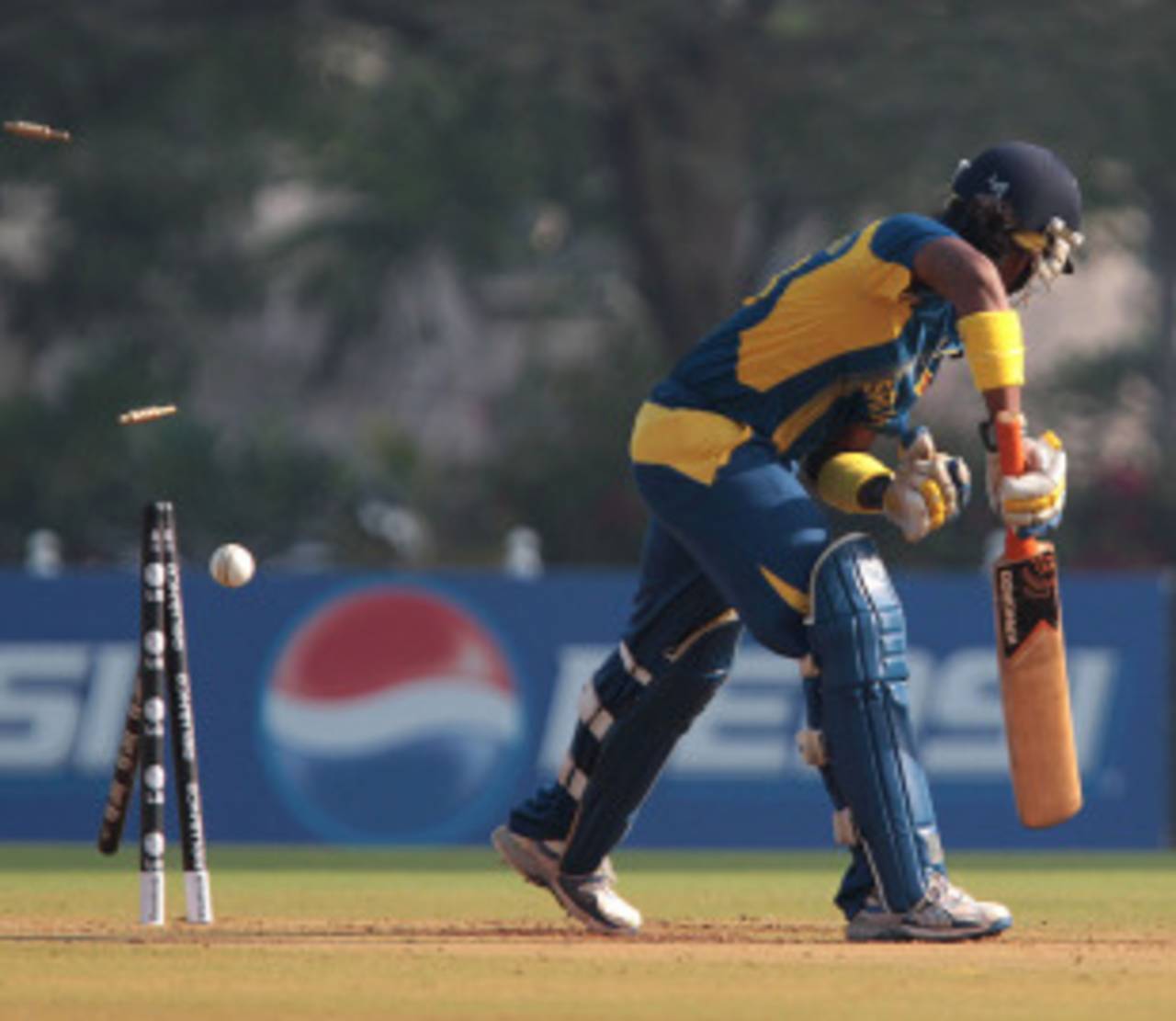
What was striking in these women's matches has been the number of bowleds and lbws they have got. This is because of the full length they tend to bowl; on the pitch map we could see that most of their deliveries were pitching in the full-length area, unlike in men's cricket, where the stock delivery is just short of a good length and balls invariably sail over the stumps if allowed to pass.
Women are able to bowl full because they know very few women in the world can hit the ball out of the ground. So it does not need an especially big-hearted, courageous bowler to pitch it full or throw it up in the air as a means of deception. Even though the boundaries are shorter (around 55 metres on average), sixes are rare in women's cricket, while in men's cricket, with 70m boundaries, it is batsmen who can't hit sixes who are rare.
| Women bowl their overs quicker because they do not "mill around" like the men do. Even on a humid day, the women were rushing through their overs and running to take their positions in the field in between overs | |||
One other reason why 50-overs men's cricket seems a drag sometimes is because men take so long to bowl their quota of overs. They invariably go overboard by 30 minutes. Women get three hours and ten minutes to bowl their 50 overs, as against men, who get three and a half hours. This, I am told, is because men tend to have longer run-ups.
But it was obvious to me that the real reason why women bowl their overs quicker is because they do not "mill around" like the men do these days. Even on a humid day, the women were rushing through their overs and running to take their positions in the field in between overs.
Visits by substitutes with drinks are infrequent, unlike in men's cricket, where it has gone completely out of control. In the women's games, every time the batter was ready, so were the fielders and the bowler.
Why are women generally so keen to finish their overs in time - even when their side is lagging in the match sometimes? Is it hefty fines or penalties in terms of money or runs? Bans? No. There is no penalty of any kind if they don't bowl their overs in time. They do it out of habit, a good habit.
The game is a lot more attractive to spectators if they get to see all its facets in one match, and those include swing and spin. It is up to administrators to ensure this. My stint covering women's cricket has confirmed what I have felt quite strongly for a while: sooner rather than later, the rule-makers will have to restrict the weight and dimensions of the cricket bat. At the moment the edges are starting to resemble the face of the bat.
Wherever possible they need to drag the boundaries further away, so a batsman will know he is taking a huge risk when he is trying to loft a full, swinging ball or a flighted, spinning delivery. If it does not come from the middle of the bat, he should know that is probably going to be the end of him. When a batsman has this doubt in his mind, watch how the game becomes more attractive than it is today.
Former India batsman Sanjay Manjrekar is a cricket commentator and presenter on TV. His Twitter feed is here
© ESPN EMEA Ltd.
| ||||||
| Comments have now been closed for this article |
||||||
'Administrators think making more money is better for the game'
Geoff Boycott on mixing cricket and business, and the Ashes
'I always keep one shirt from every team I play for'
Quick Singles: Azhar Mahmood on sharing a dressing room with Waz, and the disappearance of the English summer
A choke? Not really, just a thrashing
There appears no end in sight to South Africa's quest to banish their demons. By Firdose Moonda
ESPNcricinfo at 20: Could the world live without the site's favourite stats-spewing thingummybob? By Andy Zaltzman
Mahesh Sethuraman: Every time Karthik looked set to cement his spot, Dhoni seemed to emerge as an obstacle. Until now
India prepare quietly ahead of big clash
India look at ease as they train quietly and purposefully on the eve of their semi-final against Sri Lanka in Cardiff
Why India have had success in this Champions Trophy
The unexpected conditions in England have favoured India's adventurous batting
Lots of rumour, but no hard evidence
The words of a former England captain turned commentator have sparked a controversy around the Champions Trophy hosts but, as yet, there is no hard evidence
Pakistan were cheered fanatically to three defeats and an embarrassing Champions Trophy exit
A contest that brings cricket alive
The game can often seem dreary, predictable and endless. Not when India and Pakistan play each other
India prepare quietly ahead of big clash (191)
India look at ease as they train quietly and purposefully on the eve of their semi-final against Sri Lanka in Cardiff
Why India have had success in this Champions Trophy (87)
The unexpected conditions in England have favoured India's adventurous batting
The day the laughter died (70)
Pakistan were cheered fanatically to three defeats and an embarrassing Champions Trophy exit
Pakistan have always looked wistfully at the batting riches produced across the border
Batting trips up Pakistan again (48)
The Champions Trophy debacle was just another example of how frail Pakistan's batting has been over the last few years
Online Money Transfer, 3 easy steps
Confirmed exchange rates. Register now!
Buy Wisden 2013 & get a FREE Playfair
Available now at Cricshop
Good article Sanjay, I've been very impressed with the general standard of this World Cup, players like Sarah Taylor, Stafanie Taylor, Mithali Raj and Deandra Dottin are superb talents. Absolutely agree with the suggestion to increase boundary sizes, in fact why not get rid of the ropes and go back to the old days of having to hit the ball into the fence? It would be up to the fielders to have the common sense to not go diving into them! It's thanks to Ricky Ponting sliding into the boundary boards at Sydney a few years ago that they brought in the ropes in the first place.
Not so sure about regulating bats. However TOTALLY agree about the drinks breaks, matches in Australia in particular now are ridiculous, the 12th/13th men seem to be on the pitch every 2 overs with drinks!!! The ICC need to bring in some limit, surely drinks every hour is more than enough, bowlers can always keep a drink just inside the boundary anyway.
Manjrekar is spot on! Women's cricket is a flashback to the way cricket was probably meant to be played 150 years ago. (Not a negative statement). There is so much grace & little in the way of brute slogging with the batting. It is enjoyable to watch & there is a heck of a lot of skill to appreciate. @nidhin.rajan on (February 16, 2013, 17:50 GMT) - I totally disagree. Men's cricket is turning into an ugly power game, mainly in the short forms. The amount of ugly swipes to the leg side that take the edge & fly for 6 to 3rd man is crazy. I wouldn't mind bats being de-powered.
Interesting read. Like the flair of it. And suggestions at the end are good. There needs to be a limit put on weight and weight of bat. Boundaries need to be 80 meters at all the grounds. These are simple things to be put in place for a cricket game to take place, wonder why ICC has failed to lay them down strictly. Marketing a game is one thing but allowing marketing to changes essentials of game take away the charm. Its been taken away at least for the moment. Fun is not just in watching sixes & fours hit, but the skills and courage shown. Alas somewhere in past people forgot cricket was liked more for attitude shown by cricketers than for boundaries. Keep the charm intact. And may be its our obsession with runs or lack of quality cricket that leads to drab cricket even when there are results. Lest play the game fair a square for all 11 players spinners, batter, fast bowlers and will see charm of cricket back.
I believe this to be a good article, and all the observations to be correct. There is one point not addressed though that I wonder about. What role does the smaller ball play?
Posted byWatching (men's) Test cricket remains the ultimate fan experience for me, but I could not help wondering why was so often switching over from ODIs and the BPL T20s being shown on other channels to have a look the Women's World Cup, (much to the chargrin of my wife, incidentally!). Reading Sanjay's article, I now know why; men's limited overs cricket has become much more predictable and monochromatic in terms of the skills on display, while in women's cricket, they are much more varied. I fully agree with Sanjay- unless they do something about bat weights soon, one might as well stop watching limited overs cricket. Its an absolute travesty that someone like Matt Hayden, to a large extent by reason of the weight of his bat, should have an avergae which brackets him in the same class as Greg Chappel, Viv Richards, Lara, Tendulkar or Ponting.
Posted by kalyanbk on (February 17, 2013, 14:51 GMT)Cricket will be a better game when administrators realize that the contest between bat and ball is more exciting than a contest between bat and bat.
Posted byHello Sanjay Manjrekar. Nice to see a former cricketer write a wonderful article on women's cricket. I completely agree with what Sanjay had to say. By the way, there's always a huge difference when a cricketer/former cricketer write articles about the game (either men's or women's) and someone who didn't play any level of cricket in their lives write articles on espncricinfo website. Just goes to show the latter don't read, understand, interpret and analyse the game properly while they're watching it. That is why we need more cricketers/former cricketers to write articles on this website.
Posted by suvam.ask on (February 17, 2013, 6:45 GMT)Men do need to realise this.......and more than that the public(cricket viewers) of us.....
Posted byRestrictions on the weight and dimensions of the bat will be restricting batsman's individual capability.If you do this then why not restrict fast bowlers' speed, say to them you cannot bowl with speed more than 145 and less than 125.Just swing and seam the ball.That will be not fair to bowlers like Lee and Akhtar.It is their individual capability if they can use a heavier bat or not.I also disagree that mishits or edges should be penalized. If they give batsman unfair runs, they also give bowlers many chances to take wicket.It is a risk, a chance, sometimes batsman benefits sometimes bowlers, and that is the beauty of cricket. In 20-20 and ODI, game may seem a bit unfair for bowlers, but it is more due to time. In 120 bowls, it is hard to take 10 wickets, batsman can take as many chances as they want.It doesn't effect team much if one gets out while trying to hit. There are others to take place.All focus is on getting as many runs on board. Bowlers still rule and win Test matches.
Posted by MridulM on (February 17, 2013, 0:41 GMT)@nidhin.rajan : Manjrekar is not comparing the quality of cricket. He is comparing the skills being used. Unlike tennis, quality of a team game depends on the facilities being provided to that game. Its a matter of altogether different discussion. We can't even say that quality of men's game has improved. Put the players of todays generation in trying conditions and a spinner loses his spin, pacer can't swing/seam the ball and batsmen can't gauge the swing/seam/spin/bounce of the delivery. As the men's game has evolved in time, a tendency to blame the lack of skill on pitches has increased. If you agree on the lack of skill part, the next question is how come skills have deteriorated? Well, to provide "entertainment" to the crowd, game has been continuously tweaked in favor of the batsmen consequently focus of bowling has increased more towards containment. Somehow this misplaced notion of "entertainment" being "batsmen beating a hell out of the bowlers" has damaged the gmae.