
Scratching a living
Nick Newman
15-Apr-2008
 | |
It's as inevitable as a middle-order collapse or a Steve Harmison wide:
sooner rather than later a cartoonist puts pen to paper and scribbles a
drawing encapsulating the eccentricity, frustration, peculiarity, joy or sheer
pointlessness of cricket. A game that can last five days without a result
is an inviting target, even for those with no interest in it. And the jokes
also work for those who find it a tedious mystery. Maybe it's the English
character - to laugh at the things for which we are famous. Or perhaps
cricket just provides
endless opportunities to
lampoon stuffiness and
silliness.
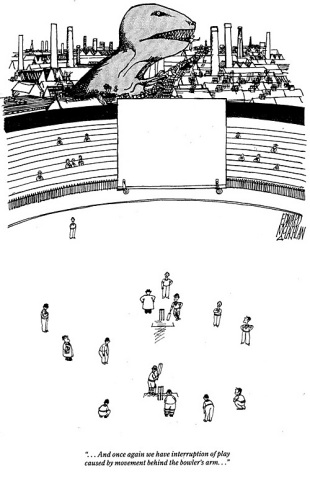
A personal favourite
appeared in Private Eye in
the 1970s. Ed McLachlan
depicts a typical scene at a
major, sparsely populated
ground. Play has stopped,
the umpire turns round
in annoyance and an unseen
commentator explains
"…And once again we
have interruption of play
caused by movement
behind the bowler's
arm…" Except the movement
is a giant
Tyrannosaurus rex rampaging
through the city,
destroying buildings and
gobbling people. In the
world of cricket, global
catastrophe plays second
fiddle to the niceties of
the game. The balloon of
pomposity is held up -
and pricked with sublime
surreality.
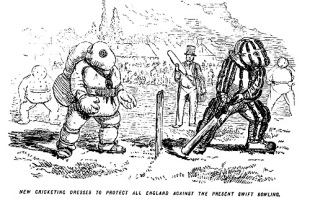
Cricket cartoons have a long history. One classic drawing shows a bizarre
armour-plated and padded figure wearing what looks like a deep-sea diver's
helmet - but wielding a bat - and is entitled "New cricketing dresses to
protect All England against the present swift bowling."
It was drawn by John Leech and appeared in Punch as long ago as 1854,
but the theme, if not the style, could have come from almost any decade.
Similarly timeless are William Heath Robinson's ideas for cricket novelties,
including the device below.
Completely oblivious to the existence of this cartoon, dating
from the 1930s, I drew the selfsame joke about batting
against Harmison only last year.
 | |
Fougasse, a contemporary of Heath Robinson's,
drew for Punch (and ended up as editor). The
son of a notable cricketer,
he was also an acute
observer of the game. "Of
course," says one Fougasse
spectator to another,
"there's one thing that no
foreigner will ever
understand, and that's our
enthusiasm for cricket" -
as he sits in a vast, empty
stand… Plus ça change.
Fougasse was best known for his economy of line in the "Careless talk costs
lives" posters during the Second World War. But he perfectly captured the
village cricketer in his "Charm of Village Cricket" character series for Punch:
"Other things being equal," notes Fougasse, "if one hits the ball directly to
a fielder in a cloth cap one can run a single - stretching it to three for a straw hat - and four for a black waistcoat - while
for cuffs buttoned at the wrist - or a dickey, one just runs it out. With small
boys in shorts," he concludes, "one naturally takes no chances whatever… - as everyone knows they are apt to become so confoundedly enthusiastic."
Village cricket, with its slapstick of dropped catches and run-outs and
clichéd social mix of toffs and blacksmiths, has provided the bread and
butter for gagsters down the years. But cricket has also provided an irresistible
metaphor for political cartoonists. Sir David Low caused a furore in
1925 when a cartoon for The Star entitled "IT" caricatured Jack Hobbs,
standing as a colossus beside the diminutive statues of Caesar, Lloyd George,
Charlie Chaplin… and Mahomet. The Morning Post reported that in pre-
Partition India the cartoon "convulsed many Moslems in speechless rage".
Some feared there would be riots - a dramatic foretaste of the Danish
cartoonists' controversy 80 years later, and a reminder of the enduring power
of the pen. Less contentiously, the 1930s, 40s, 50s and 60s saw Low, Vicky
and others drawing political figures being bamboozled and bounced out by
the trade unions, their colleagues, the Opposition or the Lords. The 1970s,
80s, 90s and Noughties have seen Garland of the Daily Telegraph and others
drawing… well, political figures bamboozled and bounced out by the unions,
their colleagues, the Opposition or the Lords. Plus ça change indeed. "A
treaty too far" (overleaf ) appeared in July 1992 during the debate on
Maastricht, when the cricket-loving and vaguely europhile John Major was
being undermined by the strongly eurosceptic Margaret Thatcher.
So what inspires cartoonists to focus on cricket? Ken Pyne produced Silly
Mid-off, his wonderfully observed book of cricket gags, "because I was
asked". And that's probably the case for the majority of scribblers. Newspaper pocket cartoonists have to respond to events with a gun to the head - and
'twas ever thus for the likes of the Express's Roy Ullyett, whom Trevor Bailey
considered the greatest sporting cartoonist. There's nothing quite like
a five o'clock deadline for
summoning the muse at
4.55 p.m.
Few cartoonists' involvement
with cricket has gone
beyond spotting a chance
to sell a drawing to pay
for hard liquor. There are
exceptions. Willie Rushton
was an enthusiastic player
for the Lord's Taverners,
whose current president
is Bill Tidy. Sir Bernard
Partridge, Punch's political
cartoonist before the
Second World War, played
cricket with J. M. Barrie and Sir Arthur Conan Doyle (who himself once
dismissed W. G. Grace). Pocket cartoonist Bernard Hollowood edited Punch
from 1957 to 1968 and played for Staffordshire from 1930 to 1947. The
tone of Punch's cricket cartoons was almost uniformly deferential: Mr Punch
saluting Ranji as "A Prince of Cricket"; "Mr" Warwick Armstrong depicted
as "The Lion Tamer", with a humbled British lion seeking his autograph;
or Bradman towering over his English opponents in "Gulliver's Tour Among
The Lilliputians (with Mr Punch's compliments to Mr Bradman)". All of
which may have been fair and sporting, but wasn't exactly funny - and
confirmed Punch as the voice of the Establishment.
My own enthusiasm for the game is matched only by my ineptitude as a
player. But having drawn more cricket cartoons than Matt Prior has dropped
catches, I've come to certain conclusions:
1. There are no jokes in England winning. For the cartoonist, England failure
is far better than a Flintoff century or a Panesar five-for. In 1994, The
Guardian's David Austin celebrated Brian Lara's historic 375 with him saying
post-match: "I'd like to thank the England team, without whom…" Matt of
the Daily Telegraph marked England's 2006-07 Ashes debacle by observing
a genteel lady in a travel agent's. "My husband's in Australia watching the
cricket," she says. "As a Christmas treat, I thought I'd fly him home." So,
roll on more England disasters.
2. There's only one thing funnier than England failure - Australian failure.
Particularly if they cry. Unfortunately that rarely happens, and I sadly can't
find any cartoons of Kim Hughes blubbing, or Trevor Chappell bowling
underarm. So we have to resort to jokes about Shane Warne's amusing hair
or misdemeanours, and gags about Australian bowlers going out to nightclubs and texting nurses. The Aussie cartoonists can't think of anything else either.
The Ballarat Courier's John Ditchburn has drawn countless cricket cartoons
- most seemingly about Warney. I've certainly yet to find anything else
comical about Australian cricket.
3. Cricketers habitually behave badly. They cheat - hurrah! From balltampering
to mysterious substances in the pocket, cricket has provided
cartoonists with the materials with which to tweak their gags and get them
through joke-blind editors and into the papers. Even better is bad behaviour
on tour: upturned pedalos, jelly-bean incidents, love romps and broken beds.
These are a cartoonist's slow full toss. So hats - and trousers - off to
bounders everywhere.
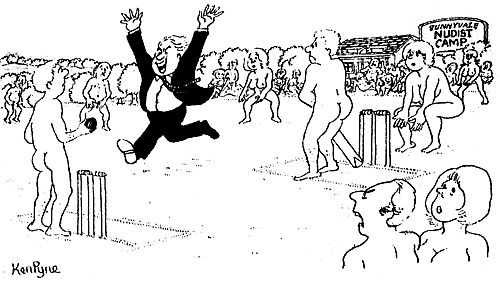
4. Cricket is inherently absurd. It attracts streakers, men with beards dressed
as nuns, thin men dressed as fat men dressed as Vikings, and occasionally
fat men dressed as international cricketers.
So, if you want to draw cricket cartoons… forget it. There are far too many
cartoonists as it is, the pay's lousy, and you have to deal with constant
rejection. On the other hand, it gives you an excuse to watch cricket all day
under the pretence you're scratching a living. What could be better?
Nick Newman is the pocket cartoonist for the Sunday Times and draws
for Private Eye, The Spectator, The Wisden Cricketer and Wisden. He was the Sports Journalists' Association's cartoonist of 2005.
He averages just under three with the bat.