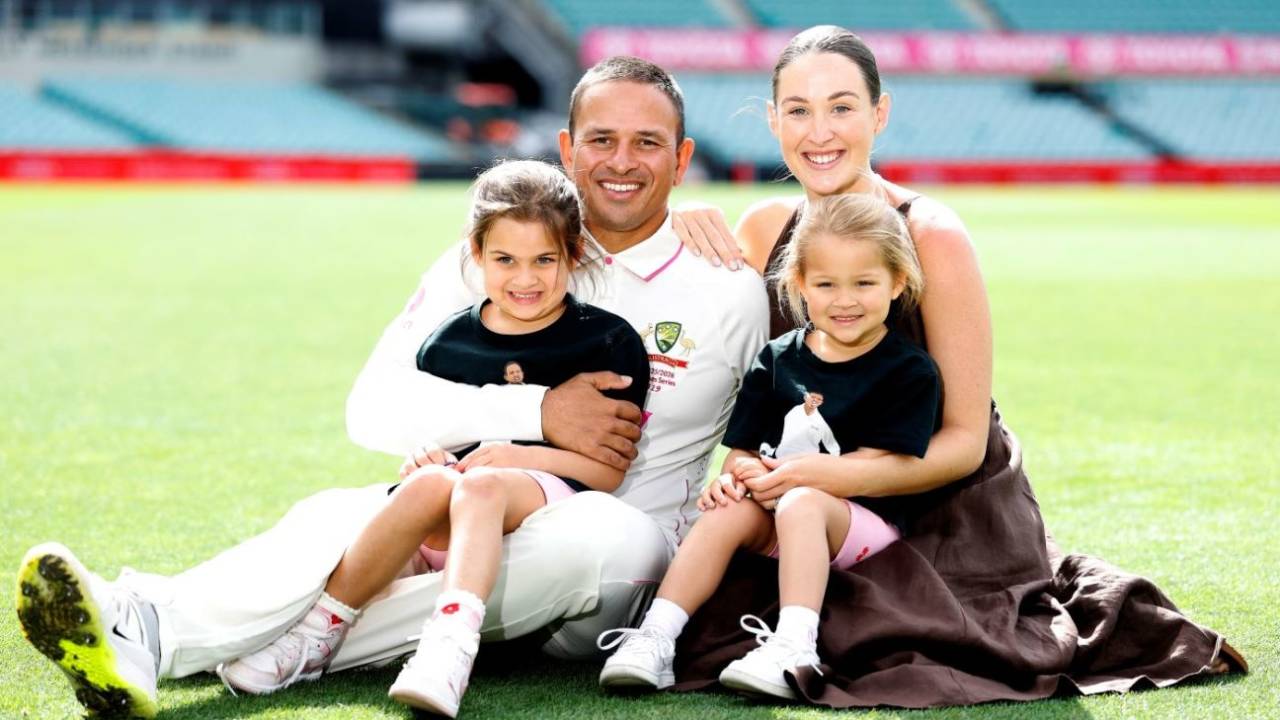
Usman Khawaja with his family after announcing his international retirement • Getty Images
"I'm a proud Muslim, coloured boy from Pakistan who was told that he would never play for the Australian cricket team. Look at me now. And you can do the same."
A stone's throw from where Usman Khawaja grew up, having emigrated to Australia when he was five, his Test career will come to a close on the ground where it all started. When he was young and the family couldn't afford tickets, he would wait until the gates of the SCG were thrown open late in a day to catch a glimpse of the action. His farewell will come in front of a full house.
Khawaja told his team-mates a few minutes before walking into an early-morning press conference on Friday. He said he hadn't expected to get emotional but admitted there had been tears. Khawaja had made peace that Perth early in the series could have been it when he was left out in Adelaide following back spasms, but Steven Smith's illness gave him a chance to write the final chapter. He made up his mind in Melbourne, but only coach Andrew McDonald was privy to the details.
His 6206 runs, with he will hope to add a few more to in his swansong, and 16 centuries are the mark of a fantastic career. They place him 15th on Australia's overall list, with a chance of moving ahead of his close friend Mike Hussey in his final Test.
By playing his 88th Test - "Dad, is that enough," Khawaja said during his opening speech - there will be a perfect symmetry to his career: 44 matches before being dropped for the seventh time in 2019 and 44 since the recall, which also came at the SCG, in 2022 when he scored twin centuries against England. "It's the tale of two halves," he said. "I've definitely enjoyed the second half way more than the first half."
But his career has a wider significance, too. As will, you sense, his post-playing days.
His place in Test cricket remains a unique one: he is still the only Pakistan-born player and Muslim to play Tests for Australia.
During a 50-minute press conference deep in the stands of SCG, with his family sat in the back row and his youngest daughter Ayla saying "Dada, Dada" as Khawaja sat down at the top table, he spoke at great length about the challenges of being "different", especially in the early days, but also the societal issues that remain.
"I didn't want to talk about this, but I just want the journey for the next Usman Khawaja to be different," he said. "I want you to treat him or her all the same. Not have racial stereotypes of who they might be."
"I'm trying to bring everyone together. I'm trying to bring inclusivity into Australia"
Usman Khawaja
Asked whether he felt cricket was in a better place now than when he started 15 years ago, he said: "Absolutely, it definitely is. There's still a bit to go, but the sport is definitely in a better spot. There's still challenges because if you look at Australia outside, it's such a multicultural community. The amount of participation we have in cricket, subcontinent players particularly... we don't see that always in the Australian cricket team.
"And I get it. The Australian cricket team's hard to make. There's 11 spots. It's not easy. We don't want to just gift people spots. We definitely have improved on that, but there's still an undertone here and there. There's still challenges to be faced. We can't just be like, yeah, we fixed everything, everything's fine. It's not.
"But that's all right. You've just got to accept that it's not fine. It'll probably never be 100% fine. It's very normal. But we've got to try to get as close to equality as we can. I think we are heading to that spot."
It has been in the second half of Khawaja's career that he has become confident to speak on a range of broader issues, and his attempts to take a stance has brought him up against the ICC and the Australian political landscape.
"I was told I'd never play for Australia" - Usman Khawaja shares a message for kids who are made to feel they don't belong pic.twitter.com/diAP8ugtaC
In 2023 he was prevented from wearing shoes with "all lives are equal" and "freedom is a human right" written on them in a Test against Pakistan. He was then reprimanded for wearing a black armband instead. He made an application to have a dove symbol on his bat, which was rejected.
"I understand that I've talked about certain issues outside of cricket which a lot of people don't like," he said. "I still find it hard when I say that everyone deserves freedom, that Palestinians deserve freedom and equal rights, why that is such a big issue.
"But I get it, I put myself out there, even when we talk about Australian politics, and we get all these right-wing politicians that are anti-immigration, anti-Islamophobia [Islamophobic], and I speak up against them.
"I know people don't love that, but I feel like I have to because where these guys are trying to divide, create hate, and trying to create animosity in the Australian community, I'm doing the exact opposite. I'm trying to bring everyone together. I'm trying to bring inclusivity into Australia."
During the pre-written speech, which Khawaja delivered before taking questions, he expressed what he hoped his career had achieved.
"I hope I've inspired many children along the way, particularly those who feel that they are different, those who feel that they don't belong, or those others tell that they will never make it," he said. "I felt all these things growing up and trying to be an Australian cricketer, but seeing is believing, and I'm here to tell you that you can do whatever you want, you've just got to keep trying. Never let anyone convince you that you can't, because if they do convince you, then you never will."
The commentary box beckons for Khawaja, but his standing and influence will be felt in many ways, not least his foundation, which helps youth from refugee, immigrant, Indigenous, rural, remote and low socio-economic backgrounds. Even though he has looked outward during his playing career, Khawaja conceded being a professional cricketer required elements of selfishness to remain successful.
"I've tried to give as much as I can during that time," he said, "but I don't want to do anything now for the rest of my life unless some way, shape or form it revolves around helping other people, helping those who need, helping friends helping family, just other people than just myself."
The final question of a near hour-long stint in front of cameras and reporters, was how he hoped to be remembered. "Just as a good person, as a good human, as a good father, as a good son," he said, before adding with a smile. "Maybe easy on the eye to watch when I'm batting. I think there's no greater compliment I get when people come up to me and say, 'oh, I love watching you bat'. So I just want to be remembered as a humble cricketer who went out there and entertained and people enjoyed watching."