Why Oman became home to Sri Lanka's Duleep Mendis
The former Sri Lankan captain has been an important part of Oman's rise as a cricket nation
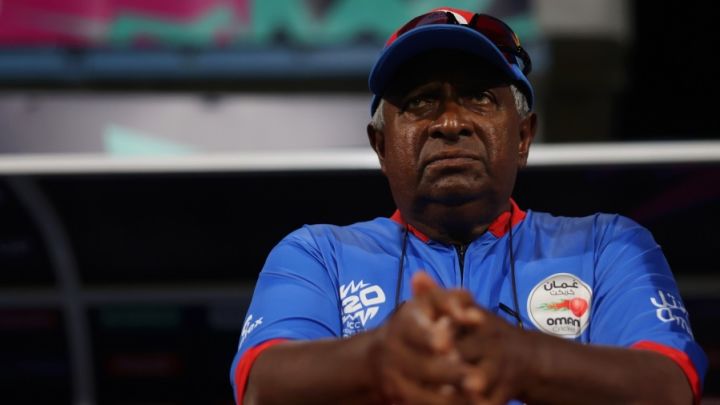
When Duleep Mendis first arrived in Muscat to help a budding nation find its footing in international cricket, he expected his stay to be brief. That was 13 years ago.
The 2026 tournament in India and Sri Lanka is Oman's fourth T20 World Cup and Mendis has been around for the whole journey. He had not expected to stay, and find a second home in a desert nation that has grown into a competitive force in Associate cricket.
"Initially I went for one or two years and ended up being there for about 13 [14] years now," Mendis, the Oman head coach, says while in his old stomping grounds, Colombo, where they are based for all their Group B matches.
Around him, the dressing room is boisterous, filled with a team spirit he cultivated as the players prepare for Thursday's crucial encounter against Sri Lanka. And it's there that he recalls a conversation with Oman Cricket's leadership that was the catalyst for him to stay permanently.
"Pankaj [Khimji, chairman of Oman Cricket] asked me how long I was going to keep shuffling up and down and whether I would like to come and settle down," Mendis says. "By that time, I found out it was the right place. And more than anything I must say the people who were administering Oman cricket were fantastic guys."
What Mendis found was rare in international sport. While many coaches battle board interference, he had a group of leaders who offered him a "free hand" to build.
"I liked very much working for the board because they gave me the authority... there were many [proposals] that we took forward. You are given a free hand, and there were times that we failed, but you correct it and go forward."
To comprehend the breadth and depth of growth in Oman cricket during Mendis' tenure, one must first take a step back. When he started, their infrastructure was minimal. Founded in 1979 by the late Kanaksi G Khimji, Oman Cricket became an Affiliate Member of the ICC in 2000, gained T20I status in 2015 - three years after Mendis joined - and ODI status in 2019. Today, Muscat boasts world-class facilities that rival those in most Test nations.
The academy features a state-of-the-art indoor facility with seven pitches (fast, slow, and ordinary) in a fully air-conditioned environment, while barren land has been replaced by "beautiful lush green" turf, with the government recently gifting the board three additional grounds.
While centred in Muscat, Mendis is pushing to take the game to Salalah and Sohar, to ensure cricket isn't just a capital-city sport. However, the road to the top division of international cricket has not been without complications.
The transition from "honorary" board to professional entity reached breaking point following the 2024 T20 World Cup when 11 senior players, including stars like Aqib Ilyas and Zeeshan Maqsood, clashed with the board over unpaid prize money.
The fallout was severe. The board suspended central contracts, and because residency in Oman is often tied to these sporting visas, several players were forced to leave the country.
While the board eventually pledged to clear all dues by July 2025, attributing the delay to procedural hurdles, the incident highlighted friction in a rapidly evolving system.
For Mendis, who views the board members as "passionate guys who only wanted to do well," these obstacles were part of the journey.
"I would say the hurdles were there, you had to just cross it," Mendis says philosophically. "When the obstacles are coming, we discuss it as a panel and try to take constructive decisions. We are an Associate country, and there is a big difference from Associate to Test."
Mendis is a realist regarding priorities in the region. He understands that in the Gulf Cooperation Council, of which Oman is a part, the focus is on white-ball cricket, which fits the working schedules of their player pool.
"The infrastructure and everything is suited for the white-ball game," Mendis says. "Most of them are there for work, though that is slightly changing now. When the team does well, people start talking... it's like back in '96 when we [Sri Lanka] won the World Cup."
As a batter who faced the world's most fearsome bowlers in the 1970s and 80s, Mendis views the modern game with a nuanced eye. While he marvels at the athleticism, he sees a decline in the purer arts.
"Modern day cricket is completely different... it is almost like athletes playing. But I would say batting technique and standards have dropped a little."
But despite that, he does envy the security the modern player has compared to his era. "Today you can come into cricket and say I will make it a career. That is an advantage."
Read in App
Elevate your reading experience on ESPNcricinfo App.