| Series | Countries | Live Scores | Fixtures | Results | News |
Features
|
Photos | Video & Audio | Blogs | Statistics | Archive | Games | Mobile | ||||||||||||||||||||
|
The Australian opener has shown he isn't afraid to play his natural game, no matter what the format

January 15, 2012
![]()
|
|||
|
Related Links
Christian Ryan : There's something about Warner
Ian Chappell : Kohli and Warner prove T20's got class Matches:
Australia v India at Perth
Series/Tournaments:
India tour of Australia
Teams:
Australia
|
|||
So much for all the talk about David Warner being a Test player. He proved at the WACA that he's a 20-over specialist.
It's what he does. He has made back-to-back centuries in the Champions League and a hundred in the Big Bash League, both Twenty20 competitions. His latest century also took him 20 overs, but this time it was in a Test match and against the new-ball bowlers of a team that was recently ranked No. 1 in the world. Now that really is some 20-over specialist.
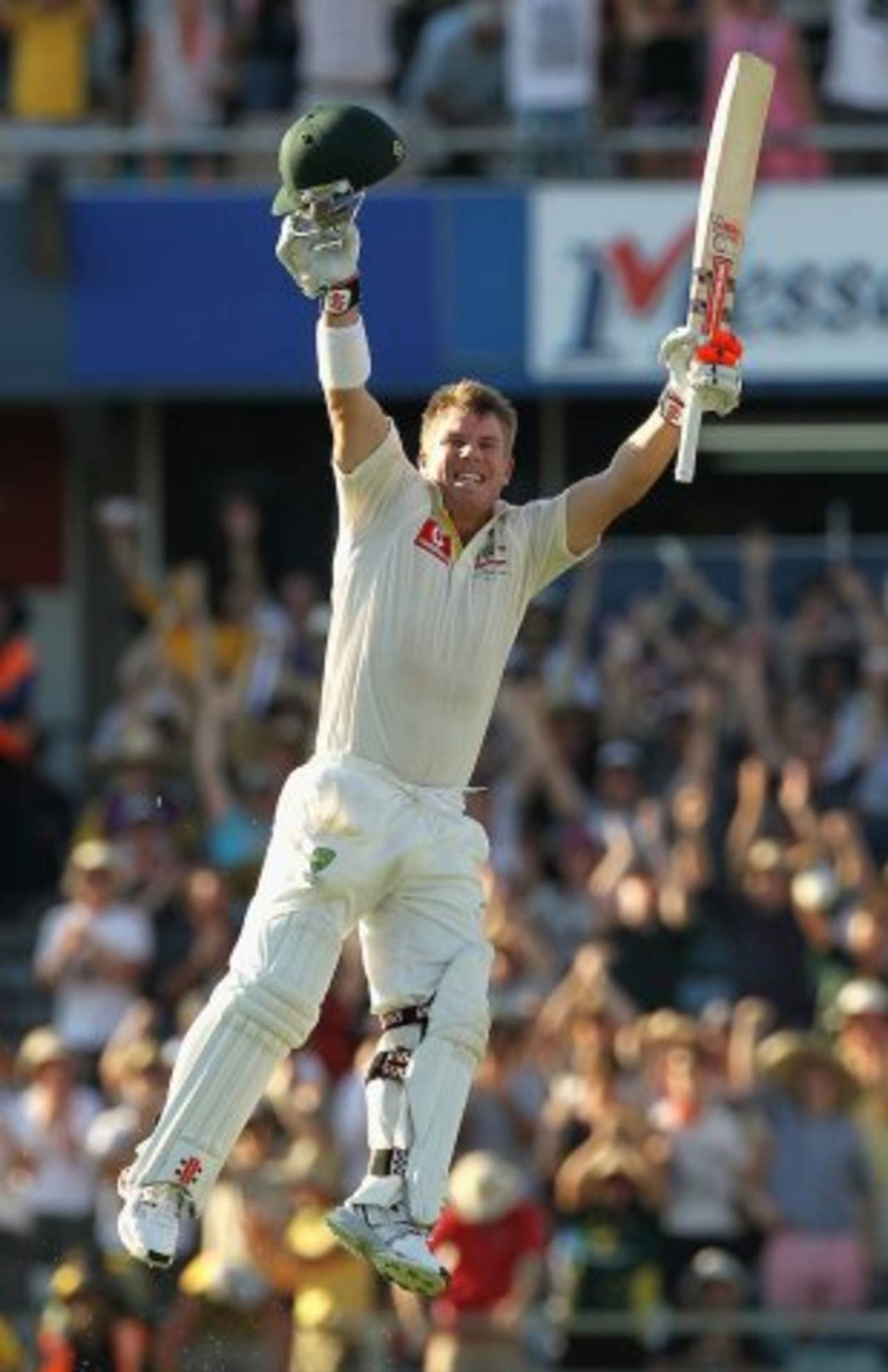
Warner's batting is attuned to T20 cricket but it translates into the Test match arena because he has the skill to compete at that level and the nerve to play his natural game. His innings at the WACA was like something out of a movie - a Warner Brothers flick.
The irony of his knock was that it was played against Virender Sehwag, a man who told Warner he'd be a better player in Test cricket because the close fielding positions would suit his aggressive style. Warner's belligerent century not only demoralised an already flustered Indian side, he also remastered a few thrills from other memorable knocks at the WACA.
The diminutive Warner reminded me of the flamboyant West Indies opener Roy Fredericks, who thrashed a hundred in 1975-76 in just 71 balls of mayhem. Warner beat that incredible performance by two balls.
Another West Indies opener, this one more burly, Chris Gayle, bludgeoned a hundred off just 70 balls at the WACA. Gayle hit a monstrous six that travelled 104 metres, but he did it off a spinner. Warner, the muscled marauder, beat Gayle to the century by a ball and managed to hit one of the Indian fast bowlers a massive 98 metres into the stands.
These blistering centuries stand out because the batsmen concerned were openers facing international new-ball attacks. That takes as much nerve as skill.
Another such innings, 37 years on, remains etched in Australian cricket folklore. Dashing Doug Walters hit a six off the last ball at the WACA in 1974-75 to complete a century in a session in an Ashes Test. It wasn't the last ball of the day but Warner reproduced that drama when he clouted Vinay Kumar for six to bring up his electrifying century.
The reception Warner received when the ball landed over the ropes was one reserved for batsmen who play with entertainment uppermost in their mind, no matter the form of the game. Many cricketers have received standing ovations but Warner is one of the rare ones who experienced an outpouring of unbridled joy at the pleasure of witnessing something extra special. His response to the applause was full of emotion and fuelled by the adrenaline required to play an innings of such adventurous audacity.
That Warner is mentioned in the same breath as Walters, Fredericks, Gayle, and also Adam Gilchrist, who scored the second-fastest century ever in a Test at the WACA, is not an exaggeration. And yet his greatest achievement is to have played an innings of such daring in a Test match.
Two centuries in five Tests is an incredibly good start to an international career. Warner will have other days where things are not so good, and there'll be occasions when he questions his method of playing. I just hope that on those occasions he recalls this century at the WACA, and that the memory also remains vivid in the selectors' minds. That innings was Test cricket as you rarely see it - a long knock played in a short time.
Former Australia captain Ian Chappell is now a cricket commentator and columnist
© ESPN EMEA Ltd.
| ||||||
| Comments have now been closed for this article |
||||||
Widely regarded as the best Australian captain of the last 50 years, Ian
Chappell moulded a team in his image: tough, positive, and fearless. Even
though Chappell sometimes risked defeat playing for a win, Australia did not lose a Test series under him between 1971 and 1975. He was an aggressive batsman himself, always ready to hook a bouncer and unafraid to use his feet against the spinners. In 1977 he played a lead role in the defection of a number of Australian players to Kerry Packer's World Series Cricket, which did not endear him to the administrators, who he regarded with contempt in any case. After retirement, he made an easy switch to television, where he has come to be known as a trenchant and fiercely independent voice.

ESPNcricinfo at 20: Could the world live without the site's favourite stats-spewing thingummybob? By Andy Zaltzman
Rob Steen: While players are pulled up for various deeds of misconduct, administrators get away
Switch Hit: Mark Butcher joins the team to preview the Champions Trophy semi-finals
'He was going to run all over you'
My XI: Allan Donald on the most intimidating bowlers he has seen. Right up there: Malcolm Marshall
'New Zealand are the worst users of DRS'
Beige Brigade podcast: Only Taylor, McCullum and Williamson should be allowed reviews
Why India have had success in this Champions Trophy
The unexpected conditions in England have favoured India's adventurous batting
Lots of rumour, but no hard evidence
The words of a former England captain turned commentator have sparked a controversy around the Champions Trophy hosts but, as yet, there is no hard evidence
Pakistan were cheered fanatically to three defeats and an embarrassing Champions Trophy exit
A contest that brings cricket alive
The game can often seem dreary, predictable and endless. Not when India and Pakistan play each other
Warner row shows how Root has bedded in
That he was out drinking with senior players and was targeted by David Warner's misfiring aim proves Joe Root is firmly a part of Team England
India prepare quietly ahead of big clash (147)
India look at ease as they train quietly and purposefully on the eve of their semi-final against Sri Lanka in Cardiff
Why India have had success in this Champions Trophy (87)
The unexpected conditions in England have favoured India's adventurous batting
The day the laughter died (70)
Pakistan were cheered fanatically to three defeats and an embarrassing Champions Trophy exit
Pakistan have always looked wistfully at the batting riches produced across the border
Batting trips up Pakistan again (48)
The Champions Trophy debacle was just another example of how frail Pakistan's batting has been over the last few years
Online Money Transfer, 3 easy steps
Confirmed exchange rates. Register now!
Buy Wisden 2013 & get a FREE Playfair
Available now at Cricshop
I think BnH1985Fan explains the reality well. Bashing a poor India attack when they are down and out is one thing - lets see how he goes against England and SA. Watching him bat you can see the gaping holes in his technique, which is why one assumes he wasn't picked earlier.
Posted by PiyushD on (January 16, 2012, 11:09 GMT)Well they would say samething for Sehwag when he fires and when he fails they will say he should be more responsible, Warner you entertained and here you have priases and moment you start failing we will se a lot of things in you not responsible, no test match temprament, no technique. Welocme to International cricket. You know its better to be in Autralia than India as Australia plays other sports too.
Posted byWarner will always be an impact player. It is possible with the fact that there will be bowlers and coaches who watch hours of video and analyse his technique and possibly find chinks in it. I have always maintained that his technique is better than that of Hughes who seemed so vulnerable. He is a modern version of Slater and Gilchrist in the one dayers. Of course his success will always depend on how long he sustains in the international circuit and how often he makes runs. Players who come to mind are Gayle and Sehwag and they taught bowlers a lesson or two. As long as Australia remembers that he will be an impact player and as long as the rest of the team too makes runs once in a while as they are supposed to , he can make a difference to Australian cricket not only with his batting but with his enormous enthuisasm in the field. Imagine Australia"s batting card in the two games where he scored centuries without his contributions! A player worth paying to watch sridhar
Posted byI guess Virender Sehwag gave Warner the confidence to play test cricket with his natural agression, the former was just outstanding but the latter looks like to surpass the Indian marauder with his aggressive play in all formats of the game. Would love Viru to fire in the one-dayers atleast....if he and warner play to their full potential...it will be nightmare for bowlers all around the world.....Thanks to players like warner and sehwag, gayle who make test matches so interesting and High adrenaline....its sad that Gayle is not given a chance by the stupid WI selectors.......
Posted by ElvisKing on (January 16, 2012, 5:25 GMT)I beg to differ with Ian Chappell, Warner just took advantage of India's low score of 161 and went hammer and tongs after the bowling since he knew even if got out there would be no pressure on him if fails to score. It would be a different ball game when there is good formidable total to chase, so far he has not been a success in this series except for this century. The real test will come when he is under pressure and then only you can judge him if comes out on top. Time will tell.
The reference by Chappell about India's NO. 1 ranking makes it sound as if Warner scored the runs against the best bowling side in the world ! What a joke ! This will be a good bowling attack in future but not at the moment. So make hay while the sun shines .
Posted by perkin-aus on (January 16, 2012, 4:24 GMT)It is not co-incidence that the innings mentioned by Chappell all occurred at the WACA (along with the second highest individual Test score by Matt Hayden). This ground is a great one for good batsmen. Hard and fast outfields, a good seeing ground, good light and if you are batting at the start of an innings as Fredricks, Gayle, Hayden and Warner were, playing on the WACA deck while it is still hard, fast, true bounce and carry mean a good batsman can and will score well, score fast and score a mountain of runs. Pity there was not one Indian batsman who could claim to be in form with the bat or mentally.
Posted by Meety on (January 16, 2012, 2:26 GMT)I'd be happy if he can continue the ratio of 2 tons in 5 tests for the rest of his career.
Posted by __PK on (January 16, 2012, 1:32 GMT)Spot on. The only thing I'd add is that he made a modification to his batting to fit Test cricket - a more careful selection of which ball to play the big shot on. This is the difference between his batting and Sehwag's at the moment. Andrew Symonds did the same thing during his brief, but productive, stay in the side - keep your limited over shots, but be more circumspect about when to play them and in between, make sure your defence is solid.
Posted by Boba_Fett on (January 15, 2012, 23:18 GMT)There was an interesting comment by Warner at the end of the game where he poiinted out that the majority of fieldsmen are placed behind the wickets. This gives him confidence to play so many straight drives in the air - the chances of him getting caught are very low. And the fact that he hits it so hard that even a mis-hit doesn't represent as much of a danger as it does to most other batsmen.
Posted by BnH1985Fan on (January 15, 2012, 21:59 GMT)Warner looked good at Perth -- but India's bowling "attack" was really poor; easily WELL below the bowling attack from any current first class team in Australia or England. Against really good pace attacks, Warner may turn out to be like Sehwag -- looks great when he is firing on all cylinders, but looks horrible when is not. Unlike India's selectors who have given Sehwag umpteen opportunities, Australia's selectors will not keep Warner for long if he can't produce runs with consistency. Pressure to keep your place on the team is very high for every Australian player, never mind how well you have done in past (ask Simon Katich)!!