
Cricket and the lure of betting
Each IPL game fetches upwards of £10 million in legal bets. And that's just the tip of the iceberg. Will legalising betting in India end the fixing menace once and for all?
Ashok Malik
Jul 15, 2010, 3:10 AM
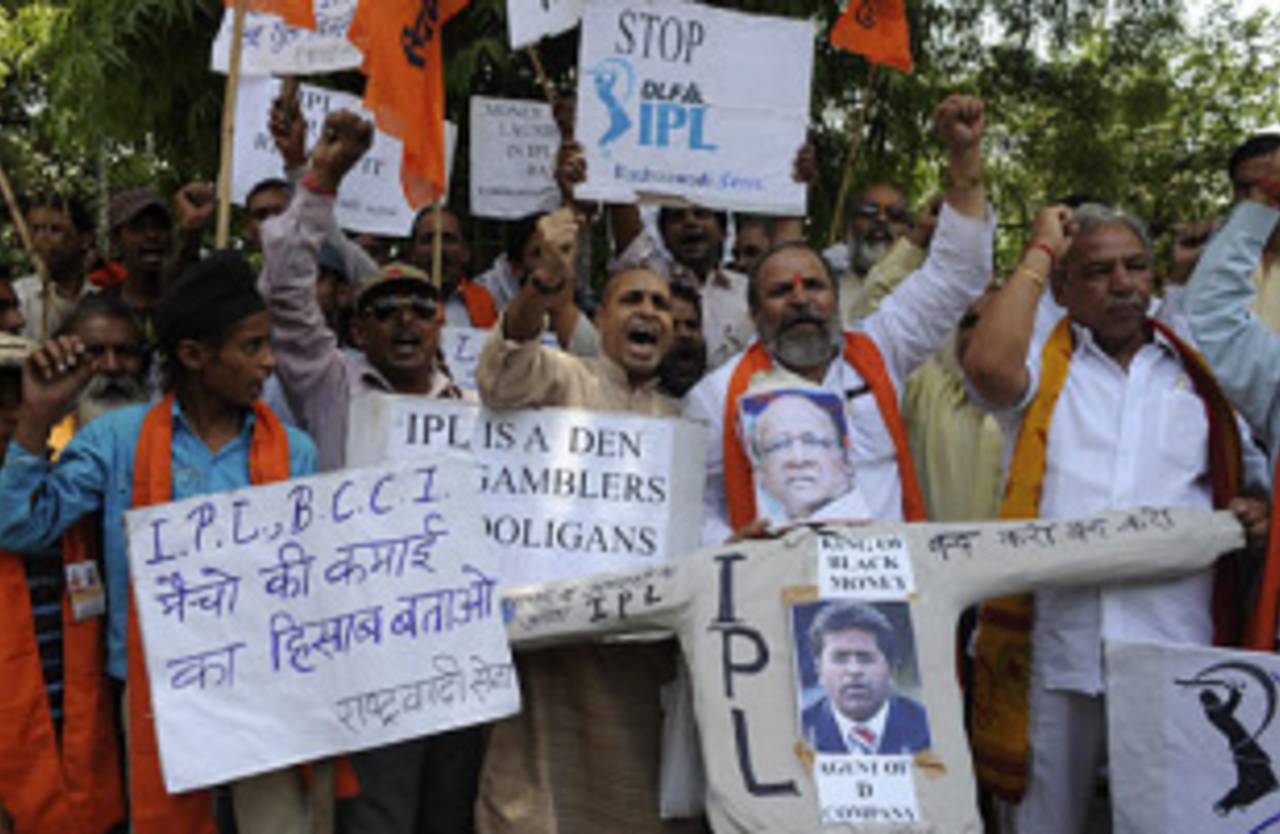
The IPL has widened the illegal betting market in India • AFP
What is the quantum of money bet on cricket in India? An exact number is impossible to arrive at but the few statistics that are authoritatively available are revealing. Betfair is the world's leading sports betting company. It accepts bets online from registered punters who pay using a credit card. It is also an industry innovator in that odds at Betfair are not set by an individual bookmaker or a consortium but by the market: the odds change as the amount bet on or against a particular team or individual player grows.
Betfair was born in the summer of 2000, coincidentally within a few weeks of the Hansie Cronje match-fixing scandal. The two occurrences were, of course, unrelated. Even so the volume of cash Betfair attracts during cricket matches is telling.
According to insiders, a top golf tournament, say the US Masters, would attract bets worth £2 to 3 million on Betfair. For a smaller sport, with a very limited geography, cricket seems to do better. During the 2010 World Twenty20 in the West Indies, each match drew bets worth £3 to 4 million. In contrast, this year's Indian Premier League, which preceded the World Twenty20 by a few days, saw betting amounting to over £12 million per match on Betfair. "Some of the matches," says an unimpeachable source, "crossed £15 million in bets."
What do these figures indicate? Frankly, they tell us more about India than about the nature of sport. Cricket is big in India and so is betting. That's why cricket matches are magnets for such huge betting opportunities. In contrast, golf is not a mass sport in India and there is no great interest in betting on it. Quite obviously, a large percentage of Betfair's incremental clients - those who become active only during cricket matches and are dormant when it comes to, say, rugby or poker - are either Indian or have an India connection.
Betting is illegal in India and Indian credit cards cannot easily be used on betting sites. To access Betfair, an Indian punter has to have either a bank account or a credit card overseas - perhaps borrowed from a friend or cousin. Alternatively, he has to have legal status (as a foreign-exchange earner or non-resident Indian) permitting him to park money abroad. It is not an easy process.
It is much smoother, however, to get in touch with a bookie in your town. Indian bookies run trusted client networks. Most of them are honest, in that, even if they cheat the tax man, they don't lie about the odds available and ensure payments are made on time. If a would-be punter is introduced to a bookie by another client, he can enter the circle, and must play by the rules.
When a cricket match is on, all one needs to do is call the bookie. (The bookie changes his mobile number frequently but is certain to keep his clients updated.) On being called, the client is offered two figures and two options: "Lagana" and "khana".
Indian bookies run trusted client networks. Most of them are honest, in that, even if they cheat the tax man, they don't lie about the odds available and ensure payments are made on time. If a would-be punter is introduced to a bookie by another client, he can enter the circle, and must play by the rules
This exercise of choice is also a test of the bookie's business ethics. Let's suppose India are playing Australia in an ODI and you want to bet on Australia. The bookie offers you the "lagana" (putting) odds. To show he's not being unfair and giving you incorrect odds, he offers you an option: "khana" (eating), the odds on betting against Australia, and on India. "In this manner you can back a team or 'eat' a team," says a veteran punter. "The bookie has come clean with you."
How large is this bookie-by-phone market? If an IPL match on Betfair gets about £12 to 15 million per match, it would be a safe expectation that the unofficial, cash-only betting economy is much larger. "I would estimate it is 20-25 times as large," says a betting specialist, "maybe even 50 times."
Then and now
Online betting wasn't always this sophisticated or massive, setting odds wasn't as transparent, and the betting revenue was smaller. Even so, much of the narrative in the section above was true 10 years ago. The secretive network of Indian (or South Asian) bookies and their mobile phones, complete with their code language, still dominated cricket-related gambling and fixing.
Online betting wasn't always this sophisticated or massive, setting odds wasn't as transparent, and the betting revenue was smaller. Even so, much of the narrative in the section above was true 10 years ago. The secretive network of Indian (or South Asian) bookies and their mobile phones, complete with their code language, still dominated cricket-related gambling and fixing.
So what has changed in the past decade? First, the IPL as a phenomenon has gripped not just cricket fans and sponsors but the betting industry as well. That single tournament in the Indian summer attracts a disproportionate amount of betting money. Combined with the fact that the Twenty20 format is so susceptible to a match outcome being decided by just one bad over or one batsman failing at a crucial time, this makes the IPL a potential target for the fixing mafia.
These concerns have been voiced elsewhere. The ICC's Anti-Corruption Unit has spoken on the issue. When the two additional IPL teams were auctioned earlier this year, BCCI officials were worried that if a franchise was won by a small-time bidder that promised to pay an unrealistic licence fee and did not have the backing of an obviously rich business house or billionaire, then it would leave the individual franchise vulnerable to manipulation by the betting mafia. This fear was mentioned in the context of at least one bidder who seemed to have somewhat opaque business links.
The methodology of fixing - or attempted fixing, since very few matches have been proven to have been fixed - has also evolved. A Test match lasts five days. To pre-determine its result, a large number of players, including at least one of the captains, may need to be compromised. Twenty20 cricket is a much shorter format. Here, fixing one or two players is all a corrupt bookie needs to do.
How does this work? Let's say a team is 45 for 2, chasing 150. An in-form batsman walks in and is expected to hit his team out of trouble. As he reaches the crease, the odds still favour his team but marginally. If he fails and gets out in single figures, then the odds could change substantially.
Now what if a corrupt bookie knows this cricketer is going to fail? What if he has bet a certain amount using the odds available as the batsman walked in and now waits for him to fail, and for the odds to fall?
"It's a bit like the stock market," explains a punter. "You agree to sell a scrip at Rs 20 at 2pm. But you don't actually have the stock. You know there's a big announcement coming that will cause the stock to drop to Rs 18 at 4pm, and you plan to buy then. So you agree to sell at Rs 20 but wait to buy at Rs 18."
The introduction of market-determined odds and the ability of some websites to allow the punter to - within reasonable limits - set his odds or to "buy" or "sell" his wager on a team at differential odds (and so make a profit) have made such situations feasible.
Such parameters create conditions for what is called "spot fixing": asking a single player to do something - whether get out or bowl three successive loose balls that concede boundaries - that significantly alters the immediate odds but may not necessarily decide the final result. Has this happened in the IPL? Frankly, despite rumours, innuendo and apprehensions, there is no hard evidence. Nevertheless, this is a potential pitfall Twenty20 leagues have to look out for.
Legalise it?
Will legalising betting in India end the fixing menace once and for all? Would bringing Betfair in as a sort of IPL partner - which Lalit Modi had reportedly considered in his time as IPL commissioner - be a good idea?
Will legalising betting in India end the fixing menace once and for all? Would bringing Betfair in as a sort of IPL partner - which Lalit Modi had reportedly considered in his time as IPL commissioner - be a good idea?
The answer is a mixed one. In a country that bets on everything from cricket matches to the amount of rain that will fall in a day, legal betting would seem logical. It would earn the government revenue in the form of service tax and income tax. Those who run large-scale betting companies are unlikely to want to corrupt sport and bribe players. A Betfair or a Ladbrokes is a genuine corporate operation, not a cartel of the corrupt.
Yet what happens when a betting company becomes the setting - rather than the protagonist - of a sports corruption scandal? A prostitution racket may be run out of a hotel with the hotel's management being completely innocent of what its guests are doing. Legalising betting, especially online betting, cannot eliminate the potential for fixing.
In the end, it boils down to that one cricketer who is induced by a smarmy man in a shiny suit to throw his wicket away or bowl that one very expensive over, with two no-balls and a wide for good measure. At the root of that is temptation and greed. It is a basic instinct; and you can't use the law to defeat it.
Ashok Malik is a writer based in Delhi