
Ashes tours can end careers. Ollie Pope could be next
With 64 Test caps, Pope is a senior player who bats with the naivety of a rookie

Matt Roller
18-Dec-2025 • 16 hrs ago
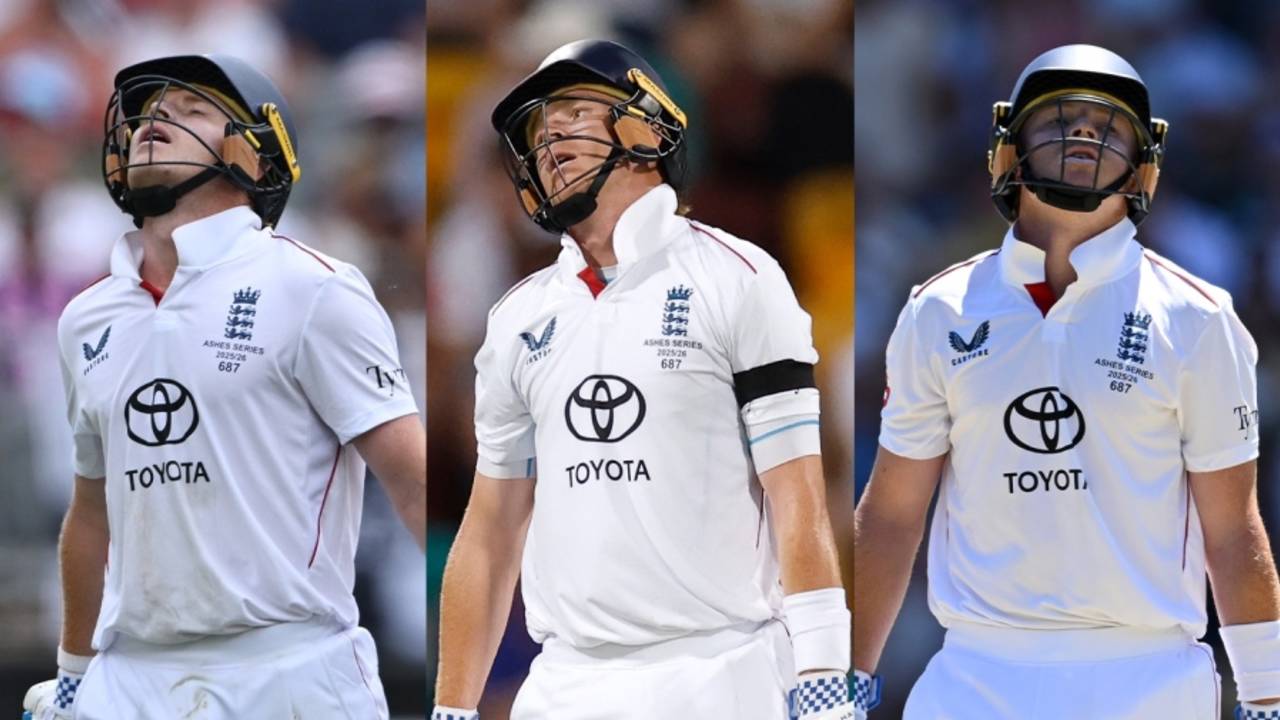
Ollie Pope in despair - after dismissals in Perth, Brisbane and Adelaide • Gareth Copley/Darrian Traynor via Getty Images
They call Adelaide the city of churches, and Ollie Pope needs a miracle. He will be batting for his Test future in England's second innings after his impossibly soft dismissal to Nathan Lyon in their first, and it is increasingly hard to envisage how a player without a half-century in 15 innings against Australia will ever rise to the Ashes stage.
It is a stark reality of English cricket that tours to Australia tend to end players' careers. Four years ago, Rory Burns, Haseeb Hameed, Dawid Malan and Jos Buttler formed four of England's top seven in the first Ashes Test at the Gabba; since the end of that series, none of them has ever played Test cricket again.
Pope now faces the same fate. He turns 28 before the Sydney Test so is young enough to come again, but looks like a player - and a man - who would benefit from time away from the scrutiny and spotlight of international cricket. He is playing his 64th Test in Adelaide but, to misquote Shane Warne, he might as well have played his first Test 64 times.
Related
Lyon restates the value of spin as Australia lock in on series-seizing day
Australia have the urn in their sights as England self-destruct again
McCullum in firing line as England batten down hatches
McCullum warns against 'knee-jerk reactions' to England batting line-up
A generational flaying takes its place in England's Ashes lore
The uncomfortable truth is that Pope sits in the category of England players - alongside Graeme Hick and Mark Ramprakash before him - who dominate at domestic level but are not quite good enough against the best: he averages over 60 for Surrey in first-class cricket but below 35 in Tests, and just 24.20 against Australia and India. Like Ramprakash, it is self-doubt that has plagued him.
Pope could not have asked for a better opportunity than the one that presented itself in Adelaide. He walked out to bat at 37 for 1 on a pitch that Justin Langer described as "an absolute road" with the prospect of keeping Australia's attack out in the baking sun all day, and with Mitchell Starc and Pat Cummins at the end of their opening spells.
"Pope has won enough caps to be considered a senior player but bats with the naivety of a rookie"
He faced two balls from Cummins, twice flicking him off his pads down to long leg, then had half an hour before lunch to settle in against Scott Boland and Lyon. It was a chance not only to get himself set but to set up the game for his team-mates, to overs in Australia's bowlers' legs, and to allow Joe Root and Harry Brook to come in with a strong platform behind them.
It was also a chance to make Australia pay for their own profligacy with the bat on the opening day, one that countless England batters of years gone by would have relished when facing more ruthless opposition. Pope has been backed for series after series to remove any fear of failure and, ultimately, to help him flourish on a stage like this one.
But Pope was caught in two minds, as he has been throughout this series - and much of his career. He tried to leave Boland's second ball on length, but left his hands in the way and was struck on the glove. He then went chasing after the final ball of the over with hard hands and was cut in half by a nip-backer, feet rooted to the crease as though petrified by the prospect of playing out a maiden.
His dismissal was the nothing shot to end all nothing shots, disappearing into a batting black hole. Facing his second ball from Lyon, he decided to whip an offbreak that pitched on a seventh-stump line through the leg side and offered Josh Inglis some catching practice at short midwicket. Pope threw his head back in disbelief but it was all too credible: he has now done so three Tests in a row.
It was yet another dismissal to a low-percentage option: Pope's best-case scenario from the shot he played was to beat midwicket to his left and scramble back for two. In Perth, he could not resist a drive on the up; in Brisbane, he chopped on jabbing at a cut. Pope is on his second Ashes tour, and playing Australia for the third time, but continues to make basic mistakes.
Pope started this series with 46 and 33 in Perth but his second-innings tempo was implicitly criticised by his captain: "The guys who were able to be brave enough to knock bowlers off their lengths were the ones who seemed to find success." Since then, he has batted as though stuck between two gears, without the match awareness to shift up or slide back down again.
Before the Brisbane Test, Pope was asked a simple question about whether England would alter their approach and delivered a response that betrayed his scrambled mind. He spoke about the importance of "putting the bowler under some pressure" while simultaneously "soaking it up" and the need for "complete clarity" while also getting "a feel for it while you're out there".
Put simply, he seemed confused as to what sort of player he is meant to be: he has spent the last three-and-a-half years being encouraged to play his natural game, but is yet to discover what that looks like. Pope has won enough caps to be considered a senior player but bats with the naivety of a rookie.
He is often described as a good team man who has been messed around by England's management, having batted everywhere from opening to No. 7 in his career and deputised as captain and wicketkeeper as required. But the reality is that Pope has played 41 of their last 44 Tests, missing the other three through injury, and has not delivered on that investment.
Six months ago, Pope started England's home series against India with a century that secured his spot for the summer under pressure from Jacob Bethell and pledged to "kick on" by putting "runs after runs after runs". It looked like a turning point in his career but in 13 Test innings since, he has managed 308 runs at 23.69 with a single half-century.
When Brendon McCullum backed Pope to continue at No. 3 in Adelaide, he warned against making "knee-jerk reactions" but his shortcomings have been clear for some time. Pope's next innings is the biggest of his life: his career - and England's thin Ashes hopes - depend on it.
Matt Roller is a senior correspondent at ESPNcricinfo. @mroller98