
England vs West Indies in 2024
A review of England vs West Indies in 2024
Simon Wilde
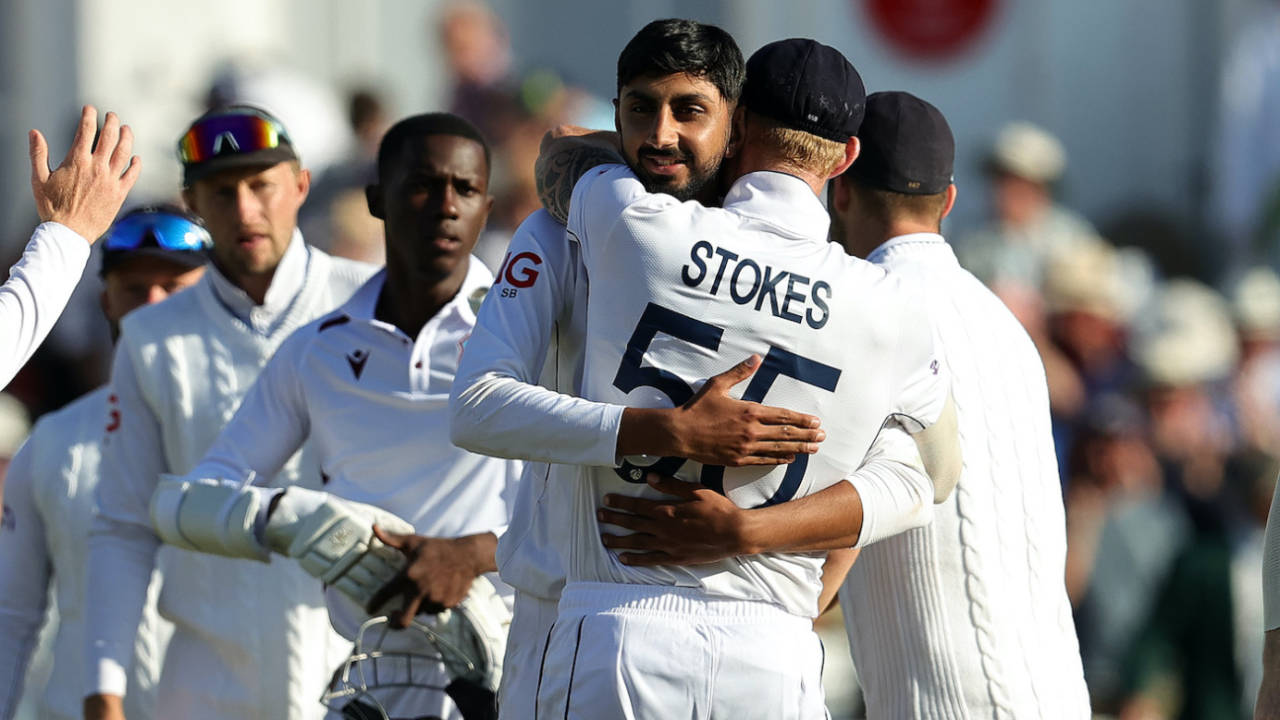
Shoaib Bashir repaid Ben Stokes' faith in Nottingham • Getty Images
Test matches (3): England 3 (36pts), West Indies 0 (0pts)
England had ended their winter tour of India chastened, and determined to improve. Head coach Brendon McCullum promised a refinement of approach, and it was evident in the way they went about a clean sweep against an enthusiastic but inexperienced West Indies. England's batsmen hardly let up, scoring at 4.73 an over, almost identical to their rate during the 2023 Ashes. But they were more controlled and clinical, and suffered fewer bad sessions. Ben Stokes said his team were playing "smarter" cricket, while McCullum claimed they were "stronger now than we may have been in the past".
The result meant England won the Richards-Botham Trophy, having lost in the Caribbean in early 2022, when it was first contested - a tour that led to Joe Root's resignation as captain, and triggered the revolution wrought by McCullum and Stokes. It also stretched to 11 the number of series these sides had played since the visiting team last prevailed (England won 3-0 in the West Indies in 2003-04).
England's desire to build for the future, specifically for Australia in 2025-26, was made plain before the series, when it was announced that the First Test at Lord's would be James Anderson's 188th and last. He made no secret of his wish to carry on, insisting he was bowling as well as ever - a view he had reinforced with a seven-for in his one Championship match for Lancashire. But England were adamant they wanted to get games into the legs and minds of a younger generation - and they were vindicated. Anderson remained in a coaching capacity, and was praised for his input.
The squad for the first two games was eye-catching for other omissions, too - Jonny Bairstow, Ollie Robinson, Ben Foakes and Jack Leach. Bairstow and Robinson had paid the price for poor tours of India, and were replaced by Harry Brook, who had missed the series for personal reasons, and the uncapped
Surrey fast bowler Gus Atkinson. Meanwhile, the fact that Foakes and Leach were viewed as first choices at Surrey and Somerset did not spare them.
England instead chose their county understudies: Jamie Smith as wicketkeeper (as well as aggressor with the bat) and Shoaib Bashir as spinner. Both proved
a success: Smith scored important runs at Lord's and Edgbaston, and kept impeccably; Bashir took five for 41, to bowl England to victory at Trent Bridge, where no male Test spinner had taken a five-for since Monty Panesar and Muttiah Muralitharan on the same day in 2006. Atkinson was the breakout star, capturing 12 wickets on debut, and 22 - at just 16 each - in the series. Not overly reliant on the new ball or extravagant swing, he displayed qualities that ought to work overseas.
No less exciting was the form of Mark Wood, who replaced Anderson in Nottingham, and bowled with such speed that it sent a frisson around the ground every time he took the ball. Though he did not get his full rewards in that game, he produced a sensational spell of reverse swing on the third day in Birmingham, taking five wickets in 21 deliveries after the ball was scuffed by a hit into the stands. No one needed convincing Wood was a threat on faster, bouncier surfaces abroad, but he now took his record in his last five Tests at home (where he had previously averaged 40) to 23 wickets at 20, which suggested a growing sophistication.
Given his own lopsided home-and-away record, Chris Woakes might have followed Anderson through the exit. But his value at No. 8, his experience, and his reputation as a selfless citizen all earned him a place that he increasingly justified, contributing 134 runs and 11 wickets, some prised out on flat pitches with the old ball. McCullum called him "a remarkable cricketer".
Perhaps most significantly, England found they could be dominant with the bat without being reckless. Fewer wickets were lost to overambition, and more effort put into the old virtue of rotating the strike rather than simply punctuating dot balls with boundaries. There was less obsession with clearing the rope: they hit only 13 sixes, with five for Smith, eager to confirm his credentials. Root benefited from the calmer mood, smoothly gathering 291 runs at 72 while striking at 65, a rate only slightly down on his previous tempo under Stokes. Ollie Pope and Brook scored a century each.
Trent Bridge, where England were pushed hardest, told the story best. They scored a similar number of runs from a similar number of balls as they had during the 2022 game there against New Zealand which properly launched their Bazball adventure, but hit 14 fewer sixes and 14 fewer fours. Despite winning by 241 runs, England needed the insurance of passing 400 in both innings - for the first time in their history - because the ground was living up to its reputation for fast scoring (Stokes said he would have preferred to set West Indies more than 385). There was also a crucial phase on the third evening, when West Indies were swinging it under lights. But Root and Brook adapted well, and survived until stumps, keeping the scoreboard ticking over without, in their captain's words, "looking like it was dot, dot, dot, smash". Stokes hailed it as a sign of progress.
There were still bursts of outrageous scoring. Ben Duckett got England off to a flyer on the first morning in Nottingham, hitting his first four balls from Jayden Seales for four, as 50 came up in a Test-record 4.2 overs. Ten days later, he and Stokes, promoting himself to open in place of Zak Crawley (who had broken a finger dropping a slip catch), equalled the record; Stokes's 24-ball half-century was England's fastest, as they chased 82 in 7.2 overs.
The captain's ability to play as an all-rounder again following knee surgery contributed to England's reset. His workload of 49 overs was his highest in a series since 2022, and he provided important support to the four frontline bowlers, notably at Trent Bridge, where West Indies batted into the 112th over. That was perhaps the one occasion when Stokes's leadership fell down, too readily dropping the field deep to Joshua Da Silva during a chaotic last-wicket stand of 71 with Shamar Joseph.
With only two Test wins in England since 2000, West Indies always faced a stiff challenge, but they were not helped by inadequate preparation - a solitary warm-up fixture against a youthful County Select XI at Beckenham. It was useful that two of their seamers, Seales and Jason Holder, had been playing in the County Championship, but Kemar Roach's early-season outings with Surrey cost him his place when he hurt his knee. Neither Alzarri Joseph, who went at more than six an over, nor Shamar Joseph had played red-ball cricket since the famous win at Brisbane in January, and some felt that Shamar would have benefited from being sent ahead to join the West Indies Academy in Ireland. In the event, he failed to reach top speed, and struggled with his fitness. To compound matters, Gudakesh Motie, the first-choice spinner, missed the Second Test through illness.
The batting, understandably, lacked know-how: only the captain, Kraigg Brathwaite, and Holder had played Tests in England before. Questions were asked about selection, though whether Shai Hope and Tagenarine Chanderpaul would have strengthened the side was a moot point. Brathwaite had come into the series short of match practice, and had a poor game at Lord's, before offering more solidity. But there were simply too many collapses: ten for 87 at the start of the First Test, ten for 82 to end the Second after West Indies had competed well for three days, and seven for 50 in the Third. Perhaps only Seales, who finished with 13 wickets, and the two Dominicans - Kavem Hodge and Alick Athanaze - who put on 175 in Nottingham, returned home with reputations enhanced.