
Sehwag's theory of relativity
Where others see risk, he sees opportunity. And he has the numbers to prove it
Apr 1, 2008, 2:56 AM
 |
|
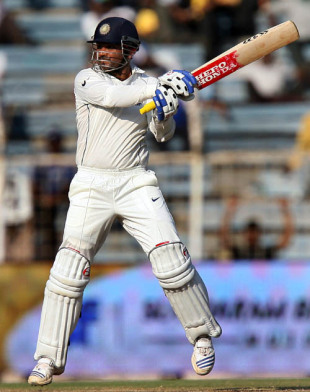
The word genius must never be used lightly, but it can be applied to Virender Sehwag's stroke-making ability. He is yet to earn the right to sit alongside Sachin Tendulkar and Brian Lara, or even Ricky Ponting, but he has an almost supernatural ability to sense a four. That's his genius.
Sehwag's batting is often associated with audacity, but I wonder if he sees it quite that way. The perception of risk in batting, or indeed in any sporting endeavour, is often directly proportionate to the sportsman's ability. Roger Federer sees winners in those deep shots that kiss the line, not risks. Similarly, Sehwag can see possibilities that don't exist for the less gifted. What appears a risk to many is for him an opportunity to create a boundary.
During the last World Cup in the West Indies, I had the chance to meet Allen Stanford, the Texan billionaire who has been pouring millions of dollars into a Twenty20 competition bearing his name in the Caribbean. I asked him why was he risking so much money without any tangible hope of return. Perhaps he had been asked the question before. "It all depends on how you look at a million dollars," he said. "What looks like a lot of money to you isn't to me. So what seems like a risk to you isn't one for me."
While watching fours rain from Sehwag's bat, I thought of that conversation. It is apparent that Sehwag sees what others are incapable of seeing. Hitting fours is not an indulgence for him. It is his lifeline, an utterly natural course for conducting his business, just as singles are for many others.
Four years ago, Wisden Asia Cricket magazine ran a cover story on India's "Fab Five" - Sachin Tendulkar, Rahul Dravid, VVS Laxman, Sourav Ganguly and Sehwag. The feature had interviews with the five players, with each talking about one of the others. Ganguly made a fascinating revelation about Sehwag. "The best way to know how [Sehwag's] mind works is to sit next to him in the players' balcony when India are batting. Every few minutes he will clutch his head and yell, 'Chauka gaya' [missed out on a four] or 'Chakka gaya' ... That's how he thinks, in fours and sixes."
All batsmen dream of and live for those perfect moments, when the mind and body align precisely and the stroke that materialises has everything right about it - balance, timing, placement. Geoff Boycott has written about such a moment in his autobiography. It was the stroke that got him his 100th first-class hundred, in an Ashes Test before his adoring home crowd at Headingley. As the ball came out of the bowler's hand, he knew it was his moment. And as he stepped out to drive it past the bowler, he felt as if he had stepped outside his body to execute the shot.
It is easy to imagine that when Sehwag gets into his zone, he has this kind of transcendental clarity ball after ball. That's a bit full on the off stump; it's going past cover. That's on a good length but a bit wide, so it can go over extra cover. Ah, the bowler has turned his wrist over, so that's a slower one; Yeh toh gayi (this one's gone).
Absolute clarity, absolute commitment, and no regrets. Nothing else can explain the big hundreds - all of Sehwag's last ten centuries have been above 150 - scored at such frenetic pace. On 195 at the MCG four years ago, he hit a full-toss from Simon Katich down the throat of midwicket. He said afterwards that he would have done exactly the same if faced with the situation all over again. Lest anyone had any doubts, he clouted Saqlain Mushtaq for six over midwicket to reach his first triple-hundred a few months later. And that wasn't even a full-toss. The bowlers must always fancy their chances when they're bowling to Sehwag; it's only that Sehwag fancies his own chances much more.
All exceptional players have this knowledge. Most batsmen good enough to play at the international level can play most strokes, but only a chosen few can play them almost at will, and that comes from knowing. Sehwag knows when he aims to belt a ball over cover, it will clear the fielder. He knows when he dances down to a spinner that he will not be beaten in flight. And he knows while employing a reverse sweep to a ball outside the offstump that there no chance that he will miss. Of course, it doesn't always turn that way, and when it doesn't it makes him look foolish, but it is important that he keeps faith in his knowledge.
His strike-rate of over 75 in Test cricket suggests a bit of madness, but Sehwag's strokes, while unorthodox in the light of the classical parameters of footwork, are absolutely pure at the point of execution. His 319 against South Africa featured only one stroke that could be described a slog - a hoick off Makhaya Ntini while he was on 193; it was mistimed but still sailed over square leg for six - the rest were cover- and square-drives, cuts, flicks, drives down the ground, and reverse sweeps that could hardly be called rash because they were thoughtfully conceived and deftly executed.
| Maybe his lack of runs against the weak teams speaks of boredom in the absence of a challenge. Sehwag is not a batsman given to milking bowling attacks. Most batsmen look on a flat pitch as an opportunity to cash in with an easy hundred; Sehwag sees a flat pitch and eyes a blistering double-hundred | |||
Also, the charge that he gets out far too often playing the wrong shot doesn't hold: that's true of all batsmen, really. Only rarely is a batsman dismissed by an unplayable ball - and more often than not, that misfortune befalls opening batsmen, a role that Sehwag found himself thrust into. In most cases batsmen, even those whose technical virtuosity is celebrated, collude in their dismissals. What is the difference between a batsman getting out because he played the wrong defensive stroke and one who is dismissed off an aggressive one? Only that a dismissal brought about by an aggressive stroke invites more scorn.
Of course Sehwag has technical limitations that can be exposed by intelligent opponents on pitches that assist seam movement or bounce. And because he plays an attacking game, he will always be less consistent than those who place a premium on survival. But he has big hundreds in almost every country, and averages nearly 54 after 92 innings, with a strike-rate of over 75 - signs of an exceptional batsman. He can't be accused of having filled his boots against Bangladesh and Zimbabwe; against those two teams his combined average is 39.80.
Maybe his lack of runs against the weak teams speaks of boredom in the absence of a challenge. Sehwag is not a batsman given to milking bowling attacks. Most batsmen look on a flat pitch as an opportunity to cash in with an easy hundred; Sehwag sees a flat pitch and eyes a blistering double-hundred. Faced with a first innings total of 540, most batsmen would think of avoiding the follow-on, but after the second day of the Chennai Test, Sehwag spoke of batting for two days and putting up 700. Anyone who has a passing knowledge of him would know that it wasn't an idle boast or posturing: it came out of true belief, and a grand vision.
Perhaps, too, therein lies the explanation for his baffling failure in one-day cricket, which led to his temporary banishment from the international scene. One-day cricket is too limited, too stifling, too rooted in percentages, to accommodate the grandness of Sehwag's vision. It can be said also that he has been too lazy to work for the singles and too rigid to adapt his game to the shorter form.
Maybe that's something we ought to be grateful for: Test cricket is Sehwag's true canvas, and there are few more thrilling, exhilarating experiences than when he paints on it with his bold strokes.
Sambit Bal is the editor of Cricinfo