| Series | Countries | Live Scores | Fixtures | Results | News |
Features
|
Photos | Video & Audio | Blogs | Statistics | Archive | Games | Mobile | ||||||||||||||||||||
|
And a tweak to the points system so that there are more outright wins

February 4, 2013
![]()
|
|||
|
Related Links
News : Three groups for Ranji Trophy, five-day knockouts
Series/Tournaments:
Ranji Trophy
| Indian Domestic Season
Teams:
India
|
|||
To stake a claim on the illustrious Ranji Trophy is no mean feat. To be able to play quality first-class cricket consistently for three months you need to put in plenty of effort into your pre-season preparation and fitness training, work on your team combinations, and ensure you have a strong bench of reserves to endure the backbreaking schedule.
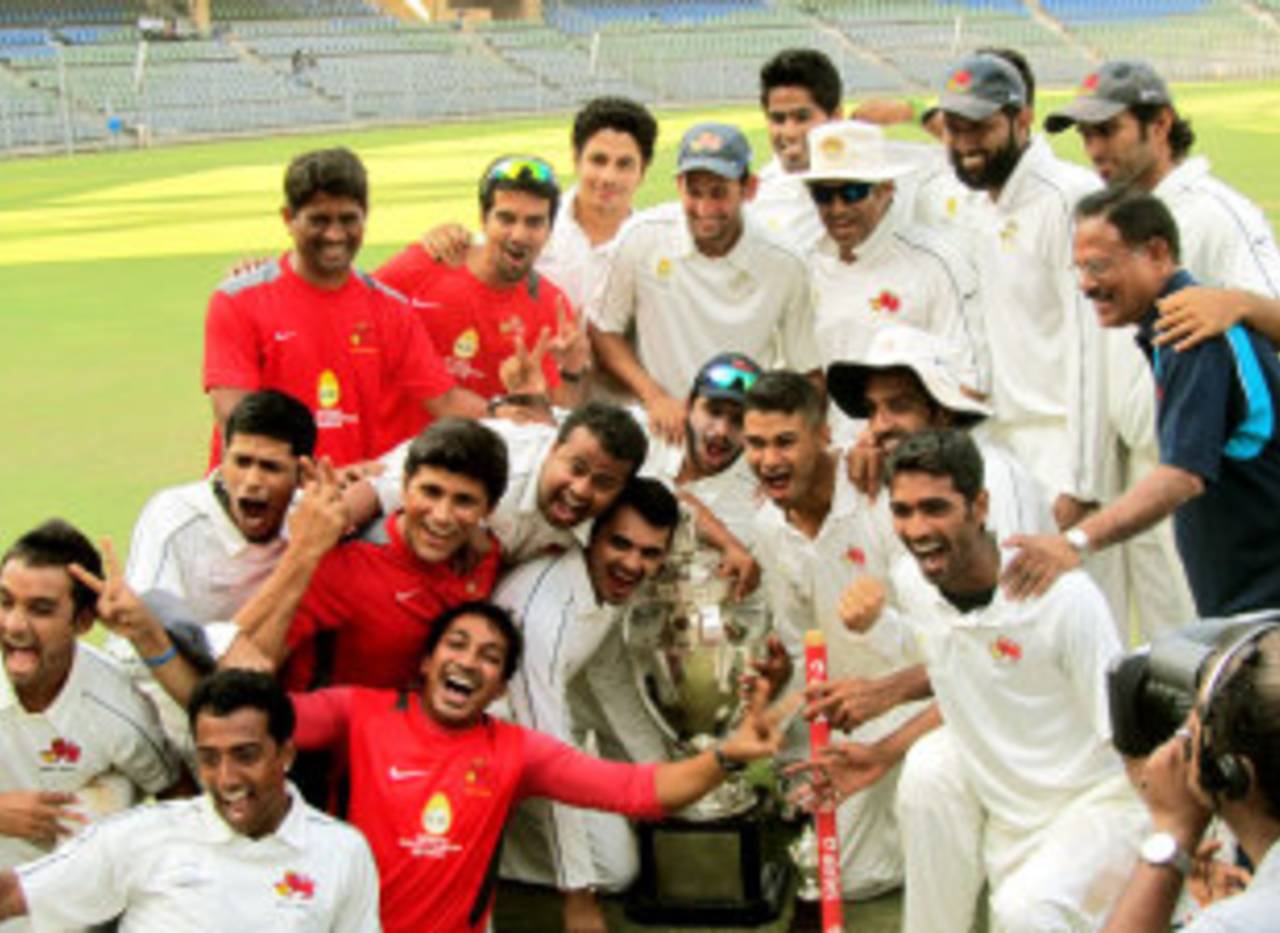
So when a team like Mumbai win the trophy 40 times - the second-best side, Delhi, haven't won half as many - other state teams should be looking at the reasons behind their successes and turning them into a blueprint to follow.
Things were a little easier till a few years ago with regards to the standard of competition and scheduling of matches, but massive changes to the tournament's rules, points system, pitches and scheduling have made winning it much more challenging today. So kudos to Mumbai for not only winning the Ranji Trophy this year, but also for reaching the finals of all the junior age-group tournaments. Undoubtedly the Mumbai Cricket Association is doing something right to be able to enjoy such consistency.
But as much as Mumbai's victories reinforce their dominance on the Indian domestic circuit, they also highlight the pitfalls in the prevailing structure.
Mumbai had only two outright wins from 11 games this season. The rest were decided on the basis of first-innings leads. There is no denying that on many occasions Mumbai must have played better cricket than their opponents to get three points for the lead, but is that how we'd like our first-class cricket to be set up - where pitches aren't good enough to produce outright results and where there is an inherent flaw in the points system, which encourages teams to get three "safe" points rather than aim for an outright win?
Pitch imperfect
Acting on the recommendations made by its technical committee, the BCCI directed curators across the country to prepare sporting pitches this season, and all matches were scheduled on a home-and-away basis.
After India's recent overseas debacles, it was imperative to take a closer look at the kind of tracks the country's young players were fine-tuning their skills on, and the consensus was that there was an urgent need to spice up pitches in India. Unfortunately it seems the curators didn't take the brief as seriously as they should have, because this season's outright win percentage of 40% is the same as last season's.
While Mohali produced results throughout the season, Rajkot had three draws and three results. And for every pitch like Mohali, we have five others like Rajkot, which is why India's below-par overseas performances shouldn't come as a surprise. After all, a player is a product of his environment.
The board needs to start penalising state associations for dishing out highways in the guise of cricket pitches. Dock the team points, slap financial penalties on the association, and treat the grounds at par with those like Karnail Singh Stadium, which was found guilty of hosting matches on underprepared pitches.
| After India's overseas debacles, the consensus was that there was an urgent need to spice up the pitches in India. Unfortunately, this season's outright win percentage of 40% is the same as last season's | |||
Not enough points
Before the season began, there was a lot of talk about changing the points system, and it was decided an extra point would be given for outright wins. While it is a noble idea to encourage teams to go for wins, the actual number of outright victories haven't gone up significantly. In fact, Mumbai found their way into the knockouts by winning only one game in the league phase.
Perhaps there's a need to add a few more points for an outright win or to revamp the points system completely to raise the level of competition. I suggested a new system for points on my blog on ESPNcricinfo.
Go back to neutral venues
The decision to play knockout matches at neutral venues was a sensible one, because otherwise the hosts have an unfair advantage. The pitch for the Ranji final between Delhi and Uttar Pradesh at the Wankhede in 2007-08 had something in it for everyone and allowed Delhi to win the game even after conceding a first-innings lead. If UP had hosted the match, they would probably have prepared a turner to take advantage of Delhi's limited spin resources.
But a few years ago, on Sachin Tendulkar's suggestion, the board decided to revert to the home-away system for knockouts to bring crowds into the stadiums. Tendulkar said neutral venues kept the teams' die-hard fans away from the grounds. But most home games are still played in empty stadiums, and now the problem of unsporting pitches has returned.
In the 2010-11 Ranji semi-final, Baroda, backing their superior spin bowling attack, dished out a dustbowl to Karnataka, who were a stronger team overall. The match lasted five sessions.
Such radical surfaces even out the playing field, but the outcome was harmful for the game. There are many such examples of hosts dictating terms at the cost of the quality of cricket.
If state associations aren't ensuring substantial footfalls, it might be prudent to host these matches at neutral venues - perhaps in tier II cities. That way not only can the pitch preparation be regulated, there will probably also be decent turnouts for the games.
This Ranji Trophy was said to be the year of transformations. But while some changes proved effective, like dividing the 27 teams into three groups of nine each so that every team got enough first-class games, others left a lot to be desired.
Former India opener Aakash Chopra is the author of Out of the Blue, an account of Rajasthan's 2010-11 Ranji Trophy victory. His website is here and his Twitter feed here
© ESPN EMEA Ltd.
| ||||||
| Comments have now been closed for this article |
||||||
Aakash Chopra is the 245th Indian to represent India in Test cricket. A batsman in the traditional mould, he played 10 Tests for India in 2003-04, and has played over 120 first-class matches. He currently plays for Delhi in the Ranji Trophy; his book Beyond the Blues was an account of the 2007-08 season. Chopra made a formidable opening combination with Virender Sehwag, which was believed to be one of the reasons for India's success in Australia and Pakistan in 2003-04. He is considered one of the best close-in fielders India has produced after Eknath Solkar.
Go Figure: S Rajesh and Andy Zaltzman explore the hidden secrets behind 222
Rewind to 1978: When the felling of a tailender by Bob Willis triggered a push for helmets. By Martin Williamson
Player education outside franchises' ambit
Amrit Mathur, Sharda Ugra and Nitin Sundar discuss the implications of the spot-fixing revelations for IPL franchises
Harsha Bhogle: Out of the shattered lives of three young men caught up in allegations of fraud, newer and stronger players must emerge
Test careers that started and finished strong
Anantha Narayanan: An analysis of how well the leading Test batsmen started and finished their illustrious careers
As we go into the last week of the league games of IPL 2013, seven teams have a mathematical chance of making the last four. Here's what each of those teams needs to do
Pollard sledges Watson, Dravid is angry
Plays of the day from the IPL match between Mumbai Indians and Rajasthan Royals in Mumbai
Unfortunate Sunrisers let match slip away
For 36 overs, Sunrisers painstakingly built a position of strength only for one terrible over to spoil it for them
A talent that didn't know its own worth
Sreesanth wasn't the most likeable team-mate or opponent, but he had skill beyond doubt, which we might have seen the last of
Kartik wins in Royal Challengers' loss
It is hazardous to go by bowlers' figures in T20, but his figures of 4-0-17-1 in defence of just 115 were possibly an accurate reflection of how well he bowled
Unfortunate Sunrisers let match slip away (73)
For 36 overs, Sunrisers painstakingly built a position of strength only for one terrible over to spoil it for them
As we go into the last week of the league games of IPL 2013, seven teams have a mathematical chance of making the last four. Here's what each of those teams needs to do
Dravid and the art of T20 captaincy (56)
Despite a small squad bereft of big names, Rajasthan Royals' captain has churned out win after win
Pollard sledges Watson, Dravid is angry (43)
Plays of the day from the IPL match between Mumbai Indians and Rajasthan Royals in Mumbai
'I have decided to return to my natural game' (39)
Misbah-ul-Haq talks about his approach to the captaincy, the criticism he has copped for his defensive style, and the lessons from the drubbing in South Africa
ICICI Bank M2I. Register Now and Get A Gift Offer.
Safe & simple online money transfer. Apply Now!
Buy Wisden 2013 & get a FREE Playfair
Available now at Cricshop
Not so sure about neutral venues for league phase but I'm all for taking the game to smaller cities. I guess the problem would be player amenities and standard of pitches there. But you cant have International and domestic games at same venues with only one match per round being televised. There would definitely be more spectator support in centres where there is less or no international cricket. BCCI's pitch monitoring leaves a lot to be desired. Ideally we shouldnt have games where even two innings arent completed. The idea is to prepare sporting tracks not necessarily hard and bouncy tracks as we need players who can excel on all kinds of pitches for who would have thought Indian batsmen would struggle against quality spin of visitors as happened in Mumbai test. First innings lead and victory shouldnt have difference of just 2 points, victory is more important. btw, Mumbai this year won as they played knockouts better but must thank MP for giving them 5 points instead of one.
Aakash,
Thanks for the article. I am not sure I agree with you on the neutral venues. I do agree with Tendulkar's suggestion that it is important to host matches in a location where the home team's fans can actually watch them. I understand that it is a bit unfair to the away team although in that sense it is no different from the national teams that play at home (and ask for pitches that suit their bowlers) and away (where they are bound to get pitches that may not suit their bowlers). You need to have the skill in all departments of the game to win. So, if Karnataka lost the semi-final in 2010-11, their spinners were not as good as Baroda's and their batsmen were not as good players against spin as Baroda's were. I looked at your blog for point suggestions and I thought that was too complicated. Perhaps, a simple suggestion to get more outright results would be to restrict the number of overs to a max of 125 per innings for a 4-day game or 150 per innings for a 5-day game.
No neutral venues. As is these games are played to nearly empty stadiums even when international players drop in once a while. On the other hand, I suggest all domestic matched be played either at one of the team's home turf to generate some interest for "home" fans.
Posted by here2rock on (February 5, 2013, 22:34 GMT)You are suggesting something which is never going to be possible. The competition needs a change in format from 4 to 5 days, very few or almost no points for first innings and huge points for a result game.
Posted by Nampally on (February 5, 2013, 21:32 GMT)Aakash, Indian Women's Team elimination from WC ODI's clearly demonstrates that the Home team advantage is secondary. A good team wins whether on neutral or away or home ground whilst a poor team loses on any ground. So the talk of neutral grounds is a mute point. As regards the Ranji trophy format, I had suggested 100 over/innings format in my earlier input. The main intent was decision orientated. If 100 overs is too much to bowl in a day cut it down to 85 or 90 over innings. When you play say 85 overs innings, one side has to win which ever side scores more runs over 2 innings. The points are only scored by the winning team. Number of points alloted does not matter- say- 2 for win & zero for loss. This approach is much better than the present one which leads to more draws than decisions. Also the first innings lead is more important on flat wkts. In addition, the nature of pitch does not matter because at the end of Day 4 one side wins.
Posted by iyers on (February 5, 2013, 8:15 GMT)Time and again we have read and heard you Aakash that Mumbai has only won 2 games outright. Are we at all looking at those wickets where Mumbai played all their matches? Can you highlight a single match where they could have pressed for the victory button? And this rule of points from First Innings lead is common for all the team, why single our Mumbai. For us proud Mumbaikars, we played SMART, HARD and When it mattered the most we delivered.
Posted by Nampally on (February 4, 2013, 21:41 GMT)Aakash, before we talk about the Neutral grounds, the Ranji trophy format has to be changed. Mumbai reached Final based on Just One outright win. Does it justify winning Trophy mostly on first innings leads? My suggestion is to play all the Ranji matches except the Final on 100 overs/innings basis over 4 days. This makes the Cricket brighter & gives equal chances to both the teams to fight it out with emphasis on brighter cricket on mostly Flat wickets. If Ranji Trophy games need to be the basis for selection Indian teams, there should be meaningful games over 2 innings not just first innings lead. It has reduced Ranji matches into a Farce. Teams like Hyderabad -who perform poorly whether they play at home or away. Home team advantage is a misnomer. A good teams performs well whereever they play. Take recent examples of Pakistan beating India in India in ODI's & England beating India in India in the Tests. How does India justify the Home team advamtage with such miserable Failures?
Posted by BeingCricketFan on (February 4, 2013, 17:26 GMT)sir how about devideing teams into 2 groups rather than 3.. Giveing 3 points for win, 1 for draw & 0 for loss, should stop giveing points for 1st innings lead (because of this lot of teams try for 1st innings lead rather then going for result). Top 2 teams from each group will play in semi-finals.. Also Associations should make sporting wickets rather then rank-turners or flat decks.. About Neutral venues: not only knock-outs but atleast 25% of each teams league matches should be played at neutral venues, specialy in small cities so that game gains more popularity.. Also BCCI & Associations should try to promote the league/game just like IPL..
Posted by arun_padmanabhan on (February 4, 2013, 15:23 GMT)About 8-9 matches are played in each round. I would suggest BCCI discuss with the broadcasters beforehand and finalise one match for each round, which will be broadcasted. Other matches should be played in smaller venues. The matches played at Mysore, Hubli, Ghaziabad re-iterate my point. This will help bring more crowds. IMO, the problem of poor pitches can be solved if all the state-employed curators are brought into a pool headed by a chief curator and they all be answerable to the BCCI instead of the state associations.
Posted by crkt4evr on (February 4, 2013, 14:50 GMT)A CHOPRA has very good cricketing mind his articles are well thought and have PURPOSE! so thank you about pitches its tough to conclude on a simple solution( it has lot complexities ) but points system has an easy solution let a draw mean share of points(no points if you are very serious about results) if teams are on same points they can be differentiated by the no of wkts taken by them if its a tie even then you can fall back on NRR