
No strain, plenty of gain
The career of Bruce Reid, a cautionary tale in Australian cricket, has not been forgotten by those seeking to preserve the latest crop of young fast men

Daniel Brettig
Feb 5, 2013, 1:37 AM
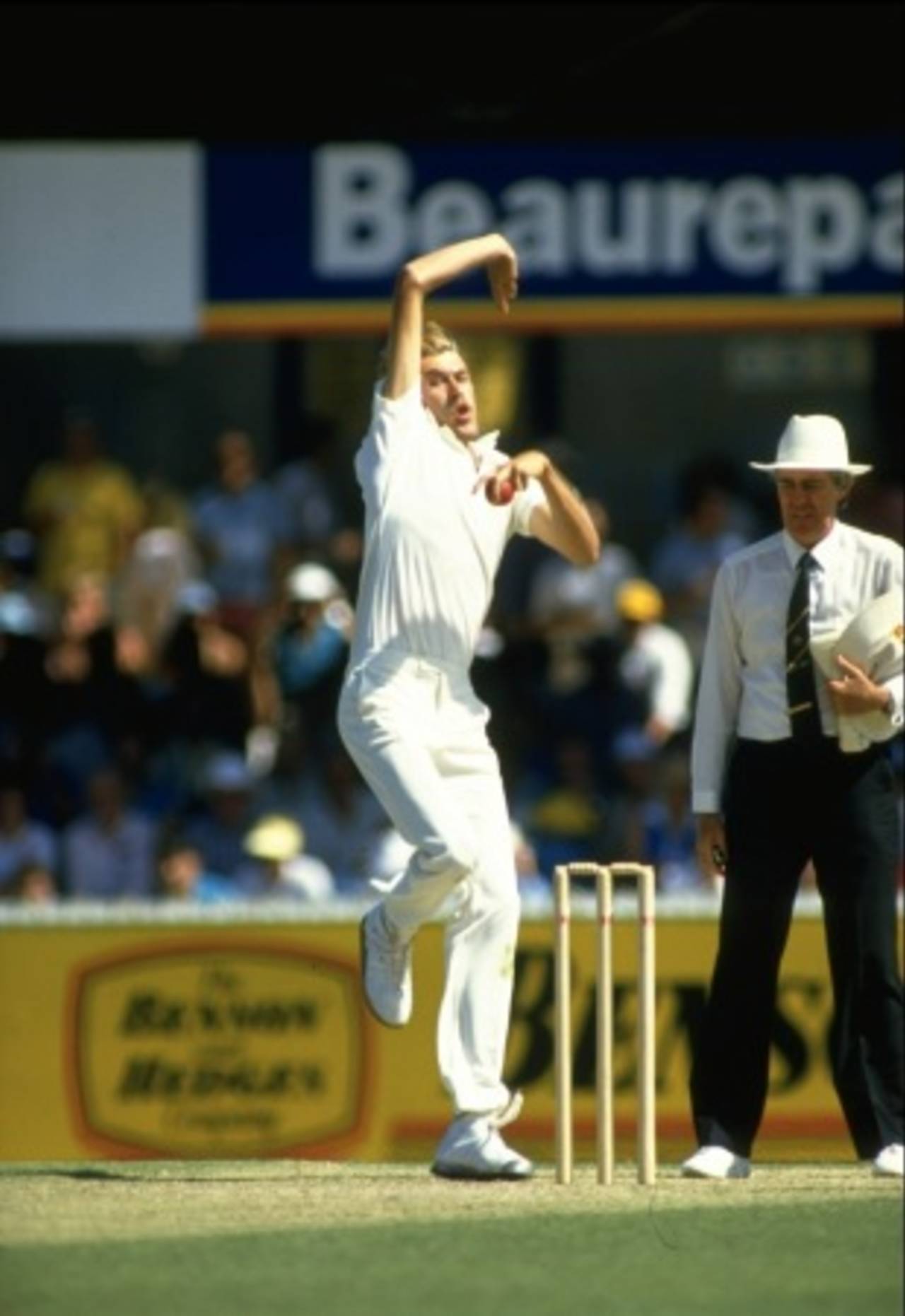
Bruce Reid only managed 12 Test appearances after he broke down at the age of 24 • Getty Images
Bruce Reid. The mere mention of his name conjures memories and regrets, of a rare Australian pace-bowling talent apparently cursed by a slender body and a haplessly fragile back. Billy Birmingham may have immortalised him as the fast bowler who "snapped in half", but Reid's Test digits were startling enough - 113 wickets at 24.63, strike rate 55.20 - without a comedian's touch. They gain gravity and tragedy when you add the fact that Reid played the last of 27 matches in 1992. He was 29.
Consider for a moment the words of Bob Simpson, the national coach for most of Reid's career: "My biggest 'if only' is Bruce Reid. If he had stayed fit, there is no doubt at all that Australia would have been recognised as world champions two or three years before we were able to claim that position, simply because he was a great bowler, one of the finest bowlers I have ever seen."
Like most at the time, Simpson considered Reid's demise to be unavoidable, reasoning that Reid and his doctors did all they could to reinforce his body and his back.
It was a popular view that Reid was simply too fragile for his craft. There was more to it than that, of course, as Reid himself has alluded at times. His early career has become, alongside those of Dennis Lillee, Craig McDermott and Jason Gillespie, a major influence on the path trodden by Australia's coaching and medical staff to develop the likes of James Pattinson, Mitchell Starc, Josh Hazlewood and Pat Cummins. Avoiding a repeat of the Reid case study is at the forefront of their minds.
Perhaps the greatest misconception about Reid is that he was injury-prone from the start. When asked about him recently, one former Australia fast bowler and sometime Test team-mate of Reid's exclaimed, "He never played two Tests in a row" as though it were incontrovertible fact. The truth is quite different. Before he started to become a frequent visitor to hospitals and orthopaedic surgeons in late 1987, Reid played his first seven Tests in succession and 15 of a possible 16 before he broke down against New Zealand with the first of innumerable back complaints. During that time, he also played 41 ODIs.
When he left the field on the first day of that Adelaide Test match, Reid was 24 years old. From there he would play only another 12 Test matches and 20 ODIs over five years. In between, recurring and debilitating problems forced the removal of two discs from his back and the insertion of a metal plate.
Those few matches included Reid's greatest days as a Test bowler: 13 Ashes wickets against England at the MCG in 1990 and 12 against India on the same ground a year later. But his appearances became increasingly sporadic, as other parts of his body broke down due to the changes made to his action to lessen the pressure on his rebuilt back. The damage, regrettably, had been done.
The early demands on Reid were heavy for any bowler, let alone a young paceman with a slender and still growing body. Partly due to his early aptitude for Test match bowling, partly due to the paucity of options left to the national selectors due to the rebel South Africa tours, Reid was cast as a stock bowler well before his frame was entirely ready for the task. It is highly likely those early exertions, un-tempered by a wider plan, contributed greatly to the injuries that would blight him later on. Reid has noted ruefully that he played in an era when there was not much science or precision to training methods either.
"We were in that era where it was semi-professional. We weren't earning the big bucks they're earning now. Some of us were still working, then trying to go to cricket and play and try to fit in as much as you could," he said in a 2010 interview. "In the old days, if the boys ran 15 laps around the oval then everyone did it, and you were expected to run time trials at the same pace as the batters and all that sort of stuff. It's a lot different now, where things are done to suit every body shape, and there's no doubt that would've benefited not only me but probably a lot of guys in that era."
A comprehensive review of the formative years of fast bowlers is one of the less-trumpeted but more valuable pieces of work conducted by Cricket Australia's team performance regime. In their research, which covers the past 40 years, the bowling undertaken by pacemen up to the ages of 23-25 is placed in the sharpest focus. The data suggests, overwhelmingly, that bowlers are likely to face a range of injury problems until their bodies mature fully, around the time they turn 25. "We've got data showing us that fast bowlers are very resilient between the ages of 25 and 30 - that's when they're at their best," Alex Kountouris, who has been working as a physio with the national team since 2003, says. However, it is quite possible that by overloading a young bowler, his body can be scarred to a point that even after 25 is reached, injuries will worsen.
Kountouris spoke of how Reid and others provided priceless knowledge about what can befall a young bowler if pushed too hard, too soon. In the cases of Starc and Pattinson, careful management is particularly necessary, for they have already reached a volume of Test-match bowling at a young age that only four other Australia bowlers had reached since 1970.
"Mitch Starc and James Pattinson are both around 23 and they're in a group that have bowled the most deliveries in Test matches at that age in the past 40 years," Kountouris says. "Those others are Craig McDermott, who is way above anyone else after debuting at 19, Dennis Lillee, Jason Gillespie, and Bruce Reid. The interesting thing about that is, Gillespie, Lillee and Reid all had injury problems in the years subsequent to that, and Craig was done by 31.
"We've got history behind us saying this is what happens when these guys get to this age, so be careful. So we're trying to look after them. As far as how we do that, no one's got a magic bullet for it, it's something we're learning about. But our goal is not to go down the same path as what happened in the past. Craig retired at 31 - we'd like to think our guys are going to go for a bit longer than that, and that's what the expectation is these days."
This is the statistical and historical background to why Starc and Pattinson have their bowling workloads and progression from format to format monitored closely by Kountouris; the team performance manager, Pat Howard; and the pace bowling coach, Ali de Winter. It is also why Howard and the Sydney Sixers fell out last year over Pat Cummins' bowling at the Champions League Twenty20 in South Africa, when the 19-year-old complained of back soreness during the event but played on until its conclusion, whereupon a stress fracture was revealed.
"Before the age of 25 they're prone to having certain injuries, after 30 they're prone to certain injuries, and we see that players fade away," Kountouris says. "But that period, the sweet spot, is where players are at their best. There's a couple things that happen: one, their bodies have matured; two, they have a history of bowling, they've built up their workloads and they've got a good base because they've done it from the age of 20-25.
"But also they're more experienced and they know their bodies well. So any athlete in that age group knows when to go hard and when to back off. That's no different to Peter Siddle, Ben Hilfenhaus, Mitchell Johnson, who are all around that age group and all very reliable. It's not necessarily individualised to a particular player, it's just that Jason Gillespie at 28 is better than Pat Cummins at 19. Will Pat be as good as Jason Gillespie at 28? We'd like to think so."
Johnson's slingy, streaky action will always ensure he holds an enigmatic place in Australian cricket. But in terms of longevity, he fits the profile of a young bowler battling injuries before developing into a reliable campaigner, at least physically, in adulthood. From an early point when he was considered too injury-prone to hold a state contract, Johnson matured into a constant presence in Australia's team from 2007 to 2011.
"He played 46 Tests straight, he played 110 ODIs, and that's as good as anyone in the history of the game for durability," Kountouris says. "We know when they get to a certain age, they've built this tolerance, and we don't know exactly what it is, but for whatever reason they become resilient at that age. It's our job to get the young guys to that stage as injury-free or as smoothly as possible.
"It's like having a 15-year-old, and saying, 'I know he's going to grow but I want him to be six foot four, can he hurry up and be that height?' He will get there eventually because he's tracking to be that height, but it's not going to happen before time. And that's what we're finding at the moment."
Such thinking arrived too late for Reid's generation, leaving his story as a cautionary tale for the current coterie of sports scientists, coaches and medical staff to learn from. But there is one area that Reid did not have to contend with - the leap from T20 to Test matches and back again, which Kountouris admits is the greatest challenge facing those seeking to adequately prepare cricketers in general and fast bowlers in particular.
"We've now got a Champions League before the start of our domestic season, and a Big Bash in the middle of our domestic season, and those tournaments alone don't do anything but it just creates a reshuffling of games," Kountouris says. "Bowlers' workloads go from really low to really high, so it is a significant challenge. And it is new, it is something that's only been around in this volume for the last couple of years. And we're learning from our experiences, we're getting better and we have to get better managing it, because it's part of life.
"I recently bumped into a former AFL footballer and coach, now commentator, and he said, 'What's amazing about your sport is it's like playing three different sports at the same time. It's unbelievable.' He's from outside the game and he saw it as T20, one-dayers and Tests are all virtually different sports, and we're trying to juggle them at the same time. Some guys are trying to play all of them, some are trying to play one, some two, and it is something unique to cricket."
Among the problems presented by the T20 age is the lack of history from which to form a method for better practice. In that way, Starc, Pattinson and Cummins are unwitting case studies for future generations, just as Reid once was. It is to be hoped none of them are snapped in half by the schedule.
Daniel Brettig is an assistant editor at ESPNcricinfo. He tweets here