
The gathering storm
In 1939 the entire summer was overshadowed by the escalating crisis in Europe

Martin Williamson
04-Sep-2009
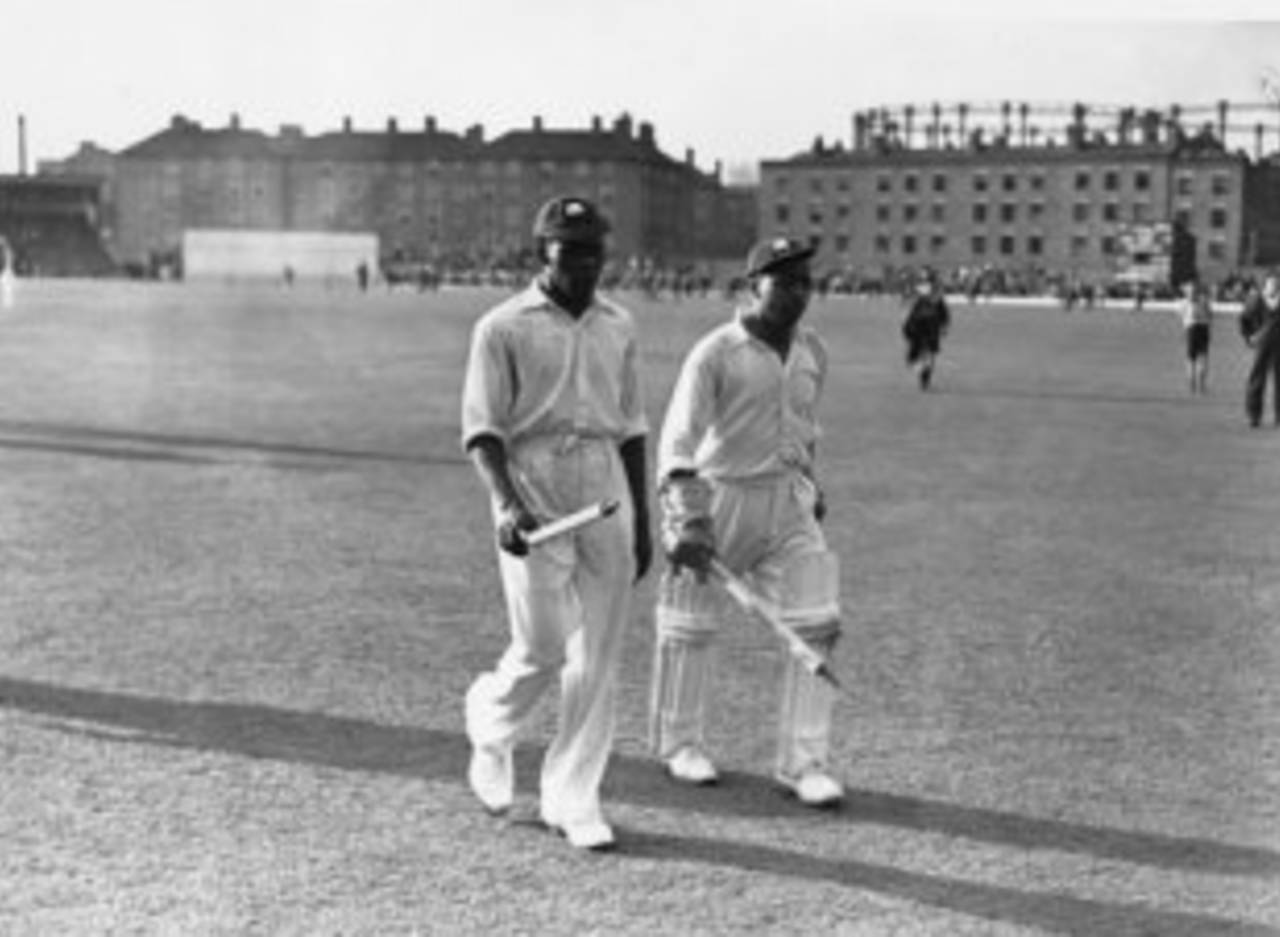
Manny Martindale and Derek Sealy leave the field at the end of the Oval Test. Within a matter of days the West Indies team was heading home after cancelling the remainder of the tour • Getty Images
Unlike the 1914 season, when it took military reverses rather than the outbreak of war itself to bring cricket to a close, in 1939 the entire summer was overshadowed by the escalating crisis in Europe.
The political situation had been deteriorating ever since the previous autumn, and by the spring few harboured hopes that war with Germany could still be avoided. The only uncertainty was when it would start. Two days before the start of the first-class season the government introduced conscription; the mass evacuation of children from the major cities started in June; and from February the authorities had been issuing Anderson shelters in preparation for anticipated air raids.
Against this backdrop, the cricket season rumbled on largely unaffected. The main subject of debate was the experiment with eight-ball overs which was used in first-class and club cricket, but not at schools level. More than 16,000 watched the University match at Lord's in early July, but a fortnight later the attendance for Eton v Harrow was well down as the political situation deteriorated.
The West Indies proved popular tourists despite losing the three-match Test series. George Headley was supreme, scoring 1745 runs at 72 including a hundred in each innings of the Lord's Test.
By August it was apparent that war was inevitable and preparations became more frenetic. The final Test at The Oval finished on August 22, but it was soon apparent that the remainder of the West Indies tour was a non starter. On August 24 the management received a telegram from Kent advising them the game due to start on August 30 might have to be cancelled, and as a result a decision was taken there and then to scrap the remaining games lest the team become caught up in the conflict. The bulk of the squad headed to Glasgow to catch a boat back to the Caribbean. The journey was eventful, with reports of U-boat sightings, and some of the team did not reach their homes until November.
The County Championship rumbled on, but crowds declined markedly and players and officials found it increasingly difficult to travel to games as trains were commandeered by the military and all but essential road transport was barred. At Lord's, Neville Cardus covering MIddlesex v Somerset for the Guardian wrote how a small crowd "hugged the days pleasures to their hearts while they lasted".
The penultimate round of Championship matches started on August 30, the same day Germany began mobilising for the invasion of Poland. The Guardian reported that the many valuable paintings inside the Lord's pavilion were "being taken down ready for removal to a place of safety".
Cricket was not alone in continuing against an increasingly surreal backdrop. A full round of football league matches took place on September 2, albeit with poor crowds across the board, and some race meetings were staged with the St Leger meeting only called off after war had been declared.
As the games rumbled on, there were regular announcements of cancellations of the traditional end-of-season festival matches. At Old Trafford, the third day of the game between Lancashire and Surrey, already switched from The Oval as the ground had been requisitioned by the military, was abandoned "because of the deteriorating international situation". The tortuous journey suffered by the Surrey team on the way to Manchester may have played a part in the decision.
Only one game continued into a third day, the match between Yorkshire, the champions, and Sussex. The Yorkshire committee had sent a telegram on the second evening suggesting it be abandoned, but Brian Sellars, the Yorkshire captain, refused, countering his players wanted to honour Jim Parks' benefit match. Sussex might have wished it had been called off as they were bowled out for 33, Hedley Verity, who was to die in the war, taking 7 for 9 as Yorkshire won by ten wickets.
The Yorkshire players still faced a difficult return journey as no private cars were permitted to be used south of Birmingham, while trains were packed with the military heading south and evacuees going to the west and north. Eventually the committee sanctioned the hiring of a coach to get the team back home.
By then, the three outstanding Championship matches scheduled to start on September 2 and 4 had been cancelled. On Sunday September 3, Britain declared war on Germany. Twenty-four hours later the MCC reluctantly cancelled its tour of India due to get underway in October.
The phoney war that followed over the winter of 1939-40 led to renewed discussions among the authorities about the feasibility of staging some competitive county cricket in 1940, although ongoing difficulties in even the most straightforward train journey made anything other than a regional competition unrealistic. "Optimism is one thing," Wisden countered. "So is sense."
In January 1940, the MCC in effect scuppered plans by announcing it had no intention to organise any formal matches. Within months the war had taken a much more serious turn, making the decision all the more sensible.
The counties themselves, with no income from spectators but many fixed overheads, appealed to members to continue to pay their subscriptions, albeit at a much reduced rate for those serving with the forces. Most did, with the result that when cricket resumed after the war, all the 17 counties had survived.
There were no first-class matches in England until 1945, although unlike World War One there was a considerable amount of good quality cricket played in matches across the country featuring leading players.
Is there an incident from the past you would like to know more about? Email rewind@cricinfo.com with your comments and suggestions.
Bibliography
The Lost Seasons by Eric Midwinter (Methuen, 1987)
The Lost Seasons by Eric Midwinter (Methuen, 1987)