
Planning amid the mayhem
How teams go about strategising in the shortest format of the game

Aakash Chopra
19-Nov-2009
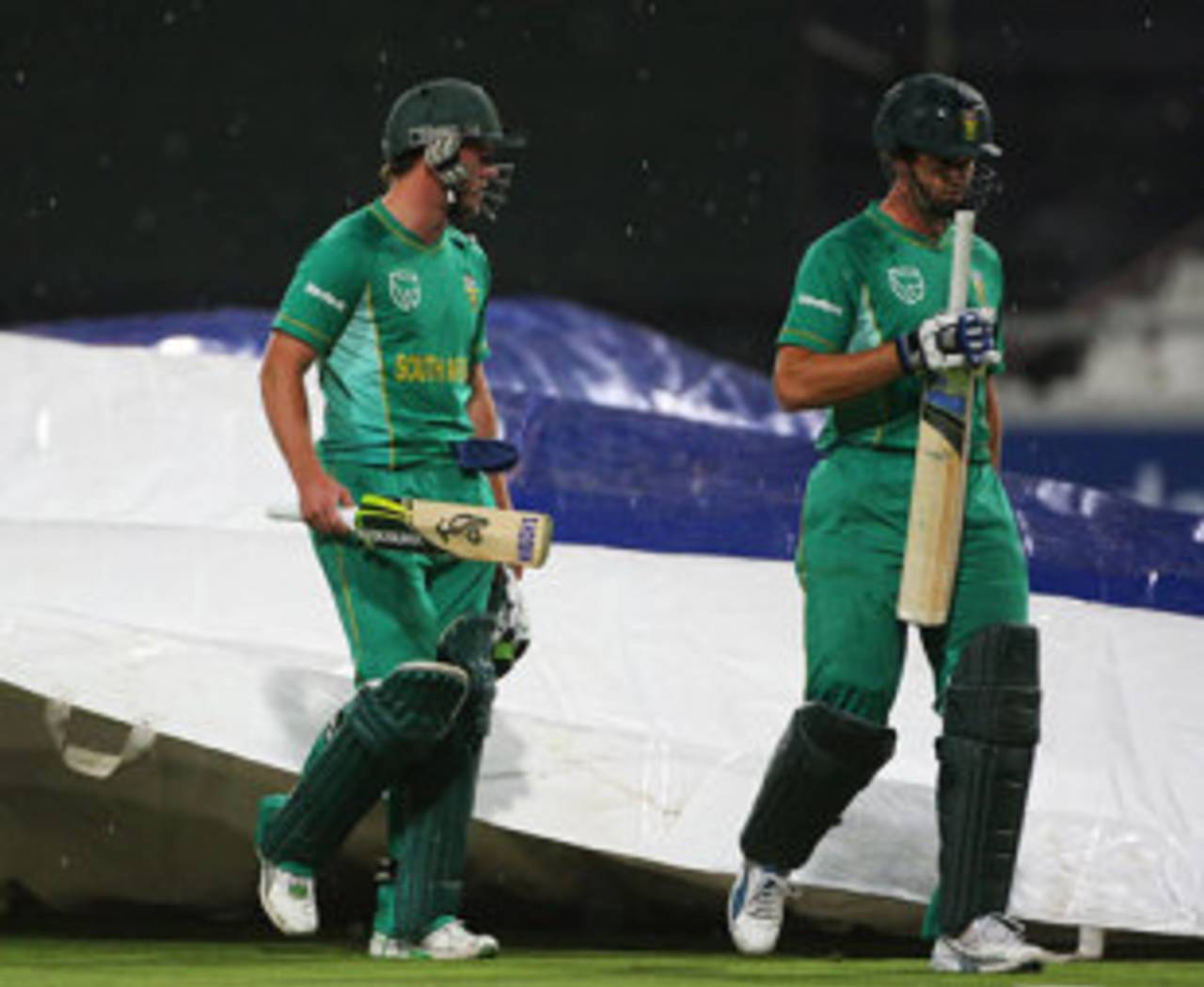
Put in a big Twenty20 target, throw in uncertain weather, and you have a planner's nightmare - as South Africa realised last week • Getty Images
Following the two World Twenty20s, the two seasons of the IPL and many other Twenty20 matches, one would assume that teams and players would have identified a way of doing things in this format. Though some might argue that it's still a game of cricket and hence should not be treated any differently, people who play the game realise that all formats follow individual patterns, with a few variables here and there.
Initially Twenty20 was perceived as a 20-over slog and most teams made the mistake of going too hard right from the beginning, and hence losing wickets, and their way.
Powerplay
Yes, there are field restrictions in the first six overs and one must try to take full advantage of them. But teams who lose more than two wickets in the first six overs more often than not seem to end up on the losing side. Hence the crucial question in this situation is: do you attack the bowling right from the start or keep a cautious approach while the ball is new?
Yes, there are field restrictions in the first six overs and one must try to take full advantage of them. But teams who lose more than two wickets in the first six overs more often than not seem to end up on the losing side. Hence the crucial question in this situation is: do you attack the bowling right from the start or keep a cautious approach while the ball is new?
Most teams have agreed that while they must capitalise on field restrictions, it should be achieved without losing too many wickets. Teams usually assign roles to the batsmen in the middle, as part of strategy. For example, in the first IPL, we at Kolkata Knight Riders gave Brendon McCullum the license to go berserk in the first six, while the batsman at the other end was supposed to make sure McCullum got majority of the strike. If McCullum got out, the team would send another hitter, and a grafter in case the other batsman lost his wicket.
Bowlers also have designated roles to play. Ishant Sharma, and briefly Shoab Akhtar, were allowed to go for a few runs in the first six overs in order to take wickets.
Conditions
The way a team approaches the first six overs depends a lot on the conditions.
The way a team approaches the first six overs depends a lot on the conditions.
In the subcontinent the new ball doesn't move around much, hence the risk of getting out is relatively smaller than in South Africa, England or Australia, where the conditions are different.
Secondly, once the ball gets old in subcontinental conditions, it starts gripping the surface, and it gets tougher for batsmen to clear the fence consistently. So the order of the day in such circumstances would be to maximise the first six overs.
On the other hand, barring the worn-out South African pitches in second edition of the IPL, and slow tracks in the West Indies, batting becomes easier on most pitches in the rest of the world as the game goes on. So a more cautious start would be the more viable option in those cases.
Strengths
Teams play to their strengths. Some are top heavy and some rely on their hard-hitting batsmen to finish the innings strongly. Teams like Delhi Daredevils, with Gautam Gambhir and Virender Sehwag, and Kolkata, with Chris Gayle and McCullum, rely on capitalising on the field restrictions, while teams like Chennai Super Kings look to keep wickets in hand for the final assault by MS Dhoni, Jacob Oram, Albie Morkel and Co.
Teams play to their strengths. Some are top heavy and some rely on their hard-hitting batsmen to finish the innings strongly. Teams like Delhi Daredevils, with Gautam Gambhir and Virender Sehwag, and Kolkata, with Chris Gayle and McCullum, rely on capitalising on the field restrictions, while teams like Chennai Super Kings look to keep wickets in hand for the final assault by MS Dhoni, Jacob Oram, Albie Morkel and Co.
Once the ball gets old in subcontinental conditions, it starts gripping the surface, and it gets tougher for batsmen to clear the fence consistently. So the order of the day in such circumstances would be to maximise the first six overs
The middle overs are utilised to either carry on the momentum or to build a platform for one final assault in the final four overs. Matches are neither won nor lost in these middle overs - high-scoring games being an exception. It's unreal how many runs teams manage to score in the last three to four overs if they have wickets in hand.
Chasing or setting a target
The strategy for chasing a target differs from the one followed while batting first. Teams can afford to leave it until late in the innings if they are setting a target, but while chasing they must keep tabs on the asking-rate, or else one economical over can change the equation. In some cases, like in the rain-affected game between England and South Africa last week, there aren't too many options for the side batting second. South Africa were chasing over 200 runs, which could have been achieved by only one strategy: to go after the bowling from the first ball and keep it going till the end.
The strategy for chasing a target differs from the one followed while batting first. Teams can afford to leave it until late in the innings if they are setting a target, but while chasing they must keep tabs on the asking-rate, or else one economical over can change the equation. In some cases, like in the rain-affected game between England and South Africa last week, there aren't too many options for the side batting second. South Africa were chasing over 200 runs, which could have been achieved by only one strategy: to go after the bowling from the first ball and keep it going till the end.
Being realistic
Twenty20 cricket has forced bowlers to shed their pride. Now you see the wicketkeeper standing up to almost all medium-pacers - which a lot of bowlers used to consider an insult till recently - to prevent batsmen from walking down the track. Only the really quick men can afford to have the wicketkeeper back throughout. And even they have started placing third man inside the 30-yard circle while bowling slower deliveries and yorkers on the leg stump. The chances of the ball going towards third man are minimal with both those deliveries if executed properly.
Twenty20 cricket has forced bowlers to shed their pride. Now you see the wicketkeeper standing up to almost all medium-pacers - which a lot of bowlers used to consider an insult till recently - to prevent batsmen from walking down the track. Only the really quick men can afford to have the wicketkeeper back throughout. And even they have started placing third man inside the 30-yard circle while bowling slower deliveries and yorkers on the leg stump. The chances of the ball going towards third man are minimal with both those deliveries if executed properly.
Taking responsibility
Kolkata and John Buchanan were criticised by all and sundry for the multiple-captain theory, but if applied properly it isn't such a bad idea. Every captain and coach encourages his players to think and act as a captain. Batsmen, since they are always alone in the centre, are used to doing this. The endeavour is to also encourage bowlers to think along the same lines. With the pace at which this format runs, the bowler should not be expecting the captain or anyone else to adjust the field, but should take the lead and do it themselves.
Kolkata and John Buchanan were criticised by all and sundry for the multiple-captain theory, but if applied properly it isn't such a bad idea. Every captain and coach encourages his players to think and act as a captain. Batsmen, since they are always alone in the centre, are used to doing this. The endeavour is to also encourage bowlers to think along the same lines. With the pace at which this format runs, the bowler should not be expecting the captain or anyone else to adjust the field, but should take the lead and do it themselves.
To be honest, I don't think there is what you can call a set winning strategy or a pattern in this format. While the players continue to find their feet in this latest offshoot of traditional cricket, it is perhaps the absence of a predictable pattern that continues to attract people to Twenty20.
Former India opener Aakash Chopra is the author of Beyond the Blues, an account of the 2007-08 Ranji Trophy season. His website is here