| Series | Countries | Live Scores | Fixtures | Results | News |
Features
|
Photos | Blogs | Statistics | Archive | Video & Audio | Games | Mobile | |||||||||||||||||||||
|
You could watch the bowler's wrist, the seam position, the side of the shine, but still not cover all eventualities. Pity the batsman a little, won't you?

February 25, 2010
![]()
|
|||
|
Related Links
News : Paced to perfection from Steyn
Analysis : Striker Steyn floors India Players/Officials:
Shane Bond
| Rahul Dravid
| Jason Gillespie
| Zaheer Khan
| Glenn McGrath
| Mohammad Asif
| Dale Steyn
Matches:
India v Australia at Nagpur
Teams:
India
|
|||
While the world sat admiring Dale Steyn's swing bowling, which caused India's capitulation in Nagpur, the batsman in me couldn't help but feel sorry for our lot. Steyn was impeccable with his line and length, crippling even the best in the line-up. As he showed his calibre with a seven-wicket haul, I wondered if anybody spared a thought for how batsmen feel when the ball is darting around.
Why did Murali Vijay and Wriddhiman Saha shoulder arms when the ball was coming in? Why did Sachin Tendulkar play at the one going away only to nick it to the wicketkeeper?
It's harder to judge a swinging delivery than it looks. For one, it requires a lot of guesswork. Even the most skilled batsmen in the world rely on their instincts and years of practice to gauge where the ball will end up when it reaches them. There is no device to tell you the ball will move x inches in the air after release and y amount after pitching. And if the ball is moving at 145kph, the time to assess becomes shorter and the margin of error smaller.
There are certain things that a batsman keeps in mind while preparing to play the new ball. It helps if you have played the bowler in the past or if there is some video data to structure your game plan. If you're up against Matthew Hoggard or Brett Lee, who swing the ball away from the right-hander, you draw an imaginary line outside off stump and leave alone all balls that pitch outside that line. In fact, you have to play well within that line to cover the movement in the air and off the surface. You can't play balls outside off stump with a straight bat, for it doesn't cover for swing - you would probably end up nicking it to the keeper. You have to play with a slightly horizontal bat, which ensures that you cover the movement. A good example of covering for swing with a not-quite vertical bat would be Michael Vaughan's drive on the off side. In this case, the batsman is beaten only when the bounce is more or less than expected.
However, you will need to play with a straight bat when you're up against someone like Shane Bond, who swings it back into right-hander. Not just that, you'll also have to play late and close to the body to ensure there is no gap between the bat and pad.
Whether the ball is moving away or coming in, you need to constantly judge the amount of movement a bowler will get.
Be watchful of subtle changes in the bowling action, wrist and seam position, and the bowler's use of the crease. Bond and Makhaya Ntini, who predominantly get the ball back into the batsmen, bowl from wide of the crease to use the angle. Outswing bowlers, on the other hand, prefer bowling from close to the umpire, for that allows them to start their line from the middle stump, the better to be able to get the batsman to play at it.
Then there are bowlers like Shaun Pollock and Praveen Kumar, who though they bowl close to the stumps are able to move the ball both ways. And if that wasn't hard enough to read, bowlers set batsmen up by bowling outswingers from the corner of the crease and inswingers from close to the stumps.
The wrist position is a good indicator of the way the ball will come out of the hand. Ishant Sharma tilts his wrist to push the ball inwards, while Zaheer Khan and Steyn bowl with a straight wrist, which allows them to swing the ball both ways.
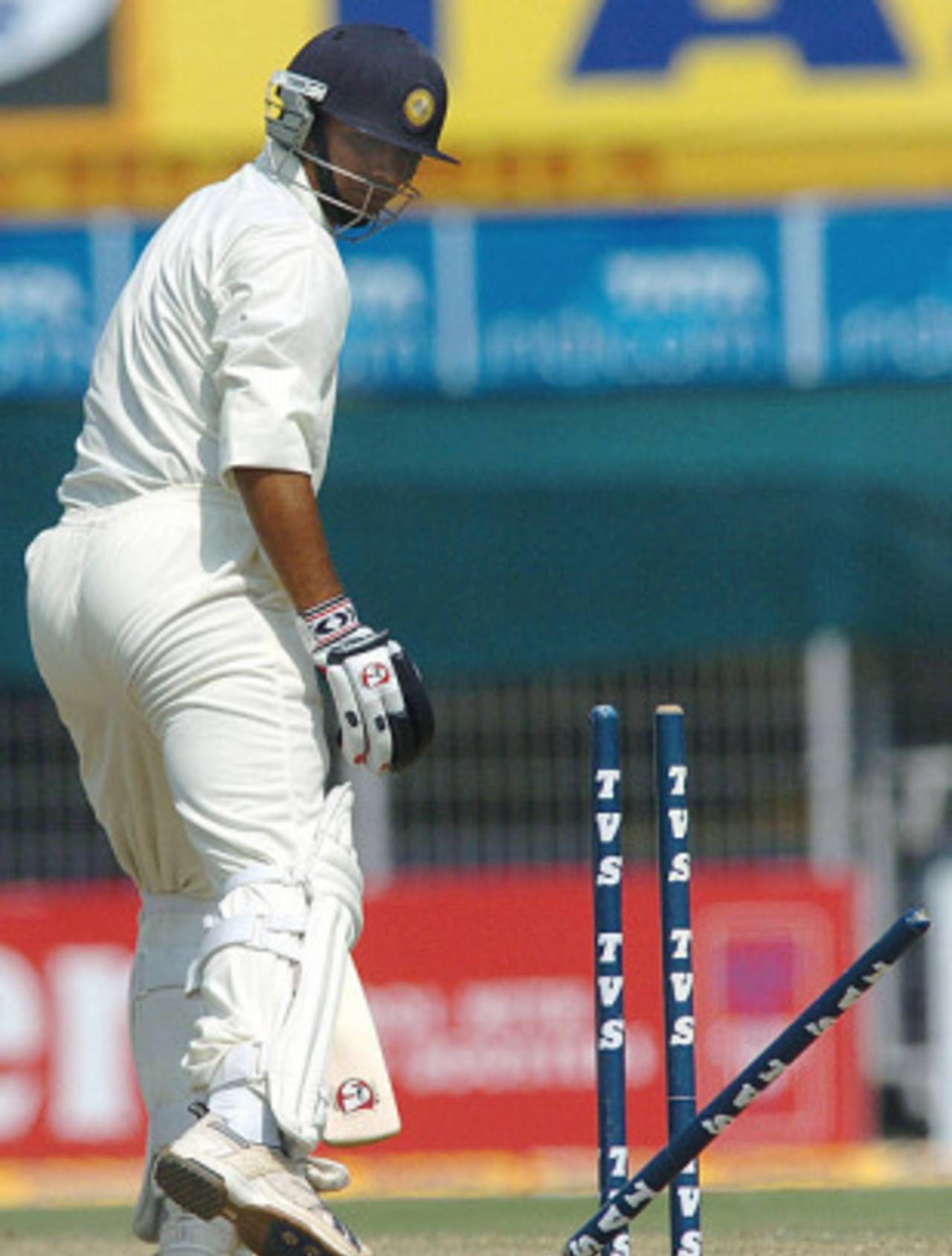
Once the ball is released, the seam can reveal some more. It will be tilted towards slip if the ball is set to move away, and towards fine leg if it is going to come in. That's not a guarantee, though. I remember getting bowled by Jason Gillespie in the third Test against Australia in Nagpur in 2004. He bowled close to the stumps, his wrist was straight and the seam pointed towards second slip. So I expected it to move away and shaped myself for it, only to find the ball darting back in after pitching. I was bowled, and so was Rahul Dravid, under similar circumstances. The only difference being that he managed to get an inside edge. On these occasions, you have to consider yourself unlucky, and in this case I wasn't the only one.
| If you can't see the shine while playing reverse-swing, as a right-hander you need to be ready for incoming deliveries, because for right-handers it moves in more appreciably than away. Play inside the line to ensure that you cover the movement coming in. If it moves away, the most it can do is to beat the bat | |||
Another way of judging the path of the ball after release is to look for the shine. In case of traditional swing, the ball moves in the opposite direction to the side the shine is on; if the shine is on the right, the ball will move to the left and be an outswinger for a right-hand batsman. This is not guaranteed either. At times the ball misbehaves and holds its line - which may not be as bad as it swinging in the opposite direction but still causes trouble.
To make life difficult, bowlers like Zaheer have mastered the art of hiding from the batsman which side of the ball is shiny. When the ball is reverse-swinging it moves in the direction of the shine, unlike with conventional swing. If the shine is on the right, it will move towards the right, as an inswinger to the right-hand batsman. It's similar to traditional swing but the swing occurs a little later in the air. Good exponents of reverse-swing have the ability to delay the swing till about a few feet before it lands. Most batsmen get duped into believing it's a straight ball till it darts in or out at the very last moment. The later the movement, the more difficult it is to adjust.
It's slightly easier to gauge if you can see the shine, but a lot tougher if you can't. That's when the non-striker comes to your rescue, since he's in a better position to see which side is shiny. He can't tell you outright but his bat can. What he'll do is hold his bat on the side of the shine - in his right hand if the shine is on the right and vice versa. But there are times he isn't sure, so he'll keep the bat in the middle and you're left to deal with it by yourself.
If you can't see the shine while playing reverse-swing, as a right-hander you need to be ready for incoming deliveries because for right-handers it moves in more appreciably than it does away. Play inside the line to ensure you cover for the movement coming in. If it moves away, the most it can do is to beat the bat.
Bowlers like Mohammad Asif and Glenn McGrath rarely get the ball to swing in the air; they rely on movement off the pitch There's little a batsman can do against these bowlers, at least as long as the ball is new and the shiny side is not visible. What you look for are subtle changes: does the non-bowling arm drop slightly earlier in the action? That may mean an offcutter is on the way. If it is held on to till late, it is probably a legcutter. But again it's difficult to be sure every time.
Playing the swinging ball is a tough proposition. Admire the batsmen who do it with aplomb and sympathise with those who struggle.
Former India opener Aakash Chopra is the author of Beyond the Blues, an account of the 2007-08 Ranji Trophy season. His website is here
© ESPN EMEA Ltd.
| Comments have now been closed for this article |
||||||
Aakash Chopra is the 245th Indian to represent India in Test cricket. A batsman in the traditional mould, he played 10 Tests for India in 2003-04, and has played over 120 first-class matches. He currently plays for Delhi in the Ranji Trophy; his book Beyond the Blues was an account of the 2007-08 season. Chopra made a formidable opening combination with Virender Sehwag, which was believed to be one of the reasons for India's success in Australia and Pakistan in 2003-04. He is considered one of the best close-in fielders India has produced after Eknath Solkar.

'Too early to judge Cook's captaincy'
Bowl at Boycs: Geoff Boycott on England's ODI success, Ponting's axeing, Brian Close's bravery and Westfield's conviction
Switch Hit: Back-to-back tons from the batsman lead England's resurgence in the UAE. Is ODI success in 2015 a possibility?
Christian Ryan: Television defines Ricky Ponting, but the more we see him on it, the less we know
How soon before broadcasters have a say in selection?
Rob Steen: Television has benefited cricket, but it is a relationship that can get far too cosy for the game's good
Opportunity in lifeless surrender
Abbasi: Pakistan were consistently woeful in the ODIs
Tendulkar and Bracewell take top awards
Kevin O'Brien and Mitchell Johnson win one-day batting and bowling honours
ESPNcricinfo presents Plays of the Day for the match between Australia and India in Brisbane
Discord, dissent hurt Indian team
It has been a long tour with little success to celebrate, and the differences and frustrations between the players are coming out now, in the form of scarcely anticipated bombshells dropped during routine press conferences
India let Thirimanne off the hook
Ashwin had appealed, Thirimanne was not inside his crease, the finger should have gone up immediately. Spirit of cricket should not have been allowed to come in the way of fair cricket
'One of the best sessions of my life'
Sachin Tendulkar goes over his epic battle with Dale Steyn and Co in Cape Town in 2011, the winner of ESPNcricinfo's Test Batting award for the year
India let Thirimanne off the hook (212)
Ashwin had appealed, Thirimanne was not inside his crease, the finger should have gone up immediately. Spirit of cricket should not have been allowed to come in the way of fair cricket
Discord, dissent hurt Indian team (196)
It has been a long tour with little success to celebrate, and the differences and frustrations between the players are coming out now, in the form of scarcely anticipated bombshells dropped during routine press conferences
Better bowlers, better Test team (119)
India are much better at one-dayers than at Tests because 50-overs cricket allows you to win with good batting and ordinary bowling. Unless that changes, they'll remain limited-overs tigers and five-day sheep
Sehwag's legacy is in his hands (119)
Whether he joins the ranks of the all-time greats depends on how he counters his current slump
Ponting and Tendulkar fight for their utility (99)
Both have been through almost everything in their ODI careers, and still love it enough to fight for it, something they are not accustomed to. It will be fascinating to watch how they come out of the rest of the triangular
The definitive Cricket Novel of the Century
Romance, Three 20/20 Matches, Murder Mystery, Book Now.
Access your Indian Rupee earnings from anywhere in the world.
ICICI Bank Money2India brings " locked exchange rate" and a free gift
on registering and transfer of USD 250 and above.
FREE copy of Playfair with Wisden order
At Cricshop.com
Once again an extremely well written article by Aakash. I like your articles because as cricketers its very easy to relate to the topics discussed. Keep up the good work and I look forward to reading more of your articles!
Posted byNice Article Aakash again! But how would one play seaming ball which moves either way after pitching. From My Opinion you have to come in the line of the ball by BACK and ACROSS feet movement and play absolutely LATE. Other wise seam GURU like ASIF,Razzaq,and Anderson would have easy pickings though off the pitch movement.. (Remember KARACHI TEST vs INDIA where ASIF and A.Razzaq get the full out of the grassy pitch.) Finally I would like to ask Aakash to right column on BACK and Across Movement (SHUFFLE).
Posted by Rahul_U_S on (March 05 2010, 20:07 PM GMT)Sehwag's batting is all about hand-eye co-ordination and natural instinct. Not many players are gifted with this. He has got a terrific eye, which makes it possible for him to make the late adjustments. And he plays the ball very very late, his body balance is incredible. But, most importantly when a bowler runs in to bowl to Sehwag, he will be under immense pressure. So the battle is almost won by Sehwag even before the ball is delivered.
Posted byInsightful article Aakash, will help the aspiring cricketers(both bowlers and batsmen). Well having played cricket myself, I can very well understand the intricacies involved in playing swing. But let me add, when you go out to bat, every theory that you've read takes a backseat. A batsmen only has a fraction of a second to decide what shot to play. Given the close dissection of counter swing bowling, it all ends in vain. The only thing which matters is the hand-eye co-ordination. And it comes with endless hours of painful practice. This is for the mortals and then there is Sachin Ramesh Tendulkar - The God. I think he sees the ball even before its bowled.
Posted by AliOnline on (March 03 2010, 21:29 PM GMT)Ive never read an article by someone who describes the exact situation in such detail. I really like the style of your writing, and hats off to the information provided. Keep it up Mr.Chopra!
Posted by tjsimonsen on (February 26 2010, 20:03 PM GMT)Spare a thought for the batsmen??? NO WAY!! Batsmen have it way too easy 85% of the time. Seaming, swinging wickets - or raging turners. I don't care, but I want to see the batsmen work hard for their runs!!
Posted by AshitYadav on (February 26 2010, 12:22 PM GMT)Good article Akash !!! But I am more curious to know the Sehwag's version on this topic. I think this approach suits batsman who are more tecnically correct, Like you or dravid. But not for sehwag or dhoni.
Posted by smike88 on (February 26 2010, 06:11 AM GMT)It's amazing to me when you read about how world-class athletes can slow down time. The flight of a swinging cricket ball takes fractions of a second to reach its destination, but to be able to deduce all of these things from such a short amount of time is incredible. (And the science is pretty interesting too!)
Posted by anunad on (February 26 2010, 05:57 AM GMT)Beautiful Article! For all openers everywhere, this is a must read.
Posted byIf we futher delve into the swing factor, its the small stip of ares near the seam say just 15% which accounts for about 90% of the swing. The logic is simple. After the release, as the ball rotates along the seam, the angular speed of the areas near seam is maximum and hence they contribute more towards creating the swing compared to the polar regions.