Ian Chappell
Ian Chappell Ian ChappellRSS FeedFeeds  | Archives
Former Australia captain, now a cricket commentator and columnist

What makes an ideal Twenty20 team?

You will need: an opener with timing; wicket-taking quicks; attacking, economical spinners; and a prodigious late-order hitter

Ian Chappell

May 9, 2010

Comments: 101 | Text size: A | A
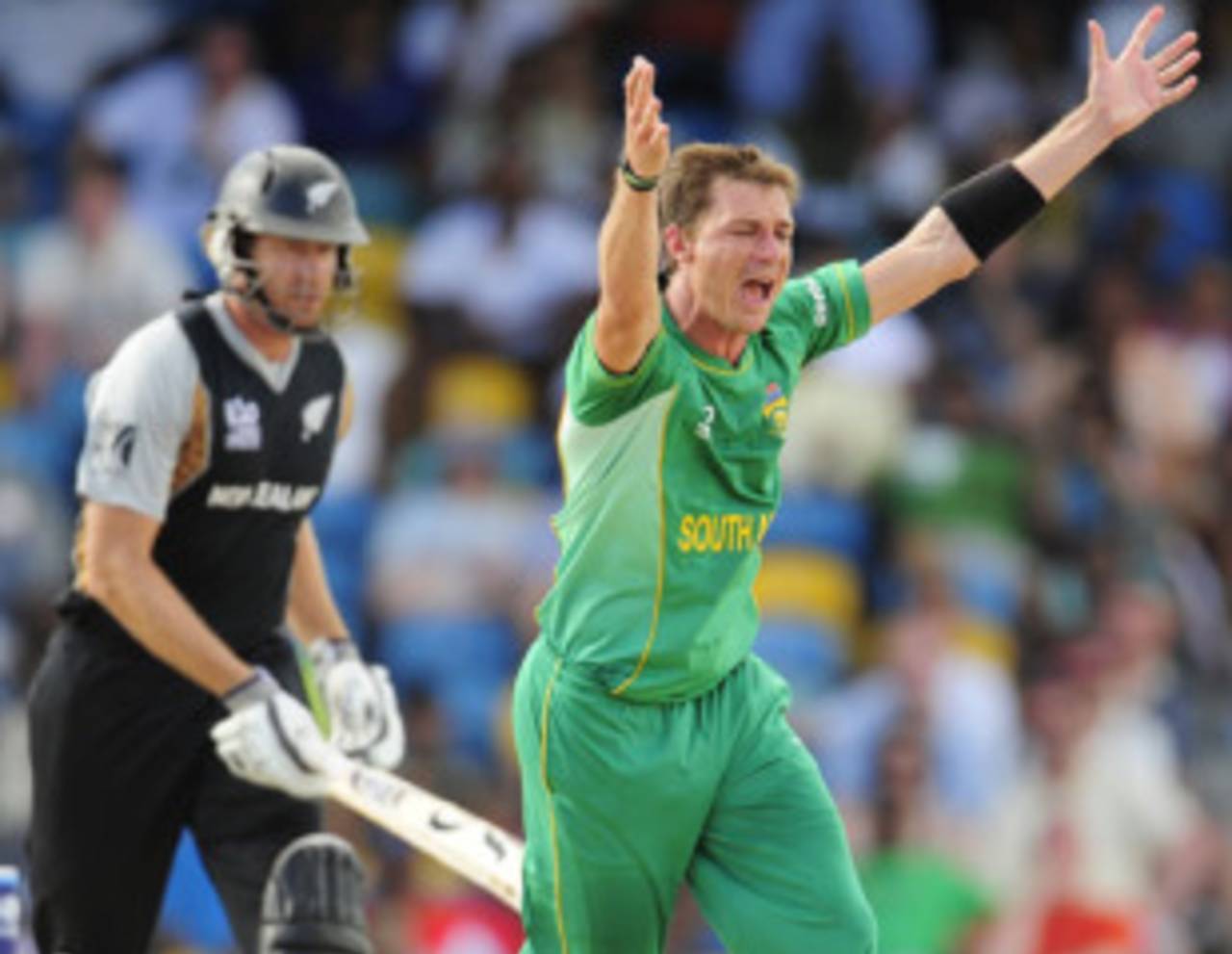
Dale Steyn appeals successfully to dismiss Jacob Oram, New Zealand v South Africa, Group E, Bridgetown, May 6, 2010
Dale Steyn not only takes wickets with the new ball, he also produces many dot balls and is difficult to hit for six © Getty Images
Enlarge

We're now into the third World Twenty20 and three IPL seasons have been completed, so it's worth looking for trends and trendsetters in the shortest version of the game.

First let's look at what makes an ideal Twenty20 team. Two vital ingredients are: a successful opener and a prodigious hitter in the late overs. Part of Sachin Tendulkar's amazing late career revival has featured an extremely successful last IPL season. Much of his success can be attributed to keeping the dot balls to a minimum (37%) and scoring more than half his runs in boundaries. This means he maintains a high run-rate by basically keeping the ball along the ground, thus reducing his chances of being caught. Consequently he accumulated a number of solid scores, making him the ideal type to anchor an innings. The highly successful Mahela Jayawardene employs a similar formula.

This contrasts with a top-order batsman like Suresh Raina, who also had a successful IPL season but took more risks. Raina scored about 25% of his runs via boundary-clearing shots, which means when his timing is a little astray or his luck is out, he's more likely to struggle than Tendulkar or Jayawardene.

Albie Morkel capably fulfills the requirements for a late-order hitter. His Kiwi-destroying innings at the Kensington Oval involved smashing balls out of the park in an arc so true it could have been mapped out using a theodolite. By hitting so straight, Morkel reduces the margin for error much the same as his fellow countryman Lance Klusener did in a golden patch during the 1999 World Cup. Incidentally Morkel scored 40% of his runs from sixes in the IPL, so his formula is surprisingly consistent.

Successful bowlers are harder to distinguish because even the best suffer some form of punishment. However, in conditions like those prevailing at the Kensington Oval, a pair of wicket-taking speedsters like Dale Steyn and Dirk Nannes are an ideal combination.

Not only are they right and left-arm bowlers, both take wickets regularly, produce a lot of dot balls, and are difficult to hit for six. The ability to take wickets with the new ball is crucial, and it is one reason why Australia and South Africa are early favourites for the World Twenty20 title.

Spinners have quickly built a reputation for being vital components in a successful Twenty20 side. The ideal type is a wicket-taker who conjures up around 50% dot balls and has batsmen caught in the outfield rather than in the back of the grandstand by a fan wearing an "I love sixers" t-shirt.


The ideal type of spinner is a wicket-taker who conjures up around 50% dot balls and has batsmen caught in the outfield rather than in the back of the grandstand by a fan wearing an "I love sixers" t-shirt
 

Not surprisingly, Muttiah Muralitharan and Daniel Vettori rank high and Harbhajan Singh also rates well for the flexibility he provides. Harbhajan has no qualms about bowling with a new ball and only two men out, and this makes him an extremely valuable commodity.

The rest of the team card can be filled out with the likes of dashing opener Dave Warner, who is also a brilliant outfielder; a floating middle-order batsman who hits the ball out of the ground, bowls tidily and fields well, a la Kieron Pollard; and a thinking wicketkeeper like Mahendra Singh Dhoni, who is also an extremely adaptable batsman. These are the kinds of players who make up a successful Twenty20 side.

The average score for a Twenty20 innings is in the 145-160 range. Consequently, batsmen who regularly maintain a run-rate in excess of eight per over and bowlers whose economy rate is under seven are going to help win a lot of matches.

As we move to the business end of the World Twenty20, the teams that have made a strong impression, statistically and skill-wise, are Australia and South Africa. However, Sri Lanka are quietly lurking with Jayawardene, the in-form batsman, guiding the way, and an attack that relies more on variety than vroom.

England are an improved side but lack one more reliable six-hitter, and India have much ground to make up after faltering against fast, short-pitched bowling. All that said, Twenty20 cricket is full of surprises and temperament features strongly. Fortunately, there's no statistic for strength of mind.

Former Australia captain Ian Chappell is now a cricket commentator and columnist

RSS Feeds: Ian Chappell

© ESPN EMEA Ltd.

Comments: 101 
Posted by Pakipaindabad on (May 12 2010, 17:45 PM GMT)

Mr.Chappell , I am so surprised at your selection capabilities and I think it was blessing in disguise for Australian cricket that they never made you the chief selector. You may have been a great batsman and captain but you are a pathetic selector. The reason I believe in this is because you didn't pick any player from a team that has qualified for last two finals of the world cup and they have also qualified to the semi-final of this world cup. They lost a close final in 2007 and won easily in 2009 final and semi-final against undefeated teams of that tournament. I know Pakistani batsmen are not that great and all these victories were possible because of their bowlers and you didn't include any of them in your team. Highest wicket taker in T20 cricket Umer Gul is missing from your list, Man of the finals 2009 and Man of the tournament 2007 Shahid Afridi is also missing from the list.

Posted by Cric_123 on (May 12 2010, 16:48 PM GMT)

I agree with the people who commented that this article is based upon performances in INDIAN PATHETIC LEAGUE...Shame on you Chappel. No T20 World XI can be complete without Ajmal, Gul, Afridi, Sangakkara, Malinga.

Posted by   on (May 12 2010, 15:15 PM GMT)

Pakistan is best team in t20...........

Posted by AdityaMookerjee on (May 12 2010, 02:58 AM GMT)

The most important ingredient in any successful T-20 team is strength of mind, perhaps more so than in test cricket. Test cricket is like life, you get a number of chances, albeit different ones. T20 cricket, on the the other hand, has to do with seizing the chances and opportunities, which may be coming your way, without wondering about how advantageous they are. One has to seize all advantages, whether great or small, in T20 cricket, but then that is also true of test cricket. The seizing of opportunities is not so pronounced in it's effect in the perception in test matches, as it is in T-20 cricket.

Posted by fairdinkum on (May 12 2010, 00:17 AM GMT)

Chappelli must giggle at what is apparently written between the lines on his computer screen. What causes this cognitive dissonance?

Posted by   on (May 11 2010, 23:34 PM GMT)

Is that all mr. Chappel? How about australia with their all out pace as seen in their faith with bollinger, johnson and tait? Pakistan with their reverse swing death bowling in umar gul? Or their highly successful introduction of crippling spin in the middle over with ajmal and afridi, something all teams have now adopted? How about kallis and his stubborness in sticking to traditionalism?

Posted by shahws on (May 11 2010, 23:05 PM GMT)

What makes an ideal T20 team is a team that plays like a team, even if it doesn't have the star power or what some commentators have started calling "T20 specialists". At the end, it's about how you smartly you make use of your resources in this form of the game. For example, how Afridi has used Saeed Ajmal in the death overs and how Collingwood is using Bresnan in this World Cup. That is why teams like Pakistan and England have out-performed the so-called favorites, such as South Africa and India.

Posted by   on (May 11 2010, 20:28 PM GMT)

I rate Chappel comments very highly but i just cant understand, how he can completely forget about Ajmal who have never given runs and has always taken important wicket

Posted by murty636 on (May 11 2010, 15:35 PM GMT)

Read ALL the posts but I think most of the guys have missed the most basic point of this article and have become emotional AND unnecessarily patriotic .. The CRUX and MOST OPERATIVE part of the article is at the very beginning ...... "It's worth looking for trends and trendsetters in the shortest version of the game. First , lets look at WHAT MAKES AN IDEAL T-20 TEAM.." All Mr Chappell is talking about the QUALITIES or ATTRIBUTES that should comprise an IDEAL T-20 team ... PERIOD. The examples he has given are NOT SACROSANCT nor NEED TO BE ACCEPTABLE TO ALL. Each viewer / reviewer can substitute his or her own favourite or appropriate player. Rather than quibbling over who has been mentioned OR omitted, lets all discuss about the Qualities and attributes he mentioned. Only two individuals got the issue right : one who pointed out more or less what i mention here and the other talked about the issue of "leadership" also being a Crucial attribute / skill in T-20.....

Posted by shehzi123 on (May 11 2010, 14:12 PM GMT)

What was dat ??? No Afridi ? no Ajmal ?? cant believe this .. Mr. Ian ur favourites SA are OUT .. Its Pak in the Semi .. THE TEAM WHO WAS IN THE FINAL OF fitst WC.. winner of second and still in the fight for 3rd consective time to play final ... Pak widout any doubt is Best t20 team and best x1 is incomplete widout Afridi and Gul

Comments have now been closed for this article

FeedbackTop
Email Feedback Print
Share
E-mail
Feedback
Print
Ian ChappellClose
Ian Chappell Widely regarded as the best Australian captain of the last 50 years, Ian Chappell moulded a team in his image: tough, positive, and fearless. Even though Chappell sometimes risked defeat playing for a win, Australia did not lose a Test series under him between 1971 and 1975. He was an aggressive batsman himself, always ready to hook a bouncer and unafraid to use his feet against the spinners. In 1977 he played a lead role in the defection of a number of Australian players to Kerry Packer's World Series Cricket, which did not endear him to the administrators, who he regarded with contempt in any case. After retirement, he made an easy switch to television, where he has come to be known as a trenchant and fiercely independent voice.

    Which teams are the worst travellers?

Numbers Game: A look at how Australia, South Africa and England have fared in Asia, and vice versa

    Cricket's not all greek to the Greeks

In Corfu and Athens it's catching on. Locals get countrymen from all over to visit and play. By Firdose Moonda

Afghanistan's remarkable rise achieves new heights

Afghanistan cricket will reach a new high when they take on an ICC Full Member for the first time. By George Dobell

    'You need to change the way the batsman plays'

Tony Greig, Mark Waugh and Brian Close on the art of fielding close in. Interviews by Dan Brettig and Nagraj Gollapudi

Younis' defining innings

Pak Spin: a masterclass from Pakistan's unassuming warrior

News | Features Last 7 days

Dhoni and Sehwag share a moment

ESPNcricinfo presents the Plays of the Day from the second Twenty20 international between Australia and India, in Melbourne

Swann v Ajmal: clash of the offspinners

They're the two best spinners in Test cricket over the last 30 months, and while their overall stats are similar, the break-ups are quite different

Kohli's dive in vain

Plays of the Day from the second ODI of the CB series, between India and Sri Lanka at the WACA

Overdue win, unusual method

India were on tonight. It was like it was all coming back to someone who had lost his memory in the first half of a Bollywood film. Simple things but somehow forgotten

Unravelling the mystery of Ajmal

The ICC have explained the science behind the offspinner's action after a TV interview caused confusion

News | Features Last 7 days
  • Cricinfo Widgets
Sponsored Links

Access your Indian Rupee earnings from anywhere in the world.

on registering and transfer of USD 250 and above.

At Cricshop.com