
Giving nothing away
Those who claim cricket in the old days was dull need not look further back than the opening Test between India and England in 1963-64 for evidence

Martin Williamson
04-Feb-2012
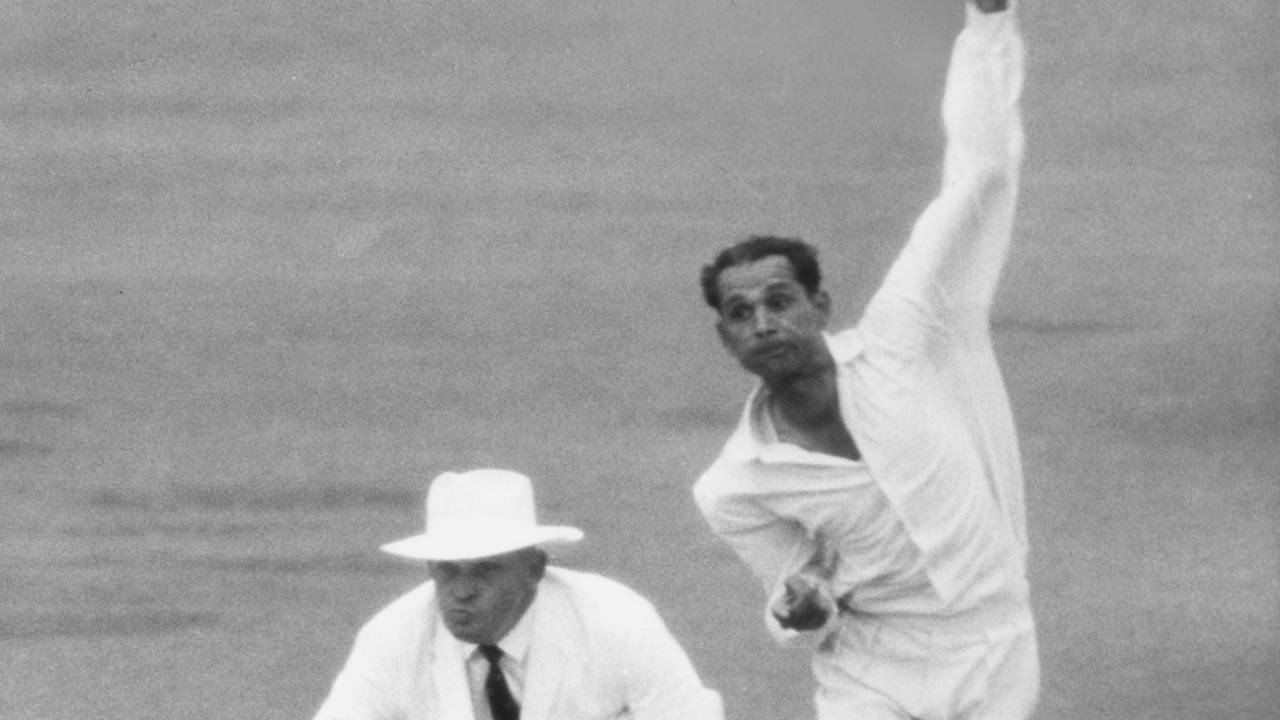
Bapu Nadkarni bowling against Australia • Getty Images
Test cricket suffered a considerable drop in popularity in the 1950s, largely because of uninspiring captaincy and a safety-first approach to the game. While a new generation of leaders in the early 1960s, typified by Richie Benaud, sought to make the game more appealing, that did not extend to everyone.
The opening Test between India and England in Madrasin January 1964 was an example of why many had been turned off by international cricket, although it did throw up the most parsimonious bowling return of all time, as Indian left-arm spinner Bapu Nadkarni finished England's first innings with figures of 32-27-5-0.
Nadkarni, a capable batsman as well, had made his debut for India eight years earlier and had been a regular member of the side since 1958-59. He had always been a stingy bowler, something he attributed to endless experimentation, along with untiring sessions in the nets. In the 1960-61 series against Pakistan - a turgid affair in which all five Tests were drawn, and fewer than 200 runs were scored on 11 of the 25 days' play - he returned figures of 32-24-23-0 in Kanpur, followed by 34-24-24-1 in Delhi.
In 1963-64, England toured India for what was by the standards of the time a whistle-stop seven-week five-Test series. After two warm-up matches, England arrived in Madras for the first Test, ready for what was expected to be a battle between spinners and the bat, so much so their tour party only included one fast bowler.
The Nawab of Pataudi, India's captain, won the toss and batted, and a crowd of 30,000 left happy as India closed on 277 for 2, with opener Budhi Kunderan making 170 not out. India moved on to 457 for 7 (Kunderan dismissed for a career-best 192) before declaring 90 minutes before the close of the second day, and England reached 63 for 2 by stumps.
However, England's problems were as much off the field as on it. Micky Stewart was left back in the team hotel with a stomach upset and raging temperature, and by the end of the second morning session Jim Parks had joined him.
On the third morning Fred Titmus and Barry Knight were also unwell but on the ground, while Parks and Stewart stayed in bed, although there was a car on standby to rush Stewart to the ground should the need arise.
Against this backdrop, and with the pitch starting to misbehave, England decided their only hope was to put up the shutters. The morning session was laborious, 86 runs coming in two hours for the one wicket, that of nightwatchman Don Wilson for 42.
Ken Barrington, a stonewaller without equal, then joined opener Brian Bolus, and the pair decided to be even more circumspect. In the two hours during the afternoon they added 27 runs, of which four were extras.
Nadkarni, brought on after lunch, wheeled away over after over with his slow, low-trajectory spinners and neither batsman made any attempt to score - even half volleys and long hops were studiously patted to fielders. The first run after the interval came in the 12th over, as Nadkarni and Chandu Borde wheeled away without tempting Bolus or Barrington into anything close to indiscretion.
Nadkarni bowled 21 overs and five balls without a run coming off him, to a field of one slip, a short leg and a four-three ring saving the single. At 3.05pm, with the tea break looming, Barrington scored a single off him, whereupon, noted the Times, he "was immediately taken off as though being altogether too expensive". Nadkarni went into the interval with figures of 19-18-1-0.
The capacity crowd - for the third day running the gates had been closed long before the start - remained remarkably good-natured, if noisy. They had a little more to cheer in the final 90-minute session, as the scoring rate accelerated, 59 runs coming, and a fifth wicket as an exhausted Bolus fell leg-before shortly before the close. He and Barrington had added 119 for the fourth wicket in four and a half hours. Nadkarni, brought back for another ten overs in the evening session, finished the day on 29-26-3-0.
The newspaper reports the next day centred, not overly critically, on England's rearguard, with the Times stating the cricket "could be interpreted either as a travesty or the inevitable sequel to England's internal misfortunes", while Henry Blofeld in the Guardian concluded "the end must be said to justify the means".
There was also plenty of coverage of Nadkarni's spell as it had broken Horace Hazell's record of 17 consecutive six-ball maiden overs (Hugh Tayfield had bowled 137 consecutive dot balls against England in 1956-57, but that was in eight-ball overs).
Nadkarni was initially oblivious. "I came to know about it later," he said. "In the evening the official scorer came up to me and told me that I have set a new world record and have bowled the most economical spell." There were no celebrations, only the usual dressing-room banter. "A few of my team-mates took a dig at me. At that time there was no media coverage and things like these went unnoticed."
A rest day followed, allowing England's sick to regain their strength, and when the match resumed only Stewart, diagnosed as suffering from dysentery, stayed away but signalled his intent to bat if needed. So weak was he that permission was sought for him to bat with a runner were he to be called upon.
England took their overnight 235 for 4 to 317 in a little under three hours, easily passing the follow-on target of 258. Nadkarni only bowled three more overs for two runs, finishing with 32-27-5-0. He may have been economical but he was not anything like as threatening as Borde, who finished with 5 for 88.
India had wobbled to 116 for 6 by the close - a healthy lead of 256, although the crowd had lost much of the patience it had shown on previous days and several times police were forced to clear the pitch.
Pataudi continued batting on the fifth morning, eventually declaring on 152 for 9 and setting England 293 in 268 minutes. England's approach was markedly different to their first innings and they switched around the batting order to get their hitters in the middle. Bolus and Mike Smith added 67 in 82 minutes for the first wicket, but the chase was abandoned when England lost their fourth wicket with two hours remaining. They finished on 241 for 5 but it was not as close as the scoreboard suggests.
Nadkarni was little used in the second innings but he did finally take wickets. The first was bizarre: Smith looked to attack him, charged down the track and was well stumped, only for the umpire to inform the scorers he had been caught. Nadkarni's analysis was 6-4-6-2 giving him match figures of 38-31-11-2.
If England thought they had survived the worst, they were wrong. The next they flew from Madras to Ahmedabad for a three-day game against West Zone and the flight was so bad that the Times reporter wrote most of the squad "would rather have been facing [Wes] Hall and [Charlie] Griffith bowling together on a dark evening and bumping pitch". By the time the squad arrived in Bombay for the second Test a few days later, the illness which had dogged them in Madras had became altogether more serious.
What happened next?
- Nadkarni finished the series with nine wickets at 30.88 but only conceded 278 runs from his 212 overs. He played the last of his 41 Tests in 1967-68 and finished with 88 wickets at 29.07, only going for 1.67 runs an over
- All five Tests were drawn as were four of the five tour matches. Despite some dull cricket, more than 1,000,000 paid to see the ten games
Is there an incident from the past you would like to know more about? Email us with your comments and suggestions.
Martin Williamson is executive editor of ESPNcricinfo and managing editor of ESPN Digital Media in Europe, the Middle East and Africa