| Series | Countries | Live Scores | Fixtures | Results | News |
Features
|
Photos | Video & Audio | Blogs | Statistics | Archive | Games | Mobile | ||||||||||||||||||||
|
However much his domestic record may glitter, in the end we have to ask why a player with so much going for him produced so little where it matters most of all - on the Test match stage
David Lloyd
July 5, 2012
![]()
|
|||
|
Related Links
Rob Steen : The burden of being Ramps
News : Ramprakash set to announce retirement Players/Officials:
Mark Ramprakash
|
|||
If Mark Ramprakash had taken to the Test arena as he later took to the dance floor then anyone assessing his 25-year playing career would happily follow in the footsteps of television judges Len Goodman, Bruno Tonioli and Co by awarding a perfect ten.
But as we are talking strictly cricket, on the day "Ramps" is set to announce his retirement, the jury is likely to agonise long and hard before declaring itself unable to deliver a unanimous verdict.
For the uninitiated, Ramprakash swept aside all rivals to win the 2006 edition of the popular British television programme Strictly Come Dancing, earning himself a host of new admirers in the process. He had seemed a most unlikely recruit for a competition that invites those taking part to fall flat on their faces (literally), but by all accounts, people who know their sambas from their salsas said the then 37-year-old was a star turn from the very first rehearsal.
Some 15 years earlier, most of us who saw Ramprakash make his Test debut - against West Indies in Leeds - thought precisely the same thing. True, the Headingley were no more substantial than a brace of 27s but the poise he showed at the crease (against a fiery attack containing Curtly Ambrose, Patrick Patterson, Malcolm Marshall and Courtney Walsh) convinced a majority of onlookers that we were witnessing the start of something big.
In fact, we were witnessing the beginning of something pretty much unfathomable. Technically and physically, the boy from Bushey, Hertfordshire, had everything and more that was needed to make a huge impression at the highest level. And yet, when England discarded him for the umpteenth and final time after a personally dire tour of New Zealand in 2002, his record reeked of under-achievement: an average of 27 across 52 Tests with just two centuries.
Given stats like that, it may seem curious he played as much as he did. But four coaches (Keith Fletcher, Ray Illingworth, David Lloyd and Duncan Fletcher) and four captains (Graham Gooch, Mike Atherton, Alec Stewart and Nasser Hussain) all hoped they might be the one for whom Ramps would bloom, thereby converting consistently excellent county form into a mountain of Test runs.
Statistics seldom tell the whole story, of course, and while Ramprakash's overall figures for England make sorry reading, it must be remembered that in 12 Tests against Australia - Glenn McGrath, Shane Warne and the rest - he averaged a far from shabby 42. On top of that, one of his two hundreds was scored against the then all-conquering Aussies (at The Oval, in 2001).
But to seize on those last couple of facts while trying to gloss over the others would be an exercise in straw-clutching: as an international cricketer, Ramprakash achieved only a fraction of what should have been. Just look at his domestic achievements, first for Middlesex and then Surrey. He registered 1000 or more first-class runs for a season on 20 occasions, went beyond 2000 three times, and in 2006, when many an unofficial selector wanted him recalled by England, his Championship average for Surrey was a staggering 105.28.
That is special; very special. And there is more: his first-class average closes at 53.14 and he hangs up his bat, a couple of months short of his 43rd birthday, with 114 centuries in the bag. We could talk about his limited-overs performances, too, but enough of figures.
We should celebrate Ramprakash's achievements and agree with former England captain Michael Vaughan when he says that the man in question is "the best technician the English game has had in the past 20 years".
But, sooner or later, we have to return to the subject of why a player with so much going for him produced so little where it matters most of all - on the Test match stage. And that is where members of the jury are likely to disagree.
| As well as the most technically accomplished player of his generation, Ramprakash was also the most intense. Sublime technique came with something more restricting | |||
Some will lay a fair proportion of the blame at the feet of various selectors, coaches and supremos who chopped and changed the England team throughout the 1990s, meaning that players like Ramprakash and Graeme Hick - that other obviously unfulfilled talent who made his debut at precisely the same time - seldom felt secure in the side. It is strange to recall that Ramprakash was dropped for, among others, the likes of Chris Adams and Darren Maddy in the days when consistency of selection was hard to find.
Others may point out that Ramprakash had more than enough chances to shine and simply did not have what it takes temperamentally to cope with pressure at the highest level. For sure, he beat himself up unmercifully after a failure. By way of just one example, this observer well remembers seeing our subject skipping long and hard under a ferocious sun in South Africa as if to punish himself for a soft dismissal. Dressing-room tantrums were also commonplace as he forever searched for perfection. As well as the most technically accomplished player of his generation, he must also have been the most intense. Sublime technique came with something more restricting.
But perhaps, as is often the case, the truth lies somewhere in between; maybe Ramprakash was just around at the wrong time, internationally speaking. England were a poor Test outfit for most of the 1990s, and while the likes of Gooch and Atherton managed to flourish in the face of so much adversity, an intense character like Ramprakash became simply too desperate to succeed and too worried about looking over his shoulder.
You play the cards you are dealt and Ramprakash could and should have used his hand a lot better. But if he were now 22, rather than 42, and a new member of this current England set-up, where the team is everything and competition for places is accepted as a force for good rather than feared, then we might be looking today at a champion Test batsman in the making. And to hell with the dancing.
David Lloyd is a former cricket correspondent for the London Evening Standard who witnessed all 52 of Mark Ramprakash's England matches and a fair proportion of his 114 first-class centuries
© ESPN EMEA Ltd.
| ||||||
| Comments have now been closed for this article |
||||||
'You can't taint the whole IPL'
Bowl at Boycs: Geoff Boycott on spot-fixing, Adil Rashid's future, and yorkers in Test matches
Harsha Bhogle: The spot-fixing controversy teaches us about the pitfalls of insecurity and of the desire to keep up with the Joneses
The new Harmison? Or is it the new Caddick?
Numbers Game: Stuart Broad is destructive at his best, but at other times his bowling average is unusually high
Aakash Chopra: Apart from luck, you need to pick your team wisely, get to bat at the top, and have your captain's support
Less cricket on TV? Hallelujah
Matt Cleary: Why Channel Nine should be applauded for not broadcasting domestic cricket in Australia
Even at the height of his success with the national side, Sreesanth was a lonely cricketer who felt hard done by
Mumbai Indians still have a better head-to-head record against Chennai Super Kings, but once again on the big occasion, they came second
Vijay slips, Ashwin does a Sahara
Plays of the day from the IPL qualifier between Chennai Super Kings and Mumbai Indians in Delhi
Spirited Sunrisers exceed expectations
Sunrisers began this tournament as one of the underdogs, but fought impressively to reach as far as the Eliminator
Another season in the bottom half
With some of their big names stumbling this season, Kings XI Punjab were rarely serious contenders for a playoff place
Spirited Sunrisers exceed expectations (85)
Sunrisers began this tournament as one of the underdogs, but fought impressively to reach as far as the Eliminator
Even at the height of his success with the national side, Sreesanth was a lonely cricketer who felt hard done by
Mumbai Indians still have a better head-to-head record against Chennai Super Kings, but once again on the big occasion, they came second
Anderson's magic not to be missed (50)
None of the other three England bowlers with 300 Test wickets - or many other of the game's finest swing merchants - could have bowled better than James Anderson at Lord's
A case of peaking too early (42)
Royal Challengers began the season in full steam, but failed to replicate their consistency away from home
ICICI Bank M2I. Register Now and Get A Gift Offer.
Safe & simple online money transfer. Apply Now!
Buy Wisden 2013 & get a FREE Playfair
Available now at Cricshop
Mark Ramprakash part of thatgolden generation of good young cricket talent that came out England in the late 1980s.Of course the others were Graeme Hick, Alec Stewart, Mike Atherton,Nasser Hussain,M Bicknell,Chris Lewis, Devon Malcolm, David Lawrence, Angus Fraser, Phil Tufnell, Robin Smith etc. Ramprakash and Co. could have been number 1 or two in the 1990s. Instead it was one of English crickets worst decades. This was solely due to the bad cricket management at the time. You wonder what the Australians would have done with talent like that with their cricket academies or what the current England set up would have done with a young Mark Ramprakash.We will never how good Ramprakash would have been at test level because he was never given a chance or guided properly by the set up at the time. They wasted a lot of that young late 1980s talent as the 1990s proved. Ramprakash technically was the best of the bunch. Mark's story is an indictment of English cricket in the late 80s and 1990s.
Posted by Beefy_B on (July 7, 2012, 18:19 GMT)Another factor for his poor test average would be the quality of bowlers Ramps had to face during his test match days. Maybe if he were 22 and starting out know he would be much more successful.
Posted by 5wombats on (July 7, 2012, 9:43 GMT)Lets get a few myths out of the way about how England were back in the late 80's and throughout the 1990's. I remember sitting with the members in front of the Pavillion at the Oval in 1989 V Australia (a horrible wet affair...). It was Atherton's second match as an England player - but it speaks volumes for how things were that even before Atherton was ever selected for England he was being touted as a future England Captain. Amazing and he hadn't even played for England! So - that was the "Old Boy"/Club/shambles selection (if you can call it that) network that Mark Ramprakash had to somehow find his way in. Read books by former players about the Atherton years (eg. Hussains book is particularly revealing). It's all there. Regarding Atherton's record - gee, everyones record is great if you take out the ducks. Fact is - Atherton, Ramps, Hick - they were the best we had and they weren't as good as what the Aussies and West Indians had. Ramps was shabily treated too.Thems the rules.
Posted by jr1972 on (July 7, 2012, 9:33 GMT)English cricket was a shambles matched only by the ignorance and disgraceful attitude of Ray Illingworth and his fellow cronies. We should be talking about a great test career in the case of both Ramps and Hick. Read any autobiography from some of the greats of that era and they are in total agreement.
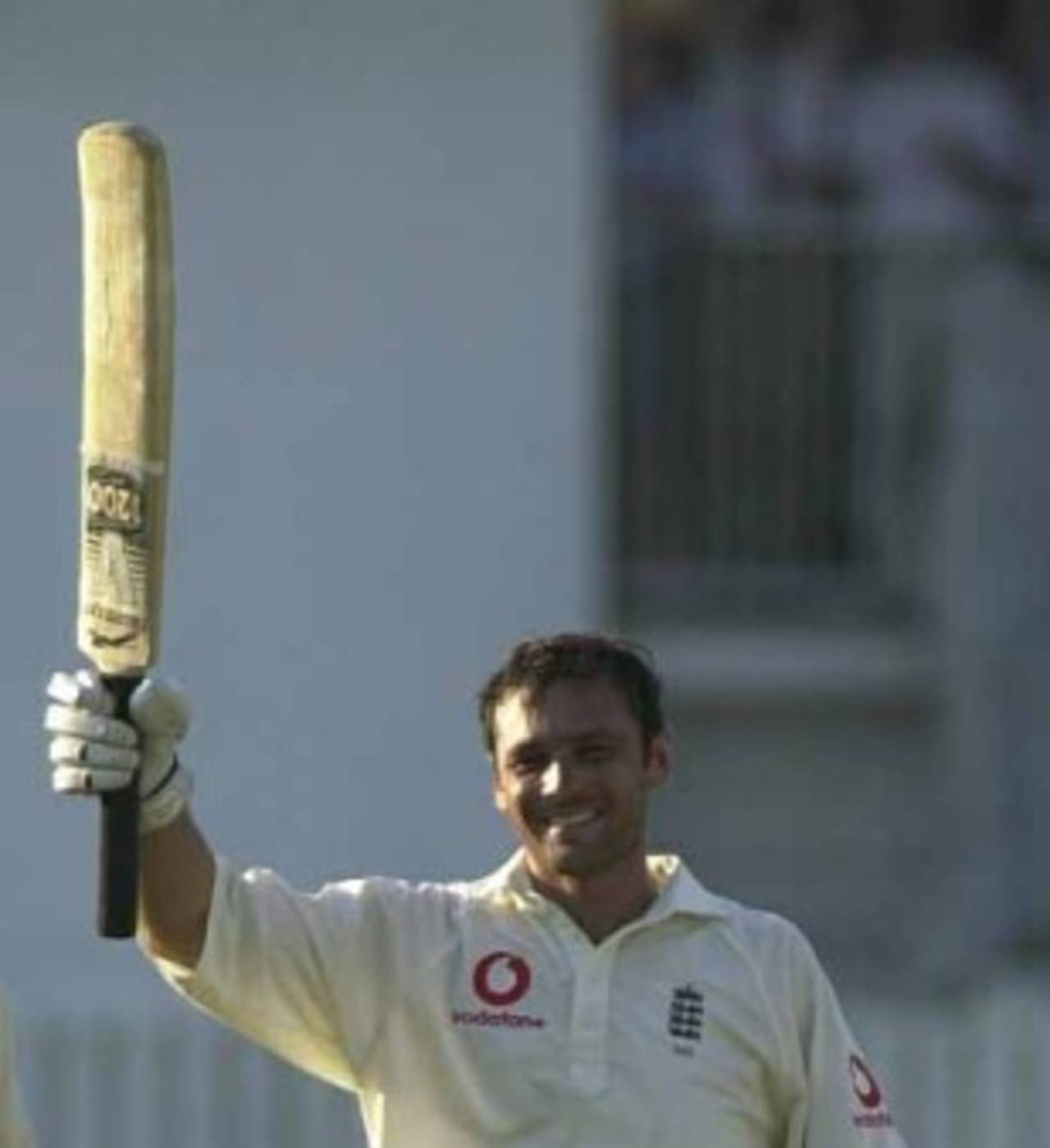
Posted by numpty-nigel on (July 7, 2012, 2:17 GMT)I think Mark Ramprakash celebrates his hundred at The Oval during the 2001 Ashes.
Only to be removed from the entire 16 man touring squad to South Africa in the following series says a lot!
I do not think it was a lack of talent, maybe a personality clash and politics with the England management!
Posted by SaracensBob on (July 7, 2012, 0:17 GMT)Fact is England wasted a whole slew of genuine, and potential, talent in the dark days of the '90s. Ramps and Hick are the obvious examples, Crawley another. But think also of the likes of Craig White, the Hollioake brothers and Devon Malcolm. Fortunately the powers that be saw the error of their ways and introduced the changes that have got us to where we are today. Talent recognised, nurtured and encouraged to blossom. Hats off to the 'men in suits' for making the changes.
Posted by mikey76 on (July 6, 2012, 22:36 GMT)5Wombats. England were crap in the 90's but that had little to do with Atherton. Gooch was not much more succesful as captain either. It was the selectors and the system at fault not a thoroughly decent and brave batsman like Atherton.
Posted by johnathonjosephs on (July 6, 2012, 20:00 GMT)Three words: Flat Track Bully. This is what separates the first class players from the test players.
Posted by AdrianVanDenStael on (July 6, 2012, 19:51 GMT)FreddyforPrimeMinister and Trueman's Ghost: fair enough, and I accept the point about Stewart's batting average being affected by when he was designated wicketkeeper, indeed I remember discussing that with TG on another discussion. While I agree with Wombats that the 1990s were a decade of disappointing underachievement for England, I can't really agree with his criticisms of Atherton and Stewart; I'd like to have seen Atherton be more aggressive at times (Sydney 1995 being a case in point) but I think there were a lot of things wrong with English cricket in these years besides the captain. JeffG agree with your points and accept that Bradman's average increases more in absolute terms if you remove single figure scores, but what is striking about Hick in particular is that his average increases more in relative terms, i.e., by about 50% (from 31 to 48), whereas Bradman's and Lara's (and Ramprakash's) increase by around a quarter. Partly that's just a reflection of Hick's inconsistency
Posted by StJohn on (July 6, 2012, 19:08 GMT)A few comments here about how averages of players like Hick, Atherton etc increase quite a bit if you eliminate their ducks or single figure scores. It seems to me that doesn't inform us very much: by definition, if you eliminate a player's worst scores his/her average will increase. A more worthwhile analysis is comparing averages against different Test teams. As such, Ramprakash's average of 42 against Australia in Tests is interesting. But the article is probably right that the reason for Ramps not doing so well in Tests is a combination of factors: his own psychology and the poor management and selection policy of England in the 1990s. I think it's right that had Hick, Ramps etc been playing today, the way players are managed might have suited them better if they made it into the team (as would the relative lack of killer strike bowlers at international level now compared to the 1990s and flatter Test pitches). Pity Ramps wasn't selected again in 2005-07 though.