
'I'll be wearing them' - Smith commits to anti-glare tape in day-night Test
Smith disagrees with Head and Cummins on batting orders saying "it's nice to have a single role"

Andrew McGlashan
Dec 3, 2025, 5:26 AM
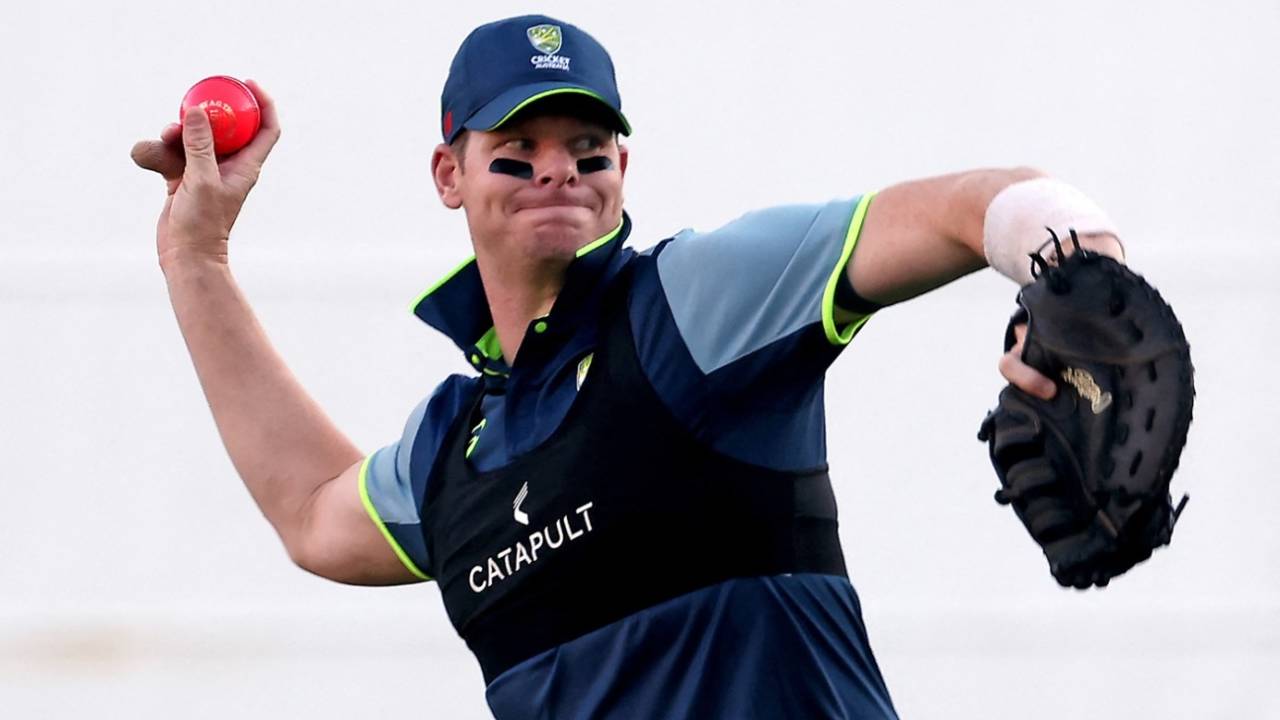
Steven Smith prepares himself for the pink ball with black tapes • AFP/Getty Images
Steven Smith has confirmed he will use the anti-glare strips under his eyes when batting during the day-night Test at the Gabba after some advice from Shivnarine Chanderpaul ensured he was wearing them the correct way up.
Smith trained with them under lights in the lead-up to the second Test against England and said he definitely felt a positive impact. However, initially he had not quite used them the way they were designed.
"I actually messaged Shivnarine Chanderpaul and asked him what his thoughts were, whether he wore the chalk or the strips," Smith said. "He said the strips, and he thinks it blocks out 65% of the glare. And he also said, 'I've seen photos and you're wearing them the wrong way'. So yesterday I put them on the right way.
"I agree with him. I think it certainly stops the glare. Yeah, I'll be wearing them."
Related
Selection uncertainty or smokescreen? Focus on Cummins day before Gabba Test
Cummins a chance for Gabba as Australia delay naming XI
Steven Smith bats with 'eye blacks' ahead of pink-ball challenge
Head 'happy' to keep opening amid Khawaja debate
Khawaja out of Brisbane Test after failing to recover from back spasms
The 'eye blacks' - small, black, adhesive strips worn on the cheekbone - that Smith wore in training are commonplace in several American sports, and are designed to reduce the glare from floodlights by absorbing the light that would otherwise reflect off the skin.
Smith is known to not be a fan of batting against the pink ball. In day-night Tests he averages 37.04 with one century compared to 58.31 in day matches with 35 hundreds.
"It's hard to bat all the time," he said of any difference between twilight and complete darkness. "It's a tricky one. The ball reacts obviously differently to a red one. It can change quickly. It can start moving randomly.
"You've got to try and play what's in front of you at that time and when it does shift on you and the ball starts doing something different, you've got to try and come up with plans to counter that, whether it be more aggressive, whether it be going to your shell and trying to get through that period. Everyone's different. It's trying to be one step ahead when it does start to shift."
During the previous day-night Test at the Gabba, when West Indies famously won by eight runs in early 2024, Mitchell Starc commented about how the harder surface at the venue meant the pink ball went softer than it does in Adelaide where extra grass can act as a cushion.
"I think Adelaide, the wicket they have down there, it's quite furry, and the ball can kind of stay harder for longer," Smith said. "Here it's obviously renowned to be quite a hard, fast wicket, and it's difficult to change your characteristics of the wicket. So at times [the ball] can get a little bit soft, and you can see guys batting comfortably at stages. So that's one thing we have to weigh up going into this game, and see how it plays out."
Amid uncertainty over how Australia would line up for the Test, Smith said they would be open to in-match flexibility around the batting line-up, referencing the possibility of two nightwatchers. But he was not fully buying into the belief of Pat Cummins and Travis Head that batting orders were overrated despite having opened the batting in four Tests in 2024 at his own request, including the last pink-ball game at the Gabba where he carried his bat to finish 91 not out in Australia's failed fourth innings chase.
"I think [with the] pink ball, anything's possible," Smith said. "We've been pretty open in the past around maybe having two nightwatchmen and things like that, so it's a completely different game.
"You've got to play what's in front of you at any given stage, but I'm not sure I completely agree with those two on the batting orders being overrated. I think it's nice to be in a similar role and get used to that role over and over again.
"So, it can change in games, and maybe that's the way forward. But having certain spots for one innings and other spots for a second innings, I'm not sure about. I think it's nice to have a single role and try to get used to that as much as possible."
Andrew McGlashan is a deputy editor at ESPNcricinfo