
A year in fast-forward: shorter games, quicker results, Starc contrasts
A stats overview of 2025, when breakneck speed was the default

S Rajesh
04-Jan-2026
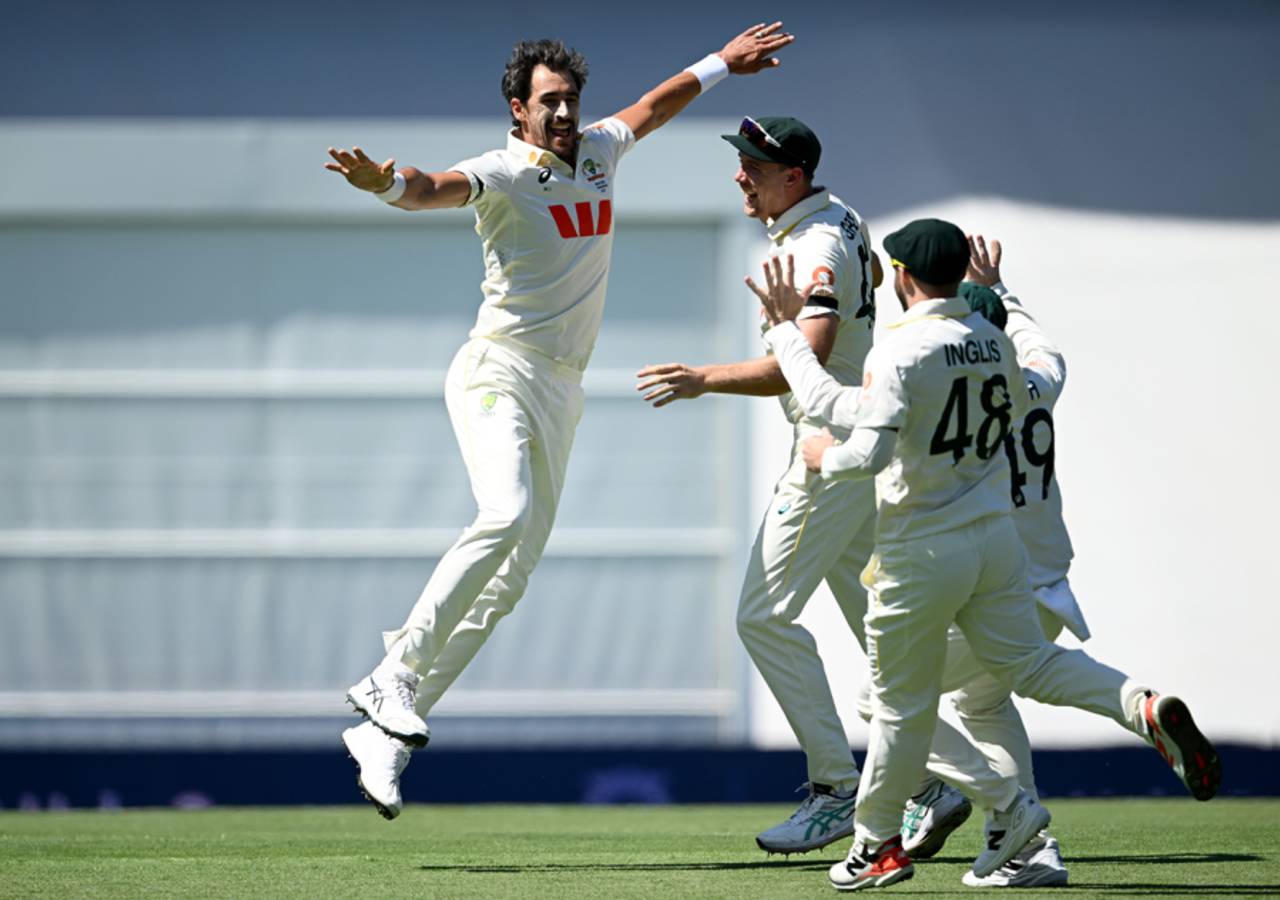
Starcnado: no bowler had a better year in Tests than Mitchell Starc who took 55 wickets at an average of 17.32, striking every 28.36 balls • Gareth Copley/Getty Images
The trend of bowler-friendly conditions and short Test matches, which was so prominent in 2024, continued in 2025. It was encapsulated in the much-hyped Ashes series, where the first four Tests saw only 13 days of cricket. The No. 3 batters struggled the most in these bowler-friendly conditions, while Mitchell Starc was unstoppable.
Elsewhere, women's ODI cricket had a memorable year both in terms of quantity and quality, highlighted by the 50-over World Cup throwing up a new champion. Here's a look at the major numbers and trends in cricket from 2025.
Hyperactive Test cricket
The average runs-per-wicket figure in all Tests went up marginally, from 29.01 to 30.24, but for the second consecutive year, only three Tests were drawn, which is the joint fewest in the 46 years in which at least 25 matches have been played. In percentage terms too, 2025 is the second-lowest in terms of draws, with 7.14, next only to 2024's 5.66%. For comparison, there were as many as 21 draws in 44 Tests in 1997, which is a telling commentary on how Test cricket has changed in the last 30 years.
The average runs-per-wicket figure in all Tests went up marginally, from 29.01 to 30.24, but for the second consecutive year, only three Tests were drawn, which is the joint fewest in the 46 years in which at least 25 matches have been played. In percentage terms too, 2025 is the second-lowest in terms of draws, with 7.14, next only to 2024's 5.66%. For comparison, there were as many as 21 draws in 44 Tests in 1997, which is a telling commentary on how Test cricket has changed in the last 30 years.
The 39 result games in 2025 lasted an average of 1633 balls each, which translates to 272.1 overs. That's barely over three days per Test, assuming 90, or even 85, overs per day. Among the 45 years in which there have been at least 15 decisive results, this is again the second-lowest, just three balls more than in 2024. Seventeen of the 39 result Tests didn't go beyond 1500 deliveries, or 250 overs. That's a whopping 43.6% of all decisive games, which is the highest ever in a year, even more than 2024's percentage of 40 (20 out of 50).
The shortest game of the year was the 847-ball Perth Ashes Test, where the bowlers dominated entirely for the first three innings before Travis Head flipped the script as Australia chased down the 205-run target in under 29 overs. That was closely followed by the Boxing Day Test in Melbourne. It wasn't quite as extreme as the 642-ball quickie in Cape Town in 2024 - the shortest decisive Test ever - but both Perth and Melbourne make the list of top ten shortest Tests ever. Five of the 11 shortest Tests have been played since 2021, indicating clearly which way Test cricket is headed. (The other six were all before 1936.)
On the other hand, only five matches lasted beyond 400 overs, with the longest of those being the drawn New Zealand-West Indies game in Christchurch, which lasted 418.4 overs. The fourth innings contributed a whopping 163.3 overs to that total, as West Indies battled hard for a draw against a depleted New Zealand attack. In 2024, there had been only one Test that lasted over 400 overs.
Overseas winners
Like 2024, overseas teams had another good year in 2025, which ended, quite fittingly, with England winning their first Test in Australia in 19 attempts. The 21 wins for away teams in 2024 remains a record, but in terms of win-loss ratio, 2025 was even better, with 19 wins - the joint second-highest ever - and as many losses, compared to 21 wins to 28 losses the previous year. In the 46 years in which at least 25 Tests have been played at non-neutral venues, there have only been four years when the win-loss ratio has been better. It helped that Zimbabwe hosted seven Tests in 2025, their second-highest ever in a calendar year. Opposition teams made good use of that opportunity, winning six of those matches.
Like 2024, overseas teams had another good year in 2025, which ended, quite fittingly, with England winning their first Test in Australia in 19 attempts. The 21 wins for away teams in 2024 remains a record, but in terms of win-loss ratio, 2025 was even better, with 19 wins - the joint second-highest ever - and as many losses, compared to 21 wins to 28 losses the previous year. In the 46 years in which at least 25 Tests have been played at non-neutral venues, there have only been four years when the win-loss ratio has been better. It helped that Zimbabwe hosted seven Tests in 2025, their second-highest ever in a calendar year. Opposition teams made good use of that opportunity, winning six of those matches.
Australia led the way for overseas teams with a spotless 5-0 record; Sri Lanka and West Indies were their hapless victims. South Africa were arguably even more impressive, with a win in Pakistan and two in India, apart from two in Zimbabwe. (The WTC final win doesn't count, as it was at a neutral venue.)
The 1000-run drought
While 2025 mimicked 2024 in several aspects in Test cricket, one major difference was the inability of any batter to top 1000 runs last year, compared to six in 2024. In fact, Shubman Gill was the only batter to get more than 850, but he fell short of the 1000-mark by 17 runs.
While 2025 mimicked 2024 in several aspects in Test cricket, one major difference was the inability of any batter to top 1000 runs last year, compared to six in 2024. In fact, Shubman Gill was the only batter to get more than 850, but he fell short of the 1000-mark by 17 runs.
That's partially because none of the teams played more than 11 Tests in 2025. Australia played 11, while England, India, Zimbabwe and West Indies played ten each. In 2024, England played 17 and India 15. Even so, it's extremely unusual that no batter got to 1000 Test runs in a calendar year: apart from the pandemic year of 2020, the last time they fell short like this was way back in 1996, when Alec Stewart's 793 runs from eight Tests was the highest. However, that was a World Cup year and Tests got short shrift - only 28 were played that year. Since then, there have been three years since 1996 when only one batter reached 1000 - 2023, 2021 and 2019 - but leaving 2020 aside, this is a first in 29 years.
No. 3s in a funk
This was the year when a No. 3 batter scored an unbeaten 367, a score bettered by only one batter at that slot, so it can't have been such a terrible year for No. 3s, right?
This was the year when a No. 3 batter scored an unbeaten 367, a score bettered by only one batter at that slot, so it can't have been such a terrible year for No. 3s, right?
Wrong. Apart from Wiaan Mulder's 367 not out, there was a 171 for Ollie Pope, a 147 for Mulder himself, and a 139 for Rahmat Shah. These all came from No. 3, and yet it's safe to say batters at that position had an abysmal year. That's because almost all their big runs - including all the innings above - came against Zimbabwe. No. 3 batters were in roaring form against that team, averaging 82.92, but against better teams they came an absolute cropper.
Against the top nine teams - Australia, India, England, South Africa, New Zealand, Pakistan, Sri Lanka, West Indies and Bangladesh - No. 3s averaged a measly 25.48, which is the lowest in any calendar year with a 20-innings cut-off. (There are 98 years that make the cut.) Against Zimbabwe, No. 3 batters scored four centuries in 16 innings; against the top nine teams, they managed two hundreds in 129 innings.
Several batters contributed to these lopsided numbers. Pope managed only 431 runs from 15 innings against India and Australia - and was eventually dropped for the final Test of the year - but scored 171 in his only innings against Zimbabwe. The contrast for Mulder was even starker: 531 runs in just three innings against Zimbabwe, compared to 90 from seven innings against Pakistan, Australia and India.
Among the others who did poorly at No. 3 against the top nine teams are Sai Sudharsan (average 27.45 from 11 innings), Marnus Labuschagne (26.12 from ten), Cameron Green (23.5 from eight), Alick Athanaze (17.83 from six), Keacy Carty (10.33 from six) and Babar Azam (11.25 from four). That has resulted in rather embarrassing collective numbers for a position that, not long ago, used to be manned by batting legends like Kumar Sangakkara, Ricky Ponting and Rahul Dravid. In contrast, the batters occupying that slot for most teams today - barring, most notably, Kane Williamson for New Zealand - are relative lightweights or struggling for form.
Quite fittingly, in the last innings of the year, England promoted Brydon Carse to that slot, hoping for some quick runs in testing conditions. He made six off eight balls. It was that kind of a year for No. 3s.
Starc soars
Mitchell Starc is unlikely to forget 2025 in a hurry. At the ripe age of 35 he has had the best year of a career spanning 15 years, an achievement made even more remarkable given he is a fast bowler. Not only is it his best year, it's also among the best any bowler has had.
Mitchell Starc is unlikely to forget 2025 in a hurry. At the ripe age of 35 he has had the best year of a career spanning 15 years, an achievement made even more remarkable given he is a fast bowler. Not only is it his best year, it's also among the best any bowler has had.
Apart from the last Test of the home series against India, and the WTC final, Starc played three series, and averaged under 18 in each of them - 14.33 in two Tests in Sri Lanka (six wickets, strike rate 33), 14.80 in three Tests in the West Indies (15 wickets, SR 26.2) and 17.42 in four Tests in the Ashes (26 wickets, SR 25.8). Add 5 for 107 in the WTC final and 3 for 85 in Sydney against India, and it gives him 55 wickets at an incredible average and strike rate - 17.32 and 28.3.
That average is in the top ten among the 108 instances of bowlers taking 50-plus wickets in a year, but the truly sensational metric there is Starc's strike rate: no bowler has ever had a better strike rate when they've topped 50 wickets. Waqar Younis' 29.5 in 1993 - when he took 55 wickets in just seven Tests - is a close second, with Jasprit Bumrah's 30.1 in 2024 (71 wickets in 13 Tests) in third place.
When got to reached 50 Test wickets for the year, in Adelaide against England, he had bowled only 1448 deliveries, which is the second fastest to the landmark for any bowler in a year. Only Waqar, in 1993, got there quicker, in 1393 deliveries.
What makes these numbers even more special is Starc's age. He turned 35 on January 30, 2025, which means he took 49 wickets last year after turning 35. Only three fast bowlers have taken more wickets in a year after turning 35 - Sydney Barnes way back in 1912, Courtney Walsh in 2000 and Glenn McGrath in 2005.
The year when women's ODIs stepped up
Women's ODIs occupied a significant portion of cricket's mind space in 2025. India's spectacular turnaround and their shock upset of Australia in the World Cup semi-final lit up the tournament and ensured it wouldn't follow the usual Australia-lift-another-world-title script, but even apart from that there were several standout aspects to women's ODIs in 2025, both for the format and in terms of personal landmarks and records.
Women's ODIs occupied a significant portion of cricket's mind space in 2025. India's spectacular turnaround and their shock upset of Australia in the World Cup semi-final lit up the tournament and ensured it wouldn't follow the usual Australia-lift-another-world-title script, but even apart from that there were several standout aspects to women's ODIs in 2025, both for the format and in terms of personal landmarks and records.
For a start, the format hosted 94 matches last year, 17 more than the most in any other calendar year till then: the previous record was 77, in 2022. Only three of those games were played after the World Cup ended (when South Africa hosted Ireland), while the World Cup itself comprised 30 matches, which was as many as the last couple of editions. So a majority of those matches were in the lead-up to the tournament. As many as seven teams played 14 or more ODIs each in the year, indicating more sides wanted optimal preparation to give themselves the best shot at the title. There had never been more than five teams playing so many matches in any previous calendar year.
The contrast with men's ODIs in 2025 was interesting. The men only played 115 matches, which is consistent with how the format is treated in non-World-Cup years: from 218 matches in 2023 when the last ODI World Cup was played, it dropped to 104 in 2024. The difference of 21 between the number of men's and women's ODIs is the smallest in the last 43 years, since 1983. The last time the difference was smaller was in 1982, when the men played 33 ODIs and the women 31.
Apart from just the sheer number of matches, women's ODIs last year were also more frenetic in 2025 than in previous years. For evidence, look at these numbers:
The average run rate exceeded five for the first time - 5.08, well clear of the previous best (with an eight-match cut-off) of 4.74 in 2024.
There were 25 totals of 300 or more in the year, a jump of 150% over the previous highest of ten instances in 2024 and 2022. In fact, India alone contributed nine such totals in the year, while South Africa had six and Australia five. All three are the highest for any team in a calendar year; the previous best was four, by New Zealand in 2018.
The sixes count shot up to 350 in 2025, up 68% over the previous best of 208 in 70 matches in 2017. It wasn't just because the volume of games went up: the per-game number was 3.7, up from 2.97 in 2017, while in terms of balls per six, the frequency went up from a six every 179 balls in 2017 to one every 133 in 2025.
For the first time, a batter scored 1000-plus runs in a year in the format: Smriti Mandhana finished with an impressive tally of 1362 runs from 23 innings, averaging 61.90. She wasn't the only one to achieve it either: Laura Wolvaardt capped a sensational World Cup with an aggregate of 1174 runs at 61.78. in fact, Pratika Rawal's 976 runs at 51.36 is also a higher aggregate than any batter had achieved in previous years.
More numbers from 2025
779
While Mandhana set the ODI record for most runs in a year, the record she held in T20Is was snatched away from her. UAE's Esha Oza scored 779 T20I runs in 2025, 16 more than what Mandhana managed in 2024. The record for most wickets in a year was also shattered in 2025, with Thailand's Thipatcha Putthawong taking 56, going past the previous high of 50.
While Mandhana set the ODI record for most runs in a year, the record she held in T20Is was snatched away from her. UAE's Esha Oza scored 779 T20I runs in 2025, 16 more than what Mandhana managed in 2024. The record for most wickets in a year was also shattered in 2025, with Thailand's Thipatcha Putthawong taking 56, going past the previous high of 50.
97
Wickets for Jason Holder in T20s in 2025, the highest ever for a bowler in a calendar year. He pipped the record by a solitary wicket - Rashid Khan took 96 in 2018, in 60 innings. Holder needed 68 innings for his 97 wickets, at an average of 21.42 and an economy rate of 8.3. Holder played for six different teams in the year: Abu Dhabi Knight Riders, Islamabad United, Khulna Tigers, Los Angeles Knight Riders, St Kitts and Nevis Patriots, and West Indies.
Wickets for Jason Holder in T20s in 2025, the highest ever for a bowler in a calendar year. He pipped the record by a solitary wicket - Rashid Khan took 96 in 2018, in 60 innings. Holder needed 68 innings for his 97 wickets, at an average of 21.42 and an economy rate of 8.3. Holder played for six different teams in the year: Abu Dhabi Knight Riders, Islamabad United, Khulna Tigers, Los Angeles Knight Riders, St Kitts and Nevis Patriots, and West Indies.
122
The number of sixes Austria's Karanbir Singh hit in T20Is in 2025, easily the highest for any batter in a year in the format. The previous record was a mere 69, by Fiaz Ahmed of Bahrain, also in 2025, followed by Suryakumar Yadav's 68 in 2022. Karanbir's 122 sixes came off just 851 balls, which works out to an average of seven balls per six. He also topped the charts for most runs in a calendar year, scoring 1488 at an average of 51.31 and strike rate of 174.85. The record for most wickets in a year in T20Is was also achieved last year, with Bahrain's Ali Dawood taking 63.
The number of sixes Austria's Karanbir Singh hit in T20Is in 2025, easily the highest for any batter in a year in the format. The previous record was a mere 69, by Fiaz Ahmed of Bahrain, also in 2025, followed by Suryakumar Yadav's 68 in 2022. Karanbir's 122 sixes came off just 851 balls, which works out to an average of seven balls per six. He also topped the charts for most runs in a calendar year, scoring 1488 at an average of 51.31 and strike rate of 174.85. The record for most wickets in a year in T20Is was also achieved last year, with Bahrain's Ali Dawood taking 63.
With more countries playing more matches in the format, it's not surprising that players from the top teams hardly feature in these lists.
8.21
The overall run rate for all T20s in 2025, the highest in any year. If we restrict this to just the top leagues - the IPL, BBL, CPL, PSL, SA20, Blast and BPL - the rate goes up to 8.91, also the highest. Next in line are 2024 and 2023, indicating that batters are gradually figuring out every year just how high the ceiling can be in this format.
The overall run rate for all T20s in 2025, the highest in any year. If we restrict this to just the top leagues - the IPL, BBL, CPL, PSL, SA20, Blast and BPL - the rate goes up to 8.91, also the highest. Next in line are 2024 and 2023, indicating that batters are gradually figuring out every year just how high the ceiling can be in this format.
8
The number of wickets Bhutan's Sonam Yeshey took in a single T20I innings, against Myanmar. This event was overshadowed by events elsewhere on the same day, as 20 wickets fell in Melbourne on Boxing Day, but Yeshey is the first bowler to take eight wickets in a T20I. Four others have seven.
The number of wickets Bhutan's Sonam Yeshey took in a single T20I innings, against Myanmar. This event was overshadowed by events elsewhere on the same day, as 20 wickets fell in Melbourne on Boxing Day, but Yeshey is the first bowler to take eight wickets in a T20I. Four others have seven.
S Rajesh is stats editor of ESPNcricinfo. @rajeshstats