
The passionate poet
Edmund Blunden's Cricket Country laments the passing of an age and revels in the timelessness of the game

Suresh Menon
Apr 5, 2009, 12:35 AM
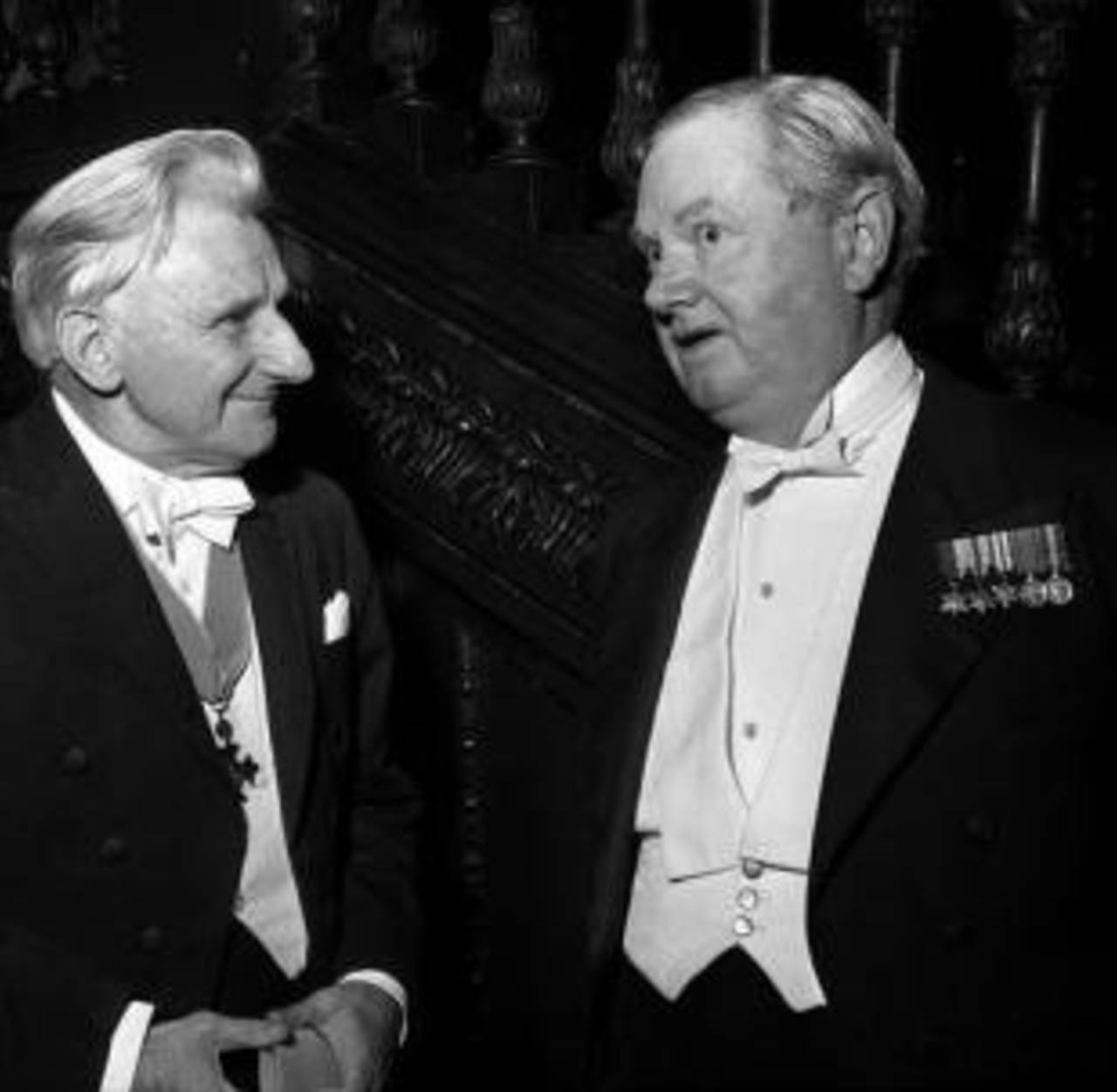
Blunden (left) with Evelyn Waugh in 1963 • PA Photos
Edmund Blunden was 70 when he became Professor of Poetry at Oxford University, succeeding his friend Robert Graves, another of the Great War poets. I don't know how many of that talented group - Rupert Brooke, Wilfred Owen, Siegfried Sassoon among them - is still read today, or which of Blunden's own efforts spring readily to mind when the poetry of that period is discussed. In 1985, 11 years after he died, Blunden was among 16 Great War poets commemorated in Poet's Corner in Westminster Abbey. The inscription on the stone was written by Wilfred Owen. It reads: "My subject is War, and the pity of War. The Poetry is in the pity."
But for our purposes here, Blunden is the author of Cricket Country, the journey of a man whose interest in the game was, in the words of one writer, "fanatical". According to the Guardian, Blunden "loved cricket... and played it ardently and very badly." Perhaps his insistence on often batting without gloves contributed to the image.
In a charming tribute, his daughter Catherine wrote: "Asthmatic and unwell, he still had the energy and enthusiasm at 68 to teach me how to play cricket in our gravelled yard. Wearing an over-washed matted grey cardigan and baggy grey trousers, now very tight around the tum, and wheezing away, he still had the strength and skill to match far younger men."
Cricket Country was written during the Second World War - a quarter century after Blunden had fought in the first. It was not listed among Cricinfo's 45 Must Read books, but had that list been made a couple of generations earlier, that book would have been on it.
In his review of Cricket Country, George Orwell called Blunden "the true cricketer", explaining thus: "The test of a true cricketer is that he shall prefer village cricket to 'good' cricket… [Blunden's] friendliest memories are of the informal village game, where everyone plays in braces, where the blacksmith is liable to be called away in mid-innings on an urgent job, and sometimes, about the time when the light begins to fail, a ball driven for four kills a rabbit on the boundary."
"The game which made me write at all, is not terminated at the boundary, but is reflected beyond, is echoed and varied out there among the gardens and the barns, the dells and the thickets, and belongs to some wider field"
That description immediately dates the book; it also underlines one of the conceits of the game, and emphasises its class divisions.
Blunden dwells on the golden age, nearly a century ago. Yet the following might have been written last week: "The press has done much to make the game more of a total warfare than it used to be. The papers during a Test match provide us with three accounts of play. Not content with that, there are some who listen to the radio! I sometimes dwell on the variants in the narratives as fondly as an editor of Shakespeare deciding whether Hamlet said that he wished his too solid, his sullied, his sallied, or souled flesh would melt…"
Blunden both laments the passing of an age and revels in the timelessness of the game, and it is this passion that marks the book, even if it is a bit over-written, with the author likely to quote poetry at the drop of a hat. Of his heroes, he says, almost innocently, "They vanish, these immortal players, and we suddenly realise with astonishment that years have passed since we heard a passing mention of some of them. At one point they seem as much a part of the permanent scheme of things as the sun which glows upon their familiar faces and attitudes and the grass which makes the background for their portrait, and then, bless us, it is time for even them to go."
Any cricket book that talks easily of Henry James and Siegfried Sassoon and Ranji and Grace and Richard Burton (the writer, not the actor) and Coleridge is bound to have a special charm of its own. As Blunden says, "The game which made me write at all, is not terminated at the boundary, but is reflected beyond, is echoed and varied out there among the gardens and the barns, the dells and the thickets, and belongs to some wider field."
Perhaps that is what all books on cricket are trying to say.
Suresh Menon is a writer based in Bangalore