
Tatenda Taibu's eyes are on the road ahead
Whether it's spotting young players with talent - from Zimbabwe or elsewhere - or mentoring his 16-year-old son, he's looking to the future

Firdose Moonda
Feb 6, 2026, 2:30 AM • 5 hrs ago
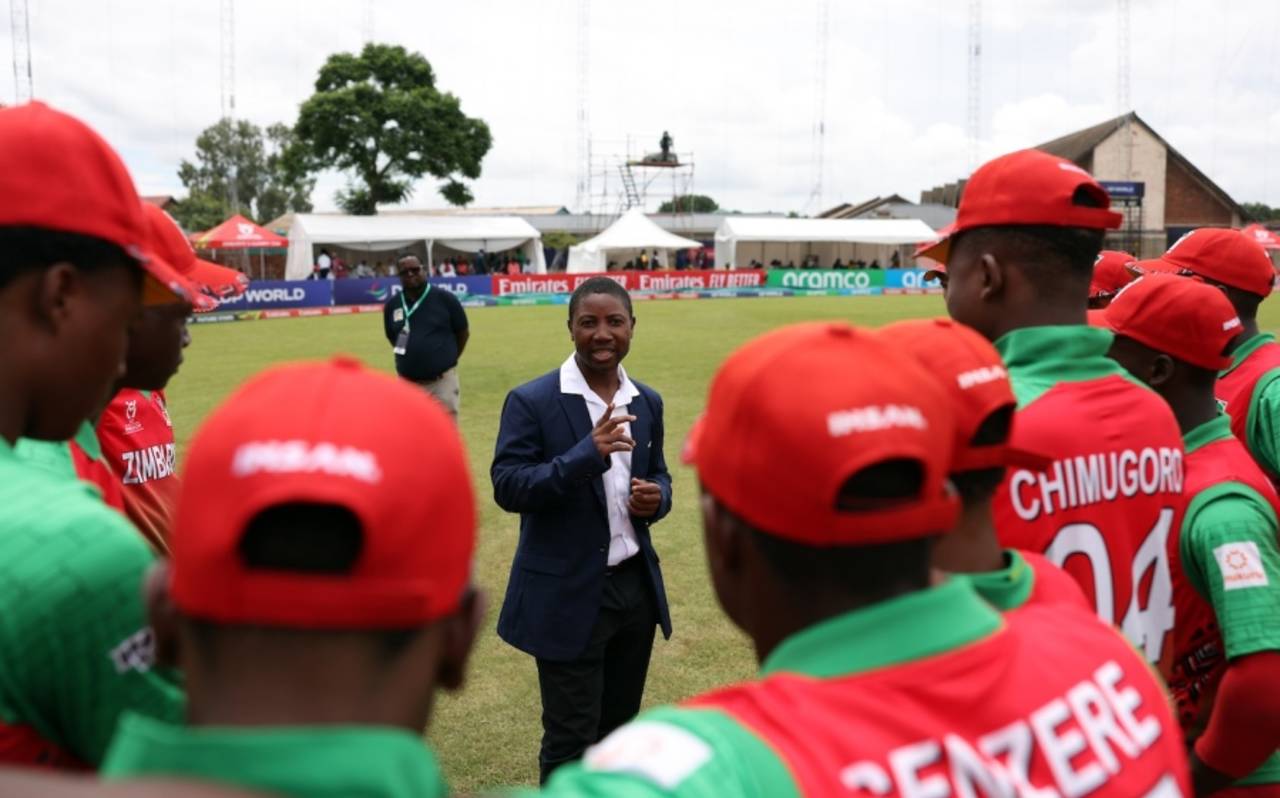
Tatenda Taibu, who played two Under-19 World Cups for Zimbabwe in 2000 and 2002, is the ambassador for the 2026 edition • ICC/Getty Images
Tatenda Taibu was just 14 years old when he helped to make sure Takashinga Cricket Club, the venue in the high-density area of Highveld in Harare, was suitable to play.
"I remember when I used to push the wheelbarrow to get some bulli [soil] to put on the wicket. There was hardly any grass, it was just dust. We started doing it little by little, playing and looking after the field ourselves. We did that for a couple of years before Zimbabwe Cricket gave us the groundsmen and started putting a bit of money into the ground," he said. "So when I walked in now and saw green grass all around the field, I was quite emotional. I hadn't seen it like that before."
Taibu, now based in England, is back in Zimbabwe in his role as Under-19 World Cup ambassador. His visits to his childhood club, which has now hosted international matches, is one of the things that has made the journey home special. The other is watching the talent at the tournament, which he calls a "trampoline" for young players to launch their careers in the same way he did.
He played in two editions of the U-19 World Cup, in 2000 and 2002, and made his senior debut in between those tournaments.
"The first one, Sri Lanka, I was pretty young and I was the second keeper at the start of the tour as we're doing the warm up games. But the coach [Iain Butchart] was really impressed with the way I was playing and I ended up being the No. 1 keeper and batting No. 2. It happened so quickly. And I think I ended up being the third-highest scorer in our side. That gave me a lot of confidence," he says.
At 16, Taibu was the second-youngest player in Zimbabwe's squad (Hamilton Masakadza was three months his junior) and finished behind Greg Lamb and Guy Crowxford on Zimbabwe's run-charts. By the time the next tournament came around, he had already played two Tests and seven ODIs, albeit with poor results, and felt even more equipped to perform. "I made the national team after the first World Cup. And, going into the second U-19 World Cup, I believed that I would be one of the best players in the tournament," he said.
In 2002, in New Zealand, Taibu finished just outside the top ten run-scorers and was Zimbabwe's second-best batter. Zimbabwe won the Plate final in that tournament thanks to a Brendan Taylor century. From that squad, Taylor, Taibu, Masakadza, Charles Coventry, Elton Chigumbura, Sean Ervine and Stuary Matsikenyeri all went on to have notable senior international careers.
According to ESPNcricinfo's stats, 61 of the 173 Zimbabweans who played in U-19 World Cups have gone on to represent their senior side. And there were a handful of others who moved on to other teams (like Colin de Grandhomme and New Zealand). That's a conversion rate of 35% which is the fifth-best among Full Member teams. How does the class of 2026 stack up?
Zimbabwe lost heavily to England and Pakistan in the group stage, and only qualified for the Super Six after Pakistan slowed down dramatically in their chase against Zimbabwe, which allowed both teams to go through.
The Zimbabwean side is inexperienced, and especially their struggles with the bat were notable, but Taibu is also concerned about their confidence.
"Part of my heart is with Zimbabwe because that's my country," he said. "When I spoke to them during their second game, when they were playing against England, just after they had their lunch break and were about to go in to field and they were quite nervous still. This was halfway into the match. I felt a bit sorry for them.
"They have to know that the talent is there. The talent is there, but it's only that I think there can be a better way to try and round up all the players. Some young Zimbabwean players are in England; some players are in South Africa. The more numbers that you've got, the better."
Mining Zimbabwe's talent is something Taibu is passionate about, especially because he has been exposed to an environment in England where that happens alongside education. Many educational institutions in that country offer cricket as a sport, so that aspirant players can get both a degree and exposure to a high level of competition. Taibu would like to see the same in Zimbabwe.
"We don't have cricket in universities, so some parents that are financially able will take their kids outside the country because they want them to continue playing cricket," he said. "If someone is to remain in Zimbabwe, they'll be playing only club cricket. That is not enough cricket for them to then push for places at the elite level. Before I think about facilities in Zimbabwe, I would think about those two levels, the grassroots in terms of making the pyramid a bit wider and then the high-performance, where cricket is also played in universities."
Zimbabwe Cricket is upgrading facilities in Masvingo province and continues to work on their upcoming flagship stadium in Victoria Falls. That way the game is set to grow in both the south and north of the country. Ultimately, Taibu believes the staging of the 2027 ODI World Cup could prove a game changer because of the impact it will have.
https://www.espncricinfo.com/story/zimbabwe-cricket-flagship-stadium-at-victoria-falls-draws-criticism-1500407
"When we had the 2003 World Cup, we predicted that in the next five years, cricket was going to be the No. 1 sport in the country because of the attraction that the World Cup brought and because we then qualified to the next round," he said. "So whenever there's a World Cup in the country, if we market it well, kids come to watch and parents have a reason for why they should let their kids play cricket. That is the main thing for me. The more players that you have, the better the elite team will be."
Given Zimbabwe's difficult economic situation, which dates back to over two decades now, growth across all sectors, including sport, is hard to measure. But given the decline in the country's football (including that there are no FIFA accredited stadiums in use and internationals are most often played in neighbouring South Africa), and the packed stands at both Harare Sports Club and Queens in Bulawayo, it's fair to say cricket has become a popular choice. Its challenge is to sustain interest through results, especially as rugby develops at pace. Zimbabwe will play at the 2027 rugby World Cup, their first appearance since 1991. At the same time they will co-host the 50-over cricket World Cup, which Taibu expects to inspire the next generation, not only through the country's own players but also with talent from abroad.
In the last few years he has coached Papua New Guinea's men's side, and spent time coaching at academies in Bangladesh and Pakistan. At this U-19 World Cup, 14 players he coached at various points were part of the tournament, ten from Pakistan, including the wicketkeeper Hamza Zahoor, seamer Ali Raza, and four from Bangladesh. Though neither of those sides progressed to the semi-finals, Taibu has identified Pakistan's captain, Farhan Yousaf, who didn't have the best tournament with the bat, making one fifty, as someone to watch. "He is a good player and maybe he just put too much pressure on himself, but he is someone to look for in the future."
He has also been impressed by Afghanistan, who reached their third U-19 World Cup semi-final, and whose No. 3, Faisal Shinozada, was the leading run-scorer after the semi-finals.
Those are not the only teenagers Taibu has an eye on. The reason he has stepped away from full-time coaching is to dedicate time to his younger son, "who is becoming quite good", he said. "He's just made the U-16 side at Derbyshire county. He's a wicketkeeper too, so let's just say the apple didn't fall too far from the tree."
There are some differences, though. "He is taller than me already, and maybe even fitter. My highest-ever beep test was 13.8. And he got to 13.8 three weeks ago. I thought I'll give him a couple of years where I'm really serious about coaching him without any distraction of coaching another national team and then see where it goes."
That doesn't mean he isn't open to a more front-facing role in Zimbabwe Cricket, with whom he has had a fractious relationship historically. After he stopped playing in 2012, he had a brief stint as selection convener in 2016 but sometimes struggled to see eye to eye with the administration. That has changed as he has gotten older and realised that he is ready to give back.
"I've got a good relationship with ZC and saw a lot of them when Zimbabwe came to play in England that one-off Test [in 2025]," he said. "But the thing for me is that I am more mature as well. Before, I was very strong on my thoughts, and I didn't care who was listening and who was not. On both sides, I think there's a bit more maturity and understanding of how life should actually go."
Firdose Moonda is ESPNcricinfo's correspondent for South Africa and women's cricket