| Series | Countries | Live Scores | Fixtures | Results | News |
Features
|
Photos | Video & Audio | Blogs | Statistics | Archive | Games | Mobile | ||||||||||||||||||||
|
Like other Australian spinners in India, Gavin Robertson finished his tour with a good idea of how to bowl there. Somehow the lessons keep getting lost

March 1, 2013
![]()
|
|||
|
Related Links
Matches:
India v Australia at Bangalore
Series/Tournaments:
Australia tour of India
| Australia tour of India
Teams:
Australia
|
|||
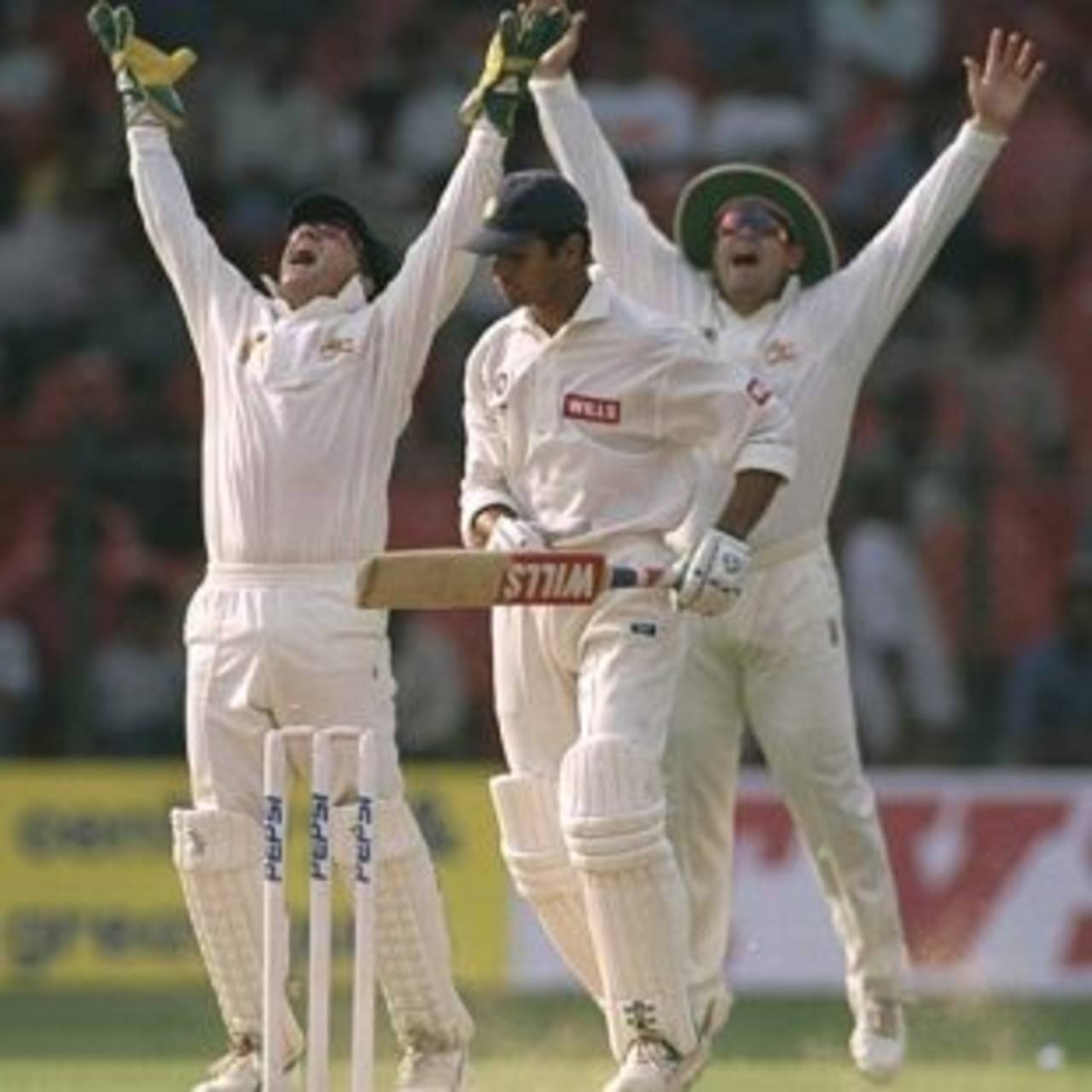
Sitting towards the back of a Bangalore function room in March 1998, Gavin Robertson and Steve Waugh shared a glum, quiet dinner. Australia had been overtaken by India in the first Test, in Chennai, and then obliterated in the second, at the Eden Gardens. Robertson's offspin had been toyed with, while Waugh was coming to terms with his first Test-series loss in four years. Noticing the duo away from the gathered dignitaries, the august figure of Erapalli Prasanna ventured over to join the New South Welshmen. By way of a greeting he offered the words: "You have no idea what you're doing here."
Robertson's mere presence in India had been a shock to many. Touring Pakistan in 1994, then opposing Waugh for Australia A in the World Series Cup of the following home summer, Robertson had drifted so far from international reckoning that in the summer preceding the India Tests, he had played only a solitary Sheffield Shield game for the Blues. In it, however, he had taken seven wickets at Adelaide Oval, keeping his name from sliding completely. Shane Warne's desire to be paired with a spinner in the vein of the retired Tim May, and some prodding from Waugh and Mark Taylor subsequently, had Robertson trading his day job managing grocery shelves for a six-week journey through India.
"I was only training two or three days a week, which I almost find hilarious," Robertson recalls. "I wasn't that physically fit, I would eat whatever I had to at work to do long days, and play grade cricket on Saturday. The next thing I knew, I was playing Test cricket in 84% humidity and 44C. I think I lost 8kg on the trip."
Perhaps not surprisingly, given his preparation, Robertson struggled to find the right method, though he fought admirably in Chennai, taking wickets and making stubborn lower-order runs. Despite the team's pre-eminence as the world's top-rated side, there was a lack of knowledge and understanding about India, a country most had visited once or twice at most - this was Warne's baked beans tour, after all.
"It was a rollercoaster three Tests. We didn't really know what we were doing in the first Test, and my pace was wrong, even though I took five wickets. What happened to me the Indians did to both myself and Shane Warne. Every time you'd bowl a good ball they negated it and waited for that patience to go, and then they really went after you. If you had a moment where you bowled two or three bad balls in an over, then you all of a sudden went for 12 or 16 runs. That's where the pressure builds."
So when Prasanna made his challenge about Australia's ignorance of India, Robertson found himself nodding. Waugh was a little more feisty, remonstrating with the man often considered the best of all India's offspinners, and author of the immortal slow-bowling maxim "Line is optional, length is mandatory." Perhaps throwing in a four-letter word or two for emphasis, Waugh asked Prasanna, "Well, if you know so much, how about you tell us?" What followed would change Robertson's tour.
"Prasanna talked about how you've got to understand a batsman," Robertson says. "You want to try to lock the batsman on the crease with the amount of spin you've got on the ball and your pace and dip. You've got to combine that to make sure the batsman feels like if he leaves his crease to take a risk, it's going to drop on him and he'll lose the ball.
"So he'll search quickly to defend, and that will cause him to feel nervous about leaving his crease, and that'll start to get him locked on his crease. Then you'll get him jutting out at the ball and jabbing at it with his hands. Then he'll start trying to use his pad and his bat together to negate a good ball. Finally he said, 'All you have to do is get that right pace and create that feeling, and then you have to do it for 20 or 30 overs in a row, and you'll bowl them out.'"
| "It's about finding the right pace and line that locks the batsman on the crease. If you can do it for long periods of time, you win the pressure battle, you break them down, you get wickets" Gavin Robertson | |||
Subtlety, discipline and consistency. These were not outlandish tactics, but they mirrored what Robertson had seen from his Indian counterparts, both in 1998 and on the tours to follow. Over the next few days before the third Test, in Bangalore, Robertson worked at this method, quickening his pace slightly and seeing useful results in the nets. By the time he came on to bowl again on the first morning of the match, his confidence was restored to a decent level. Flicking the ball from hand to hand, he thought of bowling a couple of tidy maidens before lunch then settling in for the afternoon.
Nathan Lyon is familiar with the sort of thing that happened next. Those two overs went for plenty, leaving Robertson's mind to race again. "I went to lunch with 0 for 31 off two and I thought, 'I'm in real trouble here,'" he says. "When I came back on after lunch Stephen [Steve Waugh] was at mid-off and I said 'I'm going to go for it here, I'm going to try to spin a bit harder and bowl a bit quicker.'
"I added two extra steps to my run-up, which I'd never done. I told myself to bowl like a medium-pace offspinner - you bowl with a quicker arm action and actually get more on the ball. I bowled to Tendulkar and he came forward, it gripped and it spun, went past him, nearly hit Ian Healy in the head and went for four byes.
"I just kept doing it. I went from 0 for 31 off two overs to 2 for 58 off 11.2 overs, and in the second innings I took 3 for 28 off 12 and we won the Test. Those were the lessons. It sounds quite simple, but it's having the experience and the patience to keep doing it. They're not worried about you unless you bowl really well."
Robertson's awakening to what was required to bowl spin effectively in India is a tale that is true for many Australian spin bowlers who have ventured to the subcontinent. Robertson describes it as cases of "failure, failure, then some success by the time you go home". Jason Krejza was all but a lost cause on the 2008 trip until he worked with Bishan Bedi in the Delhi nets, and subsequently harvested 12 wickets - albeit expensive ones - in Nagpur. Nathan Hauritz was never able to settle in 2010 as he entered the tour after injury and then had his bowling style changed, not by the locals but by Ricky Ponting, who desired his tweaker to "bowl more like Harbhajan Singh", whatever that meant. None were granted a second chance to tour India and use the knowledge gained on the earlier visit.
"You could almost have all those learnings on a whiteboard or some sort of document that relays 'This is the plan for this, we know what we've been up against before, knock it over,'" Robertson says. "That's what I thought we were supposed to be doing when we went two and half weeks early. We probably haven't learned from those past tours."
For now, Lyon is trying to work out how best to succeed in Hyderabad, having taken four wickets in Chennai but at an enormous cost. Robertson recalled Prasanna's advice, but also the example set by R Ashwin and Ravindra Jadeja in Chennai.
"Have a look at the pace the Indian bowlers bowled at in the first Test," he says. "Just over, say, an hour or 15-over period, and watch how many times they're full and they're up outside off stump and spinning back. And then watch us and see how many times in that period we get short and get worked. How many times do we get scored off short balls, and how many times the other way?
"The Indians always bowl full with the right pace, the ball is dropping at sufficient pace and there's not enough time to get down the wicket to it. In Australia, Nathan Lyon can bowl on middle stump and a little bit short. Because the wickets are so quick here, it's so much harder for a batsman to punish it. Over there it's so slow, as soon as you bowl too short and on the wrong line, it just sits up like a cherry and it goes.
"It's about finding the right pace and line that locks the batsman on the crease. If you can do it for long periods of time, you win the pressure battle, you break them down, you get wickets."
Prasanna could not have said it better himself.
Daniel Brettig is an assistant editor at ESPNcricinfo. He tweets here
© ESPN EMEA Ltd.
| ||||||
| Comments have now been closed for this article |
||||||
Assistant editor Daniel Brettig had been a journalist for eight years when he joined ESPNcricinfo, but his fascination with cricket dates back to the early 1990s, when his dad helped him sneak into the family lounge room to watch the end of day-night World Series matches well past bedtime. Unapologetically passionate about indie music and the South Australian Redbacks, Daniel's chief cricketing achievement was to dismiss Wisden Almanack editor Lawrence Booth in the 2010 Ashes press match in Perth - a rare Australian victory that summer.
Go Figure: S Rajesh and Andy Zaltzman explore the hidden secrets behind 222
Rewind to 1978: When the felling of a tailender by Bob Willis triggered a push for helmets. By Martin Williamson
Player education outside franchises' ambit
Amrit Mathur, Sharda Ugra and Nitin Sundar discuss the implications of the spot-fixing revelations for IPL franchises
Harsha Bhogle: Out of the shattered lives of three young men caught up in allegations of fraud, newer and stronger players must emerge
Jarrod Kimber: In this week's News Hurl, Warner rages, Yusuf kicks, a political party moralises, and Maxwell remains awesome
As we go into the last week of the league games of IPL 2013, seven teams have a mathematical chance of making the last four. Here's what each of those teams needs to do
Pollard sledges Watson, Dravid is angry
Plays of the day from the IPL match between Mumbai Indians and Rajasthan Royals in Mumbai
Unfortunate Sunrisers let match slip away
For 36 overs, Sunrisers painstakingly built a position of strength only for one terrible over to spoil it for them
A talent that didn't know its own worth
Sreesanth wasn't the most likeable team-mate or opponent, but he had skill beyond doubt, which we might have seen the last of
Kartik wins in Royal Challengers' loss
It is hazardous to go by bowlers' figures in T20, but his figures of 4-0-17-1 in defence of just 115 were possibly an accurate reflection of how well he bowled
Unfortunate Sunrisers let match slip away (73)
For 36 overs, Sunrisers painstakingly built a position of strength only for one terrible over to spoil it for them
As we go into the last week of the league games of IPL 2013, seven teams have a mathematical chance of making the last four. Here's what each of those teams needs to do
Dravid and the art of T20 captaincy (56)
Despite a small squad bereft of big names, Rajasthan Royals' captain has churned out win after win
Pollard sledges Watson, Dravid is angry (43)
Plays of the day from the IPL match between Mumbai Indians and Rajasthan Royals in Mumbai
'I have decided to return to my natural game' (39)
Misbah-ul-Haq talks about his approach to the captaincy, the criticism he has copped for his defensive style, and the lessons from the drubbing in South Africa
ICICI Bank M2I. Register Now and Get A Gift Offer.
Safe & simple online money transfer. Apply Now!
Buy Wisden 2013 & get a FREE Playfair
Available now at Cricshop
Prasanna's maxim applies to all bowling not just spin.A full toss on a good off stump line at 150km is easier to hit than a ball on a good length wide of off stump or on the leg side. The length to bowl in the conditions is what a bowler HAS to work out.Look at the success Aust had as soon as McDermott got Hilf & co. to move their stock ball up a bit.Cook hammered Hilf in the last Ashes as the length was wrong & he simply read any movement off the pitch & waited for the loose ball - which duly came!This is exactly what the Indians are doing to Lyon. His length is wrong for the conditions.It aint rocket science & it's SO frustrating sitting on a couch in Aust watching it unfold!When Lyon does bowl at the correct length & it's defended I find myself yelling at the TV "that's it Nathan,just keep putting 'em there mate!"Next ball comes in, it's shorter & the batsman shifts back & tucks it away on the legside!It's the easy milking which is hurting more than the loose ball going for 4 or 6
Nice read! Spin bowling is a huge exercise in disciplines;patience in particular.There can't be one speed for all the bowlers that are out there throwing down tweaks.More than hitting a particular range of the speed gun,the bowler needs to pay attention to getting that dip that defeats the batsman and sows that element of doubt in his mind whenever he tries to advance down the track,thereby forcing him to play from the crease or going by the phraseology employed-locking the bat on the crease.Every bowler's unique in arm action,wrist action,and the other works,and the game changes accordingly,but the basic aim must be to challenge the batsman's intention to smother the designs early by playing it from close to the pitch of the delivery,so that he feels less confident the next he goes for it. And of course length is the key.Short pitched stuff is garbage if you bowl at 90kmph. The best spin bowlers will always make you want to drive.That's how they get you...Sweet temptation!
Lovely piece! Robertson returned the favor too. Before the Sydney test of India's disastrous 1999-00 tour, Laxman was continuously getting out after trying to set himself for a long haul and getting defensive after scattering the field early. Robertson advised him to change his guard slightly and keep going for it as long as he chose the right balls to punish. The result was a brilliant 167 few days later. @Meety - thanks for the reminder about Collin Miller. Happy memories!
Great article - its worth mentioning that a few years later, Colin Funky Miller took 6 wickets in his only appearance in India. He bowled (when not as a medium pacer) around 95kph. It really does keep the Indian batsmen rooted in the crease. In Asia - Miller took 22 wickets @ 32 & a S/R of 64, not bad for a bloke who was not a full time spinner, (or for most of his career a part time cricketer)!!!
A very thought-provoking piece. I have long maintained that locking a batsman to the crease is an essential skill for a spinner, but that it is not a tactic that can easily succeed without a quality gloveman. This is because it is the very real threat of being stumped or caught behind off a faint edge that helps lock the batsman in. To this end, Robertson had the assistance of Ian Healy behind the stumps, one of the best in the business. This is a lesson which has been rapidly forgotten and, for that reason, it is partly up to the selectors to back Nathan Lyon with a better gloveman if he is to ever put such advice to effect.
Posted by@cork123 : quite correct! Even in the article it is not mentioned that Steve Waugh's the captain. However, he was taking the mantle from the legendary Mark Taylor.
Also, don't understand why Aussies give up on their spin options so quickly. This guy got 12 wickets in 3 matches against India, 1 against Pak, and never played again.. Serious issue there.. Hope same doesn't happen to Nathan Lyon..
Posted by Swingit on (March 4, 2013, 0:13 GMT)So why did line and length make absolutely no difference to the great Brian Lara. He just hammered everything good length or not, good line or not. Just ask Danish Kaneria and Murali. With the ball spitting like a cobra on subcontinental dust bowls and batsmen going down like dominoes Lara just kept piling on the misery for Murali in SL same thing in Pak for Kaniera. I would like to know what the heck was his secret.
Posted by The_Red_Cherry on (March 3, 2013, 21:31 GMT)Marvelous piece. The intricacies of spin bowling are yet to be understood fully. Anil Kumble defied almost every tenet of the coaching manual. And while he bowled in the higher 90's kmph range he actually spoke about having to bowl slower in Australia in the 2003-2004 tour where he enjoyed a terrific run. Ajmal does not flight the ball much but still manages to get that dip. At the same time I'm reminded of the New Zealand off-spinner Paul Wiseman who did flight the ball in Indian tracks but was unable to extract anything from the pitch. Sunil Joshi was another bowler who had the classical loop of a left armer but was unsuccessful even at home. I guess it is more about understanding the dynamics of your deliveries and playing with the mind of the batsman that determines your success as a spinner.
Posted byHow fantastic to wake up to nothing interesting in the mainstream news then to read cricket literature like this. Cricket is alive and kicking thanks to explorations of good writing and knowledge... and of course cricket.
Posted by Alexk400 on (March 2, 2013, 22:42 GMT)Bottom line is aussies did not have cook or pieterson caliber players except clarke. The same indian spinners made impotent by cook and pieterson