
From Chandigarh to Mumbai, Nepal's Karan KC set to fulfil long-due Wankhede dream
Now a senior player for his country, Karan's turning point came after impressing in tennis-ball cricket with Brett Lee's action

Shashank Kishore
Feb 6, 2026, 7:16 AM • 5 hrs ago
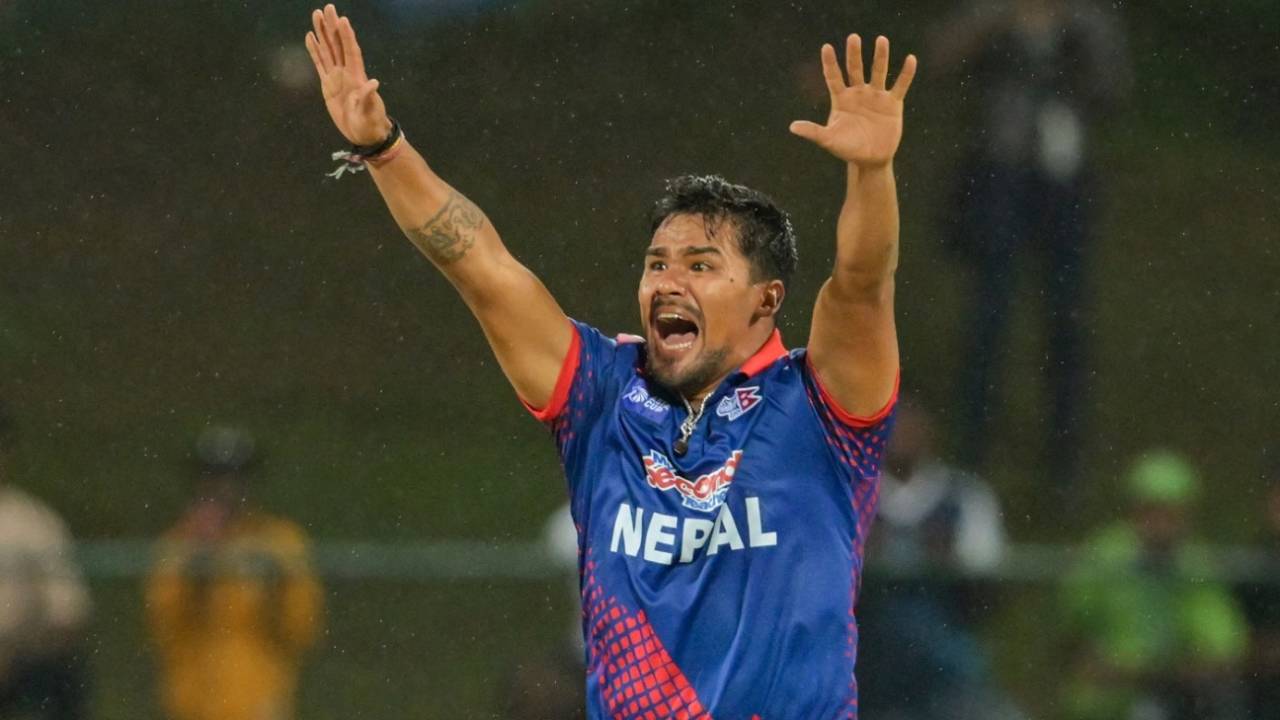
Karan KC: "Sometimes we take cricket so seriously that when we lose, we don't know how to handle it" • AFP/Getty Images
For a better part of his early years as a professional cricketer, Karan KC was a regular visitor to Mumbai. He would train every summer at an academy run by Umesh Patwal. Yet, one box on his wish list remained unticked: playing at the Wankhede Stadium.
On Sunday, when Karan walks out at the Wankhede to play for Nepal in their T20 World Cup 2026 opener against England, that long-standing dream will finally be realised. With Nepal scheduled to play all their group fixtures at the same venue, there's also the chance of creating some memories at the iconic ground.
"I've roamed around a lot in Mumbai, taking autos and local trains from Kandivali [where he stayed]," Karan told ESPNcricinfo. "But could never get inside Wankhede. During one of my first trips, I really wanted to see the ground. So we took a local train to Churchgate. Just standing outside, getting that close to the ground, was quite amazing. Now to imagine we'll be playing there, it's very exciting.
"Umesh Sir always used to say, 'one day you'll play there'. When the fixtures came out, I told him, 'finally it's happening'. He was very happy."
Mumbai, though, was only one of Karan's Indian connections. He grew up in Chandigarh, where his father worked. It was there that he built his foundation through backyard cricket with his older brothers.
"We'd play one-on-one matches, tri-series, all of that. I'd always choose Australia; my brother would choose India. If I was bowling, the rule was you had to change your action every over. My first over would always be Brett Lee's action because I was a huge fan. Then Glenn McGrath, and so on. If I was batting, I'd open like Ricky Ponting. If he got out, then I'd bat left-handed, like Adam Gilchrist. That's how I learnt the basics."
Karan wouldn't begin formal coaching until he was 14. The turning point was a school trial, where he impressed after bowling with Lee's action. By class 10, he was captaining his school team to a tournament final. Around the same time, he was also competing in the junior national judo championships for Chandigarh.
But when he went on to junior college, cricket took over completely. "Tennis-ball cricket," he interjects. "Day and night, I only used to play. I used to play matches in the morning, go to college for a couple of hours, return and once again leave in the evening, and sometimes come back home only the next morning. To the point that my parents began to wonder if I'd fallen into bad company."
By class 12, Karan had become a familiar name in Chandigarh's fiercely-competitive tennis-ball circuit that was at times frequented by those who were playing competitive red-ball cricket. "Those tournaments were big," he says. "I played with Manpreet Gony, [and] Manan Vohra. Even Navdeep Saini used to come and play."
Karan earned just enough to cover his expenses, but the joy was "something else". Once he completed his BA from Chandigarh University, his father was clear that Karan needed to get more serious.
"I was sent back to Nepal in early 2014 to apply for my passport," Karan says. "The idea was that once my visa came through, I'd move to Malaysia, where both my brothers had shifted to. I was a graduate by then; maybe I could find a job if I tried."
Karan settled temporarily in Pokhara, the nearest regional centre to his village in Baglung, and stayed with relatives. "I didn't even speak proper Nepali then," he says. "I could understand it, but I was much more comfortable in Punjabi and Hindi."
While helping his cousin one day, Karan watched people gather around the TV at the shop she ran in Pokhara. Nepal were playing Hong Kong in the T20 World Cup in Bangladesh. "That's when I realised Nepal actually had a national team. I thought, 'okay, now I should try'," he says.
"Life is good now for a Nepal cricketer. "We earn a monthly salary, plus match fees. My NPL contract goes up to NPR 20 lakh. I've been able to build a home in Pokhara. My parents moved back from India three years ago. They're very happy."
That path led him to Deepesh Khatri, a former Under-19 cricketer, who was a big name in the region. Khatri helped unroll Karan at the Annapurna Machhapuchhre Club in Pokhara after watching him impress in a college tournament while playing as a proxy for someone else.
"I didn't belong to the college, but when they saw me play, they were impressed and took me in their team," he says with a laugh. "They said we'll manage everything, [and] no one would find out." No one did, not until Karan became a big enough name.
Soon after, Karan was asked to attend a national camp in Kathmandu. He travelled overnight, unsure even where to get off. Around the same time, selections were underway for the Everest Premier League (EPL), where he was picked as a net bowler.
Pubudu Dassanayake, Nepal's head coach at the time, was overseeing the trials. Clearly impressed by what he saw, Dassanayake recommended Karan's name to Panchakanya Tej, one of the teams in the competition.
By then, Karan had been back in Nepal for nearly a year. And with no sign of his visa, his parents grew testy and would often call from India, unaware of how much headway he had made into Nepal's cricket structures.
In 2015, Karan made his Nepal debut. In EPL 2016, Karan took nine wickets in six games as his team won the title. "I earned around NPR (Nepalese Rupee) 1500 per match, plus the winners' cheque - in all about NPR 25,000 in total," he remembers. "My dad was in Nepal then. I gave him NPR 20,000, and kept 5000 for myself. He was happy. It was only when he saw my name in the newspapers that he slowly became okay with me playing cricket."
More than a decade later, the journey continues. Today, he is a senior figure in the national side, and has played a stirring run in the team's journey to the World Cup Qualifiers in 2023, troubled Rohit Sharma with his outswing at the Asia Cup later that year (reels of which he has on his favourites), featured in the T20 World Cup in 2024 in the USA and West Indies, and captained Kathmandu Gorkhas in the Nepal Premier League (NPL), apart from being Nepal's second-highest wicket-taker in T20Is.
"Life is good now for a Nepal cricketer," Karan says. "We earn a monthly salary, plus match fees. My NPL contract goes up to NPR 20 lakh. I've been able to build a home in Pokhara. My parents moved back from India three years ago. They're very happy."
Recently engaged and heading into another World Cup, Karan couldn't be in a better space.
"My brothers are both settled," he says. "One's in Japan, one's in the US. But they still call me and say, 'You're captain now - why aren't you opening?'"
Throughout the hour-long conversation, Karan regales you with stories and laughter. There's an easy and a free-spirited energy about him that reflects his deep love for the game. A self-confessed Australia loyalist, he now speaks with equal admiration for Pat Cummins.
"I'm reading his book, Tested," Karan says. "One line has stayed with me. 'Cricket is a part of life, not life itself'. Finish the game and enjoy life outside it. Sometimes we take cricket so seriously that when we lose, we don't know how to handle it. I've always liked Australian cricket. Even when they're down, losing is never in their DNA. They always find a way back. That's the mentality I have, and the one I want others around me to have."
Remember the Wankhede box Karan will soon tick? He's already looking forward to the next. Having already trekked to the Annapurna Base Camp, he has his sights on the Everest Base Camp.
"Seven to ten days. Very gruelling," he says. "We haven't had time the last few years. Maybe after the World Cup."
For now, training and bowling at the Wankhede, maybe hitting sixes, "like that MS Dhoni six", would do.
Shashank Kishore is a senior correspondent at ESPNcricinfo