
'I've got faith in my experience to do well' - de Winter
Ali de Winter, Australia's new bowling coach, says maintaining a balance on bowlers' workload will keep them fresh in a busy international schedule

Brydon Coverdale
03-Aug-2012
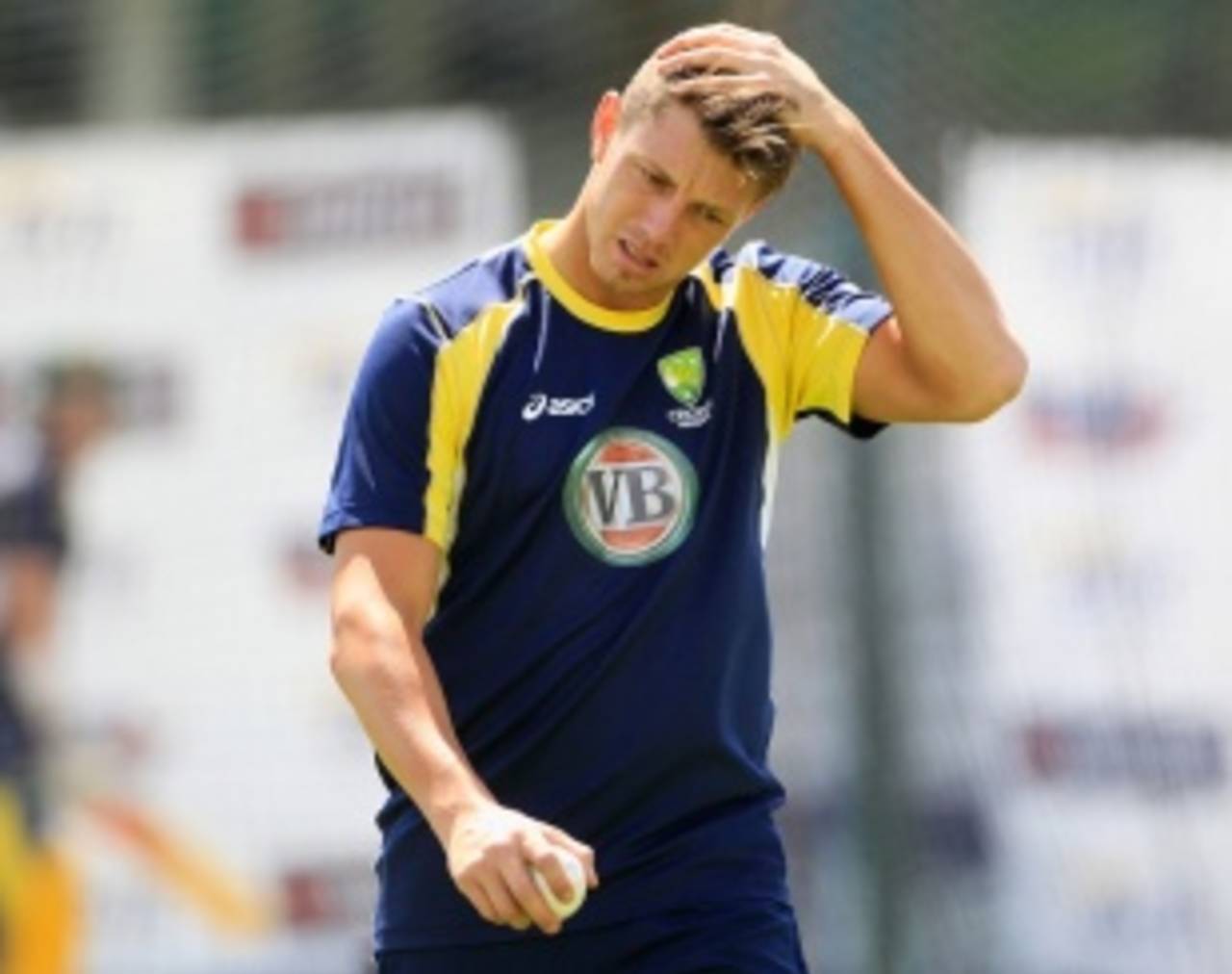
"We are on the same page," de Winter said of James Pattinson, who had asked for a proven practitioner as Australia's bowling coach • Getty Images
During Australia's one-day tour of England in June, James Pattinson spoke of the importance of Australia's new bowling coach being a proven practitioner, a former international player who could teach the young bowlers from personal experience. There was no doubt that Pattinson, and many of his fast-bowling colleagues, enjoyed having Craig McDermott around the group over the previous year and thrived under his guidance.
Less than two months later, Cricket Australia has appointed McDermott's replacement: Ali de Winter, who was the stand-in bowling coach on that England tour. He does not have international playing experience, nor even a great deal of first-class experience - in 21 first-class matches for Tasmania he collected 35 wickets at an average of 50.51. But he is a career coach, a man who has honed his teaching skills over a decade, internationally and in Australia.
He is also far from the only international bowling coach to be drawn from the first-class sphere: David Saker (England), Joe Dawes (India) and Damien Wright (New Zealand) did not reach international level and are now in charge of Test attacks. Cricket Australia had no doubts that de Winter was the right man for the job - the Pakistan champion Waqar Younis also applied - but de Winter is aware there will be plenty of people who will take convincing, just as Pattinson had done.
"I read that with interest," de Winter said of Pattinson's comments. "But to James' credit he came to me straight away and he wanted to talk through that. To me, that showed a sign of maturity. By the end of the four weeks we were on the same page and we were good mates, we could share information and we had started to build up that trust and he was really supportive of me going forward with the process and he's really looking forward to working with me now.
"I think there will be people who will say that the bowling coach needs to have been there and done it. I'm a career coach, so I don't necessarily believe that. I've got a lot of trust and faith in the experience that I've had internationally and here with Cricket Tasmania. I think it will be an issue to some people. I think the pressure will come on if the bowling group don't start to show that they're improving. But it doesn't matter to me. It matters to some."
Pattinson is one member of a very promising group of young Australian fast bowlers who will be working with de Winter on a full-time basis now, along with the likes of Pat Cummins and Mitchell Starc. But one of de Winter's major challenges will be to work with the team's medical staff to keep the young attack fit, which over the past year has proven harder than expected.
Pattinson, 22, picked up an abdominal strain during the England tour and has also had back and foot complaints since making his Test debut in December. Cummins, 19, was sent home from England with a side strain and also suffered a foot injury over the summer, and keeping both young men on the field will be critical to Australia's plans over the next 12 months leading up to next year's Ashes.
"I think their actions are both pretty sound," de Winter said. "There's little bits of tinkering you can do along the way but they've got to where they are because their actions are good and they're able to execute skill. That's one thing we don't have to worry about. The focus should be on having them physically fit enough and prepared as best as they can be.
"That means maintenance on their strength and their fitness all the way along, as well as getting good treatment and recovery. That's a difficult thing to balance in such a busy schedule. We need to maybe target bowlers that are better at one form of the game and have them more available for Test cricket if that's what it is, or one-day cricket if that's what it is, because in this climate we're in now it's very difficult to play all forms, all the time.
"We've got to find a strategy to make sure that we have less injuries. With such a busy schedule in the next 12 to 18 months I think we need to jump on that pretty quickly. People have talked about rotating the bowlers through at different times and I think that's worth consideration. But you can only rotate if you've got good players to come in."
The national selectors have already shown their hand in that regard by leaving Pattinson out of their Twenty20 plans, but rotation will become more of an issue with a heavy schedule over the next year including the ICC World Twenty20, home Test series against South Africa and Sri Lanka and a Test tour of India ahead of the Ashes, not to mention one-day internationals scattered throughout.
De Winter hopes that keeping the bowlers strong will also help them to become more physically intimidating, which is often a key feature of the best attacks. Peter Siddle, Ryan Harris, James Pattinson and Ben Hilfenhaus can display that kind of hostility, but de Winter wants to instil that aggression in the entire bowling group.
"There's a certain amount of aggression in that group," he said. "That's only four [bowlers] of maybe a dozen or 15. What I would like to see is that everybody has that mindset of being aggressive and strong and have a physical presence on the ground, which at the moment is what the South Africans are doing and what the English appear to be doing.
"Australia's bowling attack is probably not the most feared in world cricket and for a long, long time we had that aura about our bowling group. I think that's something we should want to strive to get back to. I think we can change the physical culture in our bowling group and make sure that we're the strongest and fittest going around. With that comes confidence."
And plenty of people will gain confidence in de Winter if he can achieve that.
Brydon Coverdale is an assistant editor at ESPNcricinfo. He tweets here