
Nannes for president
Modern cricket needs more players whose life is not just the game
06-May-2009
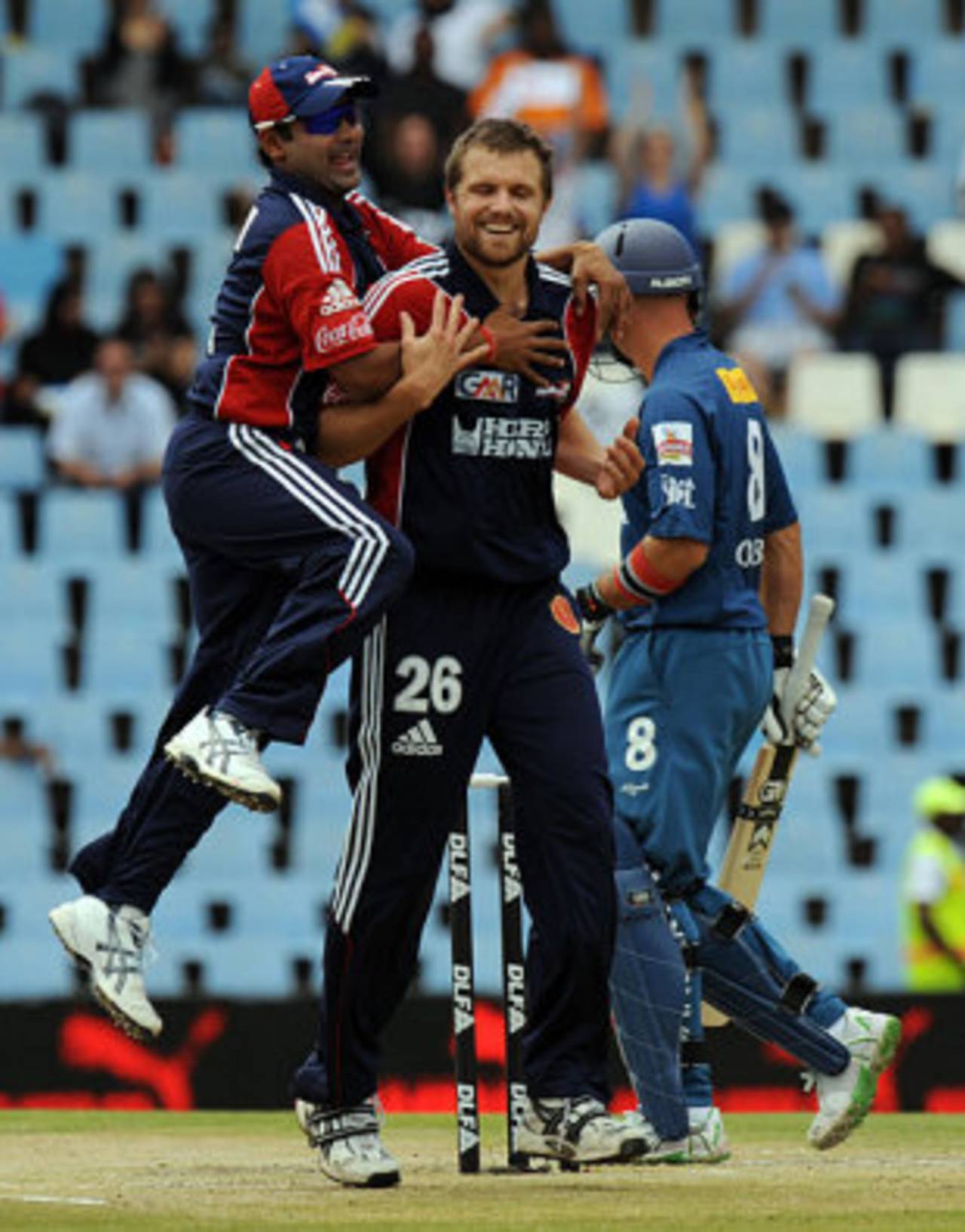
The other way in: Nannes worked his way into cricket from outside the fold • Getty Images
What's not to love about Dirk Nannes of the Delhi Daredevils? He speaks Japanese, he plays saxophone, he is an expert skier and runs a ski travel business. His nickname is Diggler, which while not hugely imaginative at least honours a pretty cool Paul Thomas Anderson film, rather than some multiplex schlock with Jim Carrey or Adam Sandler. And he bowls with a wickedly quick left arm that makes good batsmen hurry and the ball go late.
Above all, the well-travelled Nannes, 33 years old next week but only three years a first-class player, is demonstrating the good that can come from turning a game upside down, revealing the hitherto concealed: Daredevils captain Virender Sehwag says that his opening bowler is the fastest bowler he has ever faced. But were it not for the worldwide talent search compelled by the IPL, Nannes would still be the answer to an Aussie domestic cricket trivia question rather than the 21st century's answer to CB Fry.
This phenomenon of a household name being created from an outhouse name occurred to a limited degree during IPL's first season, with the accelerated advance of the likes of Shaun Marsh and Sohail Tanvir, not to mention the sudden profile it made available to Indian domestic players such as Swapnil Asnodkar and Manpreet Gony. It was the first indication of how the IPL could reshape cricket's career structures. The time-honoured progression has been school-club-state-country, with a stop-off on the way in recent years at some high-performance centre or academy. With its enormous audience and relentless coverage, IPL made everything big and everyone famous, regardless of pedigree and position.
That is being repeated in IPL 2 with the roly-poly Dolphin Yusuf Abdulla, and more talent from India's first-class circuit like KP Appanna, Shadab Jakati and Shane Warne's rags-to-rupees teen tearaway Kamran Khan. But Nannes is something else: a soi-disant "accidental cricketer" over-endowed with other talents. The only reason to discount him as the hidden hand behind "Fake IPL Player" is that as a nipponophile he probably prefers haiku. The IPL, in fact, would seem a pretty good fit for Nannes' lifestyle. Able to earn more cash in six weeks of the IPL than in six months as a Sheffield Shield toiler, he can now afford to learn Aramaic or master the harpsichord.
Even in this era of hyper-professionalism, other sports have allowed scope for the talented dabbler. In American football there was Robert Smith of the Minnesota Vikings, with his zeal for philanthropy and passion for astronomy. In golf, New Zealand's Greg Turner grew up in a family where brother Glenn was destined to score a hundred hundreds and brother Brian to pen eight collections of poetry: Greg stretched himself both ways, winning a dozen international tournaments until his retirement in 2000, while also indulging his knack for journalism and interest in politics and the environment.
Cricket loves its renaissance men: Fry, Bob Crisp, Aidan Crawley, the redoubtable Major Poore. But reaching the top today, it is assumed, demands a whole-hearted, hole-headed commitment - the game and nothing but the game. Use the phrase "well-rounded cricketer" and it is assumed you are alluding to Samit Patel or Jesse Ryder. Some have wondered whether this is all to the good. In complaining that England is surfeited with first-class cricket and cricketers, for example, Mike Atherton has mooted a "semi-professional" level, in which players could "develop interests outside the game, preparing for life beyond cricket".
The IPL seems a pretty good fit for Nannes' lifestyle. Able to earn more cash in six weeks there than in six months as a Sheffield Shield toiler, he can now afford to learn Aramaic or master the harpsichord
Nannes appears to have arrived at a sort of semi-professionalism from the opposite direction, working his way into cricket from outside the fold. But perhaps he is also the harbinger of a more interesting kind of cricketer - one whose life is not just cricket, having perhaps started late, and choosing to proceed from one professional assignment to another rather than to set his sights on a Test cap.
Whatever the case, IPL 2 is certainly pointing to another modification of the standard career structure, by demonstrating the possibility of extended twilight. Following the example of Shane Warne last year, Matthew Hayden, Adam Gilchrist, and Anil Kumble have been rolling back the years in South Africa after having ending careers in the recent past with more a whimper than a bang. What appeared at first a game for youth, elan and elasticity has turned out friendly to the old stager and the deteriorating physique, thanks to Twenty20's limited and specialised skills, and also its brevity. It's arguable, in fact, that Warne and Hayden are still in the best Twenty20 XI in Australia, albeit that they would probably be deemed ineligible for selection because they no longer represent an Australian state.
Next month marks the centenary of the first meeting of what became the International Cricket Council - which, somehow, is not marked by a worldwide public holiday. And while Lalit Modi's brainchild is reshaping cricket in more ways than anyone imagined, the ICC slumbers fitfully in Dubai, powerless to influence this ostensibly "domestic" tournament. Whither a new leader for cricket? The ideal candidate would be someone broad, strategic, eclectic, well-travelled, capable of seeing the game in the context of its society, while not regarding it as the most important thing in the world. You know what I'm thinking, don't you? Time to call in Dirk Nannes.
Gideon Haigh is a cricket historian and writer