|
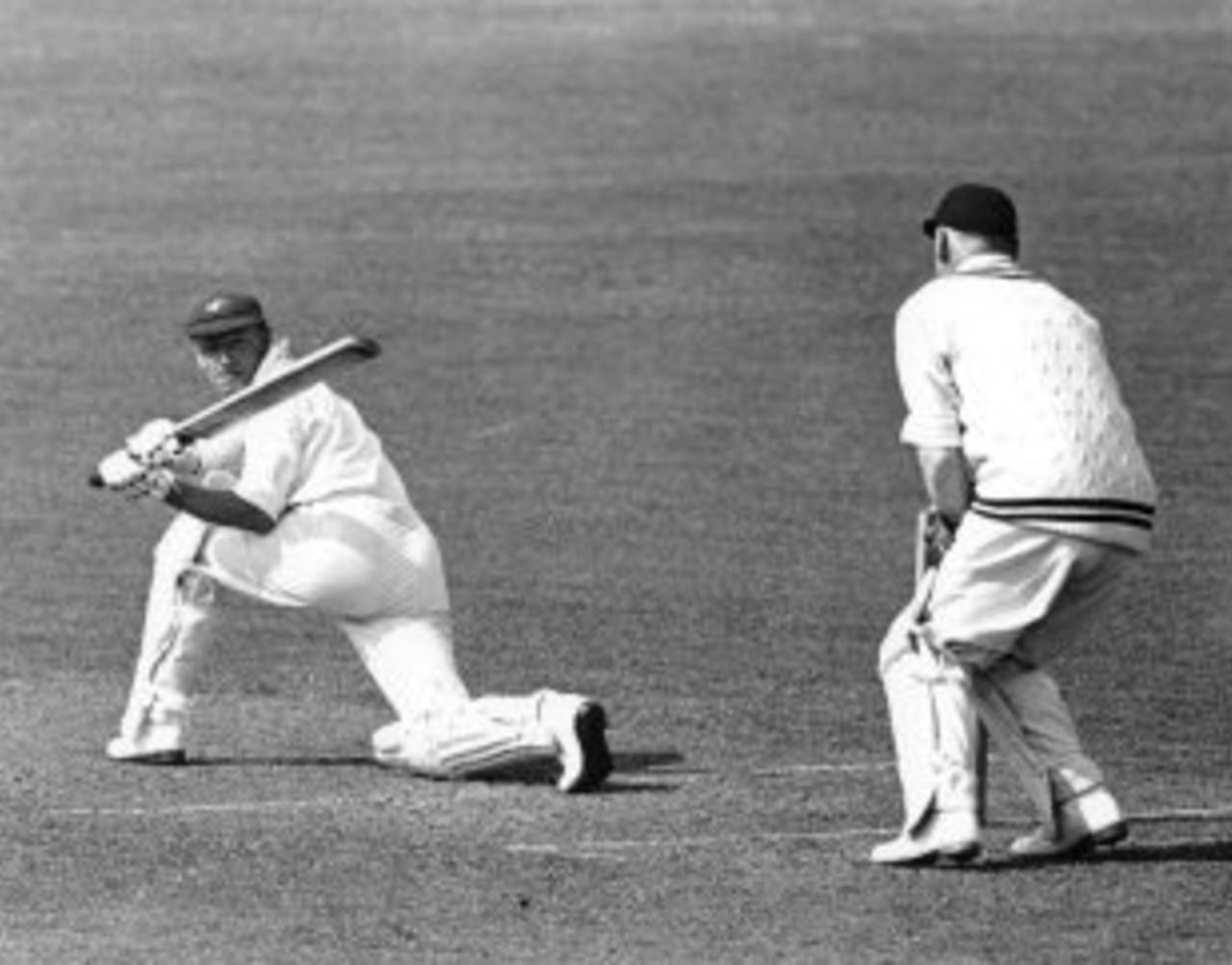
In terms of numbers, Don Bradman's achievements are so staggering that many of them will almost certainly never be equalled

September 6, 2010
![]()
|
|||
|
Related Links
Players/Officials:
Sir Donald Bradman
Teams:
Australia
|
|||
Even among cricketing legends, Don Bradman's stature is one that no other player has come close to. His stats are so much better than anyone before, during or after his time, that it truly boggles the mind. Various arguments are offered about the changes in the game today to try and explain 99.94: fielding standards have improved, making it tougher for batsmen to score; captains are more agreeable to posting defensive fields and restricting the runs; the game is played across several countries as opposed to just a few during Bradman's time, making it more difficult to adjust to different conditions. While these statements may be true as independent facts, they do nothing to diminish the sheer genius of the Don, and the staggering magnitude of his achievements.
The most famous number, of course, is his Test average, which is 64% better than the next-best (with a cut-off of 2000 runs). That alone shows how much better Bradman has been than anyone who has ever played the game. Comparing the overall batting numbers during his time with the corresponding number today further illustrates this point: in the 20 years in which Bradman played his Test cricket, the overall batting average was 31.85; in the 21 years since Sachin Tendulkar's Test debut, the overall batting average in 845 Tests is 31.07. Restricting this only to top-order batsmen (batsmen in the top six of a line-up) also throws up similar numbers - 39.99 during Bradman's time (1928 to 1948), and 38.40 during Tendulkar's (November 1989 onwards).
Apart from Bradman and Graeme Pollock, West Indian George Headley and Herbert Sutcliffe of England were the only ones who scored more than 2000 Test runs at averages of more than 60.
| Batsman | Tests | Runs | Average | 100s/ 50s |
| Don Bradman | 52 | 6996 | 99.94 | 29/ 13 |
| Graeme Pollock | 23 | 2256 | 60.97 | 7/ 11 |
| George Headley | 22 | 2190 | 60.83 | 10/ 5 |
| Herbert Sutcliffe | 54 | 4555 | 60.73 | 16/ 23 |
| Ken Barrington | 82 | 6806 | 58.67 | 20/ 35 |
| Everton Weekes | 48 | 4455 | 58.61 | 15/ 19 |
| Wally Hammond | 85 | 7249 | 58.45 | 22/ 24 |
| Garry Sobers | 93 | 8032 | 57.78 | 26/ 30 |
Among the batsmen who averaged 60, Pollock was the only one who came in after Bradman's time. Till the end of the 1940s, when Bradman finished his international career, Headley's 63.91 was the nearest anyone came to his 99.94 (though Headley's average fell away a bit later). Denis Compton, who was almost halfway through his Test career, averaged more than 60 at that point too, but his performances fell away thereafter and he finished averaging 50.06 from 78 matches.
| Batsman | Tests | Runs | Average | 100s/ 50s |
| Don Bradman | 52 | 6996 | 99.94 | 29/ 13 |
| George Headley | 21 | 2173 | 63.91 | 10/ 5 |
| Herbert Sutcliffe | 54 | 4555 | 60.73 | 16/ 23 |
| Denis Compton | 36 | 3132 | 60.23 | 13/ 12 |
| Dudley Nourse | 26 | 2469 | 58.78 | 8/ 12 |
| Wally Hammond | 85 | 7249 | 58.45 | 22/ 24 |
| Jack Hobbs | 61 | 5410 | 56.94 | 15/ 28 |
| Len Hutton | 41 | 3788 | 56.53 | 11/ 17 |
Bradman's stats are even more remarkable because of the eight years he lost due to the War. His ill health meant he might not have played too much cricket during this period anyway, but when international cricket resumed in 1946, he was able to summon his best immediately: in his first innings he scored 187 in Brisbane against England, and followed that up with 234 in the next Test, in Sydney. He followed that up with four centuries in six innings against India in 1947-48, and then, in the famous tour of the Invincibles in 1948, scored an unforgettable 173 not out as Australia became the first team to successfully chase a 400-plus target in the fourth innings. In the 15 Tests he played after the War, Bradman averaged more than 105, and scored eight hundreds.
| Period | Tests | Runs | Average | 100s/ 50s |
| Till 1938 | 37 | 5093 | 97.94 | 21/ 8 |
| From 1946 | 15 | 1903 | 105.72 | 8/ 5 |
| Career | 52 | 6996 | 99.94 | 29/ 13 |
Talking about Bradman, Arthur Morris, the Australian opener who played with him, said: "He could never figure out how someone could get 60 or 70 and not get a hundred. He was able to concentrate so well, which kept him going and going and going." One look at the conversion rate corroborates exactly what Morris was talking about: Bradman scored 29 centuries in 52 Tests, and only 13 fifties. He also scored 12 double-centuries, which remains three more than the next best, and two triple-hundreds, which has been equalled by two batsmen.
Bradman's ratio of hundreds to fifties was a staggering 2.23. Among those who have scored at least 20 centuries, the second-best ratio is less than half that of Bradman's: India's Mohammad Azharuddin has 22 hundreds and 21 fifties, a ratio of slightly more than 1. Matthew Hayden is the only other batsman with more centuries than half-centuries.
| Batsman | Tests | 100s | 50s | Ratio |
| Don Bradman | 52 | 29 | 13 | 2.23 |
| Mohammad Azharuddin | 99 | 22 | 21 | 1.05 |
| Matthew Hayden | 103 | 30 | 29 | 1.03 |
| Virender Sehwag | 79 | 21 | 22 | 0.95 |
| Wally Hammond | 85 | 22 | 24 | 0.92 |
| Aravinda de Silva | 93 | 20 | 22 | 0.91 |
Bradman scored a hundred every 1.79 Tests, which is again almost twice as good as the next best - Hayden's 3.43. The rate at which Bradman got double-hundreds was even more astounding - 12 in 80 innings, an average of one every 6.67 innings. In contrast, Brian Lara has nine in 232 innings (25.78 innings per double-century), Wally Hammond seven in 140 (20), Kumar Sangakkara seven in 152 (21.71), and Virender Sehwag six in 135 (22.50).
| Batsman | Tests | 100s | Ratio |
| Don Bradman | 52 | 29 | 1.79 |
| Matthew Hayden | 103 | 30 | 3.43 |
| Sachin Tendulkar | 169 | 48 | 3.52 |
| Garry Sobers | 93 | 26 | 3.58 |
| Greg Chappell | 87 | 24 | 3.63 |
| Sunil Gavaskar | 125 | 34 | 3.68 |
Bradman's propensity for big centuries also meant most of his career runs came in innings in which he made hundreds. Of the 6996 runs he scored, 5393 were in the 29 innings in which he scored centuries - a percentage of 77.09. In his other 51 innings he only scored 1603 runs at a modest average of 34.10. (Click here to check out where this average stands compared to other batsmen, with a cut-off of 1500 runs in non-hundreds.)
His percentage of 77.09 is also way higher than the other batting greats. Tendulkar's 48 hundreds have contributed 6964 out of 13,837 runs (50.33%), while the percentage for Ricky Ponting is 46.85, for Brian Lara 49.27, and 47.44 for Sunil Gavaskar. In those 29 innings in which he scored a hundred, Bradman scored almost 186 runs per innings, while his batting average (not-outs excluded) was more than 234. As the table below shows, his runs per innings is the highest among batsmen with at least 20 Test hundreds, though the difference between him and the next best isn't quite as much as in some other categories.
| Batsman | 100s | Runs in 100s | Average | Runs per inng |
| Don Bradman | 29 | 5393 | 234.47 | 185.97 |
| Virender Sehwag | 21 | 3706 | 185.30 | 176.48 |
| Brian Lara | 34 | 5889 | 184.03 | 173.21 |
| Wally Hammond | 22 | 3685 | 245.66 | 167.50 |
| Kumar Sangakkara | 23 | 3840 | 240.00 | 166.96 |
| Mahela Jayawardene | 28 | 4551 | 182.04 | 162.54 |
Bradman's 52 Tests were spread over only 11 series, since five-Test series were the norm then, and his averages in each of them show just how great a batsman he was. The lowest he averaged in any of them was 56.57, in the Bodyline series in 1932-33. On the other hand, he averaged more than 100 four times, and between 90 and 100 three times. (Click here for his series-wise averages.)
| 50 to 69.99 | 70 to 89.99 | 90 to 99.99 | 100 or more | |
| No. of series | 2 | 2 | 3 | 4 |
Almost 20% of the Tests Bradman played were against India and South Africa, the two weak teams of his era. Bradman cashed in, averaging 190.12 in those 10 Tests, and scoring eight hundreds. However, in 42 other Tests he still averaged more than 88, and scored a hundred every two Tests.
In the 52 Tests he played, Bradman scored more than 25% of his team's runs (6996 out of 27,624 bat runs), more than 41% of the hundreds (29 out of 70) and averaged more than three times the combined average of the other batsmen. It can safely be said there won't be another like him again.
| Tests | Runs | Average | 100s/ 50s | |
| Don Bradman | 52 | 6996 | 99.94 | 29/ 13 |
| Other batsmen | 52 | 20,628 | 31.21 | 41/ 88 |
| Comments have now been closed for this article |
||||||
Stats editor Every week the Numbers Game takes a look at the story behind the stats, with an original slant on facts and figures. The column is edited by S Rajesh, ESPNcricinfo's stats editor in Bangalore. He did an MBA in marketing, and then worked for a year in advertising, before deciding to chuck it in favour of a job which would combine the pleasures of watching cricket and writing about it. The intense office cricket matches were an added bonus.

Bought as a rookie for an eye-popping fee, Sunil Narine and his knuckle ball have delivered in the IPL. Next up? Watch out, Test cricket. By Nagraj Gollapudi
Young quick with lower back pain?
Bone stress injuries cannot be taken lightly - they have ended many careers and put others on hold, says Andrew Leipus
A pretty good day to be a 'Sam'
Two Chucks: Darren Sammy shuts everyone up, England bowlers look knackered, and what fans think of Nick Knight
The best batsman in Twenty20 cricket
The Numbers Game: Chris Gayle has scored 2591 runs at a strike-rate of 170 in the last 17 months. No other batsman comes close
Better win than be second favourites
Kimber: WI need to do more than just challenge teams
Free-spenders can't buy consistency
Despite splashing money this season, Mumbai Indians were rarely at the top of their game and most of their wins came through last-over heists
Six Indian IPL players to watch out for
Four young batsmen and two medium-pacers should be on the selectors' radar
Analysis of individual batting and bowling performances in IPL 2012
A look at which team needs to do what to make it to the playoffs
More holes than Gayle could plug
Chris Gayle, AB de Villiers and Muttiah Muralitharan could only do so much. Royal Challengers Bangalore's campaign suffered because their Indian players struggled
Welcome to fortress England (183)
The England team are utterly professional, confident in their skills and exude an air of superiority over touring opposition
'I like football more than cricket' (105)
Is the world's top allrounder trapped in the wrong sport? Hear it from the man himself
The madness of benching Morne Morkel (92)
To make up for Irfan Pathan's absence, Delhi Daredevils made two changes, one of which was leaving out Morne Morkel. And that made a significant difference
England in for test of nerve and character (87)
Fourth-highest chase at Lord's the target for a line-up that has poor previous experience of small chases
More holes than Gayle could plug (83)
Chris Gayle, AB de Villiers and Muttiah Muralitharan could only do so much. Royal Challengers Bangalore's campaign suffered because their Indian players struggled
Watch Bollywood movies for free
Citibank NRI Account, Fast Reliable & Secure Way to
Transfer Money. Apply Online Now!
Access your Indian Rupee earnings from anywhere in the world.
ICICI Bank Money2India brings " locked exchange rate" and a free gift
on registering and transfer of USD 250 and above.
BUY England 2012 official Test & ODI kit
Available now at Cricshop
Dear Mr. Xolile please go for the stats of Sobers and Kallis. In my first comments I said Sir Don is best of his era means I am not saying that he is not excellent. Dear Neutral fan, playing amatuers does not mean that all are amatuers. I have not said he is amatuer, it is your own assumption. Fastest bowler faced by him was Larwood. Without body line series he took only 45 wickets with bowling average 34.8. Highest wicket taker in fast bowling was Allen only 82 wickets. His average was best because in his own team no one has batting average more than 50-55 against England. Like Headley with average 71.23 as compare to him 89.78 but he played several timeless matches as compare to him only one timeless test against England. Even there is argument that who is actual better quality wise as Headley came from W. Indies. For English batsmen, it was very difficult to face Grimmett, Reilly, IronMonger and Gregory in timeless matches and in England, Aus spinners became most destructive.
Posted by BillyCC on (September 09 2010, 21:10 PM GMT)Xoxile, thanks for clarifying the CLT. Not sure whether your running example can be used as a point of "judgment". It can be used to rank "actual performance" but not whether who was the greatest runner. Greater fitness and evolution will enable current generations to always run faster on average than previous generations. Waspsting has brought up an issue which would raise more anomalies with you and your calculations. If you downgrade the players of the past so much in your rating system, then you get issues where good players (but not great players) of this era consistently outperform the great players pre-1960s. That doesn't sit well with me, and I'm sure it will sit well with many others.
Posted by AhmadSaleem on (September 09 2010, 20:00 PM GMT)@nivek123. So whats your point? Is he head and shoulders ahead of all other cricketers? Even if someone consider him better than Lara he would be fractionally ahead. And as far as comparison with Bradman is concerned, it defies no logic. May be I am a little biased but not like some Indians who were saying that Wasim was an ordinary bowler. There were only two or three such comments but they were really strange. Sachin is great but definitely not greater than Sunny. Have you watched him bat?
Posted by Xolile on (September 09 2010, 18:09 PM GMT)@BillyCC - CLT is not going to get you there. We're dealing with a population that is certainly positively skewed. And freaks of nature are extremely rare. Consider the 100m sprint in athletics. Everybody has a go at running at some point. Chances are that if you have talent it will be spotted. Nevertheless, we can count the number of athletes that have dipped below 9.85 on our fingers. Usian Bolt stunned us all be clocking 9.58. Now let's assume for a moment that Bradman is "Boltesque". And the next bets batsman is the equivalent of a 9.85 runner. How do you explain the difference in batting average of more than 60%? It doesn't stack up. Bradman was good, no doubt; but he cannot be as good as his Test average suggests. To conclude: I am happy to accept that he is the best there ever was; but I can never accept that he is more than 5% better than the next best guy. That puts him firmly in the 55 to 60 range.
Posted by _NEUTRAL_Fan_ on (September 09 2010, 14:25 PM GMT)@ZA77. Think about what u r saying. If the bowlers of the time were "amateurs" that means Bradman and the batsmen of his time were amateurs also=THE SAME LEVEL.The same way players now are of the same level. And Bradman was the undisputed king of that level more so than any other player b-4 or since. If there were 5 or so others avg.90, do u think persons with objectivity would say he was the greatest ever? The truth is no-1 of his time or since has ever matched his dominance over peers. Why don't u say suppose Bradman was a professional (getting paid a lot and pampered for playing like modern cricketers), how much greater he would have been? U'r too bias and stuck in your ways, I believe. Guys like u need to learn to admire other great cricketers and not just those u like to see. THe stats are there, the footage is there, the detailed reports are there. All eras have pros and cons and eventually balance out.
Posted by nivek123 on (September 09 2010, 14:23 PM GMT)@AhmadSaleem. Your argument for Lara is flawed. Lara had bowlers like Walsh and Ambrose. Indian bowlers weren't as good as them. West Indies pitches are the flattest around. Tendulkar has done better than Lara in Australia, England, New Zealand, India. Lara has only bettered Tendulkar in SRL, West Indies and Pakistan and we know about the pitches there. Please don't bring that Pakistan bias against Tendulkar here bro. Cheers.
Posted by waspsting on (September 09 2010, 12:39 PM GMT)I suppose if Tendulkar is better than Bradman, then Ramiz Raja and Salman Butt are better than Jack Hobbs, George Headley and Wally Hammond... hmmm....
Posted by AhmadSaleem on (September 09 2010, 12:31 PM GMT)@xolile: Exactly, tha'ts the point. If you see Lara's stats, he has out performed many of his team mates by a huge margin and the pacers played in his team averaged in low 20s. It shows that he played on less batting friendly surfaces and still he managed to get those runs in an epic way. Lara was best batsman for 90s, Ponting was best for 2ks. Sachin was probably more consistent but the reason has been mentioned by xolile. Still, I think what McGrath is to bowling is Sachin to the batting but his fans always over hype him.
Posted by Xolile on (September 09 2010, 11:22 AM GMT)@ZA77 - The following stats are easy to verify with StatsGuru. With Tendulkar in the team, only 8 Indian pace bowlers have taken more than 50 wickets. Here are their names and averages: Srinath 30.65; Zaheer 32.79; Prabhakar 36.62; Kapil Dev 32.13; Prasad 35.90; Pathan 34.22; Sharma 40.07; Agarkar 47.32. Also consider that with Tendulkar in the team, 21 Indian batsmen have scored more than 1000 runs. Of these the following averaged at least 85% of what Tendulkar averaged: Tendulkar 56.02; Dravid 53.33; Laxman 48.68; Sehwag 55.69; Gambhir 54.04; and Kambli 54.20. To me this clearly shows that Tendulkar has not outperformed his Indian peers by a significant margin. It also suggests, when taking into account the stats for the Indian pace bowlers, that Tendulkar has benefited from playing in batsmen friendly conditions. May I conclude by referring you to the Test stats for Sobers and Kallis.
Posted by BillyCC on (September 09 2010, 11:12 AM GMT)Xoxile, by the way, I hope my application of the Central Limit Theorem is right. Haven't touched stats for a while. If not, then perhaps you can help me clarify.