| Series | Countries | Live Scores | Fixtures | Results | News |
Features
|
Photos | Video & Audio | Blogs | Statistics | Archive | Games | Mobile | ||||||||||||||||||||
|
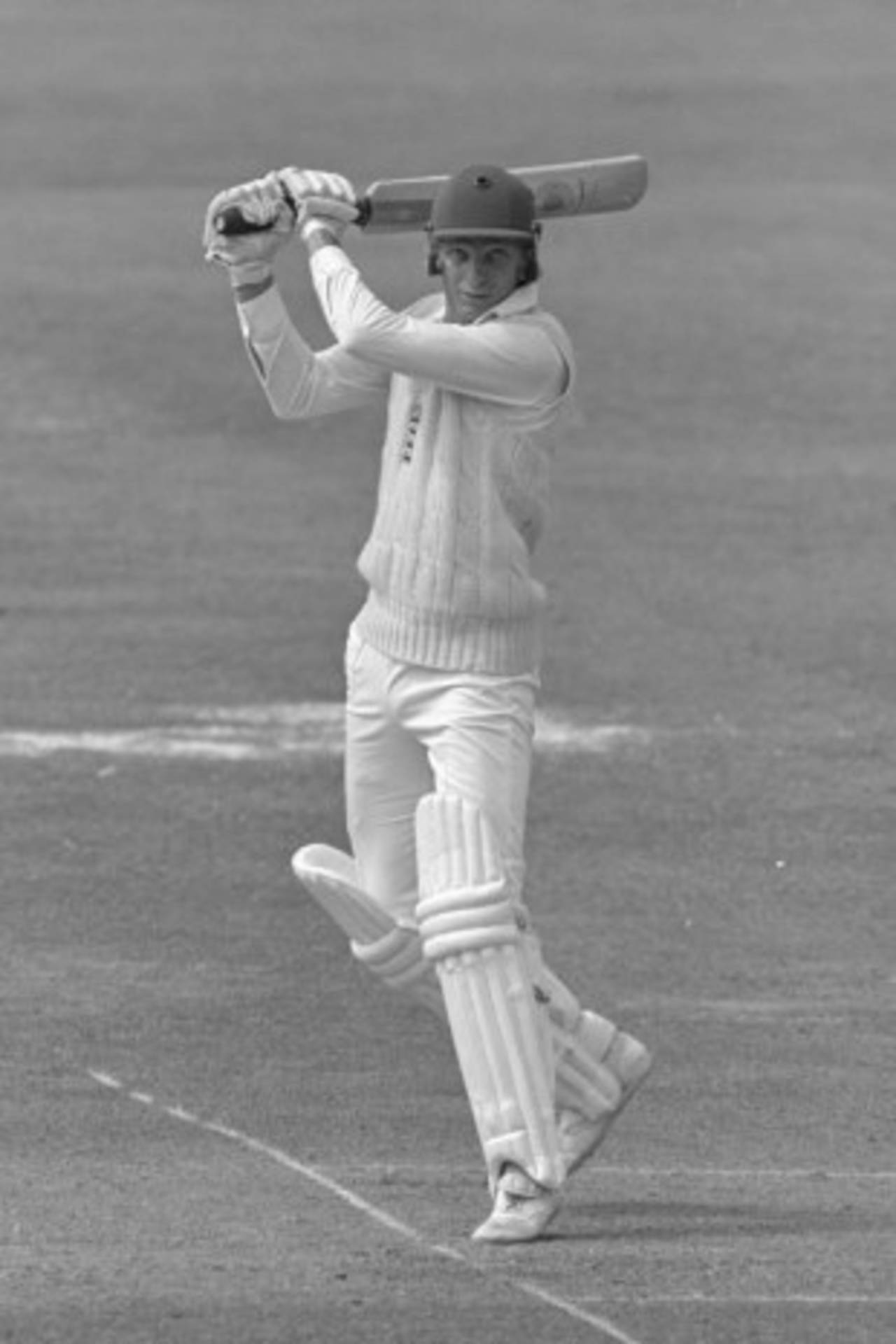
In 1985, at the height of his powers, David Gower was flawless, influential, and a lesson to eight-year-olds on what style meant

Ed Smith
October 4, 2012
![]()
|
|||
|
Related Links
Players/Officials:
David Gower
Teams:
England
|
|||
Who is your favourite player? It's only half a question because our preferences change with age. As with novels, we are susceptible to different cricketers at different stages of life. The showman, the stylist, the battler: there will be a time for each of them.
In 1985, as a cricket-obsessed eight year old, I was just about old enough to grasp the idea of style. In fact, it may have been a cricketer, David Gower, who introduced me to the concept.
That Ashes summer of 1985 seemed to be a never-ending highlights reel of languid Gower cover drives and nonchalant late cuts. Can an eight-year-old really distinguish an elegant cover drive from all the others? Perhaps only just. But like many childhood experiences, watching cricket was informed by the adult conversations around me. "Did you see that David Gower cover drive? He never looks like he's trying, it's so effortless." When you hear so many adults gasp in admiration, you subtly absorb new ways of enjoying the cricket on the television screen.
That summer's footage has lodged permanently in my memory. Gower batting without a cap or a helmet, the afternoon sun casting long shadows over the field, and Jim Laker and Tom Graveney trying to find new ways of saying, "He seems to have all the time in the world." When Gower reached yet another hundred with a cover drive, the commentator exclaimed, "I'm not sure if the bowler is clapping the shot or the century."
In artistic terms, this was "High Gower". We didn't know it then, of course, but Gower was exactly halfway through his 14-year England career; he was at the peak of his powers. We knew he was great and we knew he was close to his best. And Gower was not making flawless, inconsequential cameos. He was shaping whole matches with hundreds and double-hundreds. But High Gower, like High Federer, was ruthless as well as beautiful.
Style demands economy as well as grace. In 1985, Gower rarely wasted a movement. Even between balls, he remained in character: his Gray-Nicolls bat resting on one shoulder, blade facing the sky, his grip more open than that of most modern players, the handle settled in his hand as though it was a natural extension of his body.
One of Gower's underestimated qualities was his psychological bravery. He had the guts to keep being himself. Most players spend their careers making increasingly pragmatic compromises. We tend only to hear about the people for whom it works. Steve Waugh, of course, banished the hook shot, and developed an iron-wristed front-footed square cut to replace the classic cover drives of his early days. By the end of his England career, Graham Thorpe rarely allowed himself to use the full array of his attacking shots.
The trend is common across all forms of the game. Maturity is usually accompanied by the reduction of risk: the closing of the bat face, the favouring of the leg side over the off, the narrowing of scoring shots to just a few trusted favourites.
| When Gower reached yet another hundred with a cover drive, the commentator exclaimed, "I'm not sure if the bowler is clapping the shot or the century" | |||
If anything, Gower went the other way. He never turned away from risk. He never stopped playing his favourite shots, even when it led to recurrent dismissals. It is too easy to call this a failure of discipline. For batting is not only a question of percentages, it is also a matter of voice. Many batsmen, in the search for scientific progress, lose what makes them special, what makes them unique. Gower never did.
A former team-mate of Gower's once said to me that he "never really got better as an England player". He said it mildly, but it was accompanied by a hand gesture to signify a flat-line. I was tempted to mirror the action, only drawing the flat line significantly higher. If someone averages mid-40s all the way along, the point, surely, is that he has been exceptionally consistent, not disappointingly static.
"Late Gower" also inspired my favourite cricket poem. Gower roused the very best from the editor and poet Alan Ross, himself a romantic, writing in the autumn of his literary career:
Arm confined below shoulder level
As if winged, the slight
Lopsided air of a seabird
Caught in an oilslick. 'Late' Gower,
As of a painting by Monet, a 'serial'
Whose shuffled images delight
Through inconstancy, variety of light.
Giambattista Tiepolo
In his 'Continence of Scipio' created
Just such a head and halo.
For this descendant no confines
Of canvas, but increasing worry lines,
Low gravity of a burglar.
Stance, posture, combine
To suggest a feline
Not cerebral intelligence. A hedonist
In his autumn, romance lightly worn,
And now first signs of tristesse ,
Faint strains of a hunting horn.
Watching a champion in the autumn of his career is a double-edged pleasure. There is joy at the unexpected bonus. But sadness that it surely cannot last for much longer.
That was not the case in 1985. We knew there would be many more days like this, with Gower gliding into cover drives, swivelling on pull shots, and occasionally deigning to sweep - though never touching the ground for long enough with his knee to muddy his pad. Yes, there would be more.
But it was surely never quite so good again.
Former England, Kent and Middlesex batsman Ed Smith's new book, Luck - What It Means and Why It Matters, is out now. His Twitter feed is here
© ESPN EMEA Ltd.
| ||||||
| Comments have now been closed for this article |
||||||
'You can't taint the whole IPL'
Bowl at Boycs: Geoff Boycott on spot-fixing, Adil Rashid's future, and yorkers in Test matches
Harsha Bhogle: The spot-fixing controversy teaches us about the pitfalls of insecurity and of the desire to keep up with the Joneses
The new Harmison? Or is it the new Caddick?
Numbers Game: Stuart Broad is destructive at his best, but at other times his bowling average is unusually high
Aakash Chopra: Apart from luck, you need to pick your team wisely, get to bat at the top, and have your captain's support
Less cricket on TV? Hallelujah
Matt Cleary: Why Channel Nine should be applauded for not broadcasting domestic cricket in Australia
Even at the height of his success with the national side, Sreesanth was a lonely cricketer who felt hard done by
A talent that didn't know its own worth
Sreesanth wasn't the most likeable team-mate or opponent, but he had skill beyond doubt, which we might have seen the last of
Mumbai Indians still have a better head-to-head record against Chennai Super Kings, but once again on the big occasion, they came second
A time for anger, a time for action
Out of the shattered lives of three young men caught up in allegations of fraud, newer and stronger players must emerge
Vijay slips, Ashwin does a Sahara
Plays of the day from the IPL qualifier between Chennai Super Kings and Mumbai Indians in Delhi
Spirited Sunrisers exceed expectations (84)
Sunrisers began this tournament as one of the underdogs, but fought impressively to reach as far as the Eliminator
Even at the height of his success with the national side, Sreesanth was a lonely cricketer who felt hard done by
Mumbai Indians still have a better head-to-head record against Chennai Super Kings, but once again on the big occasion, they came second
Anderson's magic not to be missed (50)
None of the other three England bowlers with 300 Test wickets - or many other of the game's finest swing merchants - could have bowled better than James Anderson at Lord's
A case of peaking too early (42)
Royal Challengers began the season in full steam, but failed to replicate their consistency away from home
ICICI Bank M2I. Register Now and Get A Gift Offer.
Safe & simple online money transfer. Apply Now!
Buy Wisden 2013 & get a FREE Playfair
Available now at Cricshop
One of the most elegant left hand batsman...., loved his batting and his commentary is even more fascinating
Posted by Meety on (October 6, 2012, 0:58 GMT)@ghost_of_len_hutton on (October 05 2012, 02:20 AM GMT) - I agree, the Ozzy attack couldn't of been too bad as it was 2nil up at the time, BUT @AdrianVanDenStael was talking about 1985 NOT 1991. re: Sydney - wasn't Atherton's ton the slowest in Ashes history? The Ozzy attack in 1985 was okay on paper, Lawson was a very good bowler, Craig Mac was a massive threat, but Thommo was way past his prime, SO'D was an ave FC bowler & Dutchie Holland was rarely that good away from the SCG. It was the following year that Bruce Reid & Merv Hughes came on the scene. All up I say the Oz attack was good & so Gower's 200 was a fine knock!
Posted by dcglynn on (October 5, 2012, 23:06 GMT)I'd rather watch another hundred from Gower than 50 T20 matches.
Posted byQuality batsman for sure, but he severely underachieved as an England player. Yes, style is better to wastch than some middle order grinding out a six hour hundred- but for a player of his ability ,he was 3000 runs and 10 hundreds short. Yes, I agree, I would watch elegance over grit, but- you have to utilise those talents. Lara had a grace about him but he produced huge scores. Gower only managed to top 200 twice and 18 hundreds in 117 tests is a relatively poor ratio. Wonderful player though.
Posted by Paulk on (October 5, 2012, 13:29 GMT)In my time Greg Chappell, Gower, GR Vishwanath, Azhar, Zaheer Abbas, Mark Waugh, Laxman , Barry Richards, Viv Richards (never mind the power and brutal hitting) were all pleasing to the eye. But David Gower was the name that came to mind first whenever style and class and effortlessness came up. Thanks for the memories.
Posted by Nutcutlet on (October 5, 2012, 12:35 GMT)@Ngod. You miss the point, my friend! Ed's article is not to do with stats (here, there or on Mars); it's not even to do with class - it's to do with style which lives on another & higher plane absolutely: style is art; class is found in the gifted artisan! Ed makes the point that Gower's style wasn't curbed by experience; he didn't cut out his scoring options, even if they were high risk, & that's how he played right to the end of his career. He allowed himself the wonderful indulgence of playing his shots as if each one was a brushstroke on a masterpiece. He, like most artists, was true to his art, not to what I call grubby statistics (see below!).
Posted by DesPlatt on (October 5, 2012, 10:56 GMT)Great article and I have really enjoyed the comments too. Shane and Ghost_of_Len_Hutton, I remember that listening to that Sydney century under the bedclothes in 91 and drooling with anticipation that I was going to be seeing the last two tests. Sadly Gower was out to his infamous clip to long leg just before lunch at Adelaide that so enraged Gooch he stayed out in the middle to calm down. In the second innings with England involved in a run chase, he was out to an lbw where Ian Chappell said " How could you give that out". At least that match had the compensation of Mark Waugh's debut century and a stupendous century by Gooch, easy wicket accepted. Gower also failed at Perth though think he may have carried bat for 20 odd in a typical England collapse. Meety, Barry Richards was both superb technically and stylishly; I remember a Nat West game when two perfect forward defensives went for four past the bowler Peter Lee, so perfect was his timing.
Posted by MrPud on (October 5, 2012, 10:08 GMT)My Grandfather took me to Adelaide Oval 1981/82 Ashes and Gower peeled off a magnificent 140 odd, with the usual fluid cover drives and late cuts, but also straight drives on a full length Adelaide before it was roped off. Until then I thought no-one could time the ball better than Greg Chappell, then along came Gower and Mark Waugh.
Posted by Game_Gazer on (October 5, 2012, 9:24 GMT)What a stylist he was! His whipping leg-glance was also a very classy shot. It's interesting to note that often the batsmen that are languid and graceful are also great at whipping leg-glides/hook off a very good length rib-cracker on the blind-spot (leg'n'middle)...other kinds of batsmen even though great, struggle to keep them down... Eg. Imagine Saeed Anwar, Mark Waugh, David Gower, VVS...whipping off the ribs... Probably because the laziness allows them a calm & a poise that helps in playing such rare strokes !
Posted by AdityaMookerjee on (October 5, 2012, 9:08 GMT)Gower didn't need guts. He seems to have liked everyone, and didn't want to emulate them, the others being themselves. This has nothing to do with guts. He didn't exactly dislike himself, either, looking at others as he did.