| Series | Countries | Live Scores | Fixtures | Results | News |
Features
|
Photos | Video & Audio | Blogs | Statistics | Archive | Games | Mobile | ||||||||||||||||||||
|
There may be merit in exploring a format midway between the ODI and the T20

January 24, 2013
![]()
|
|||
|
Related Links
News : Sri Lanka to query abandonment with ICC
Brydon Coverdale : Blaming rotation is missing the point Series/Tournaments:
Sri Lanka tour of Australia
|
|||
Cricket is not perfect, neither would we want it to be. Match-ups are as likely to be exasperating as exhilarating. Fifty-over cricket has taken it in the neck for being out of date. "You're obsolete my baby / My poor old-fashioned baby / I said baby, baby, baby you're out of time" wrote Jagger and Richards, and T20 is the flared trouser of the day.
But T20 is not cricket in the true sense. T20 has escape clauses that allow mediocre talent to survive. Worse still, the best talent is in the wash with everyone else, restricted by overs and playing regulations that dumb down a greater game.
The series between Australia and Sri Lanka that was completed yesterday had little suspense but much interest. On occasions the ball swung - yes the cricket ball was swinging! - and batsmen were rooted in amazement. We're not talking Bob Massie or Wasim Akram here, we're talking Nuwan Kulasekara with his tidy medium-paced induckers, and Lasith Malinga with quirky round-arm outswingers. Australia were clueless in Brisbane and not much better in Adelaide or Sydney. Sri Lanka were hardly masters of their moment either. Thus, catches were taken at slip and lbws came from deliveries pitched on a good length. For a couple of the games, yorkers and slower balls were redundant. The balance between bat and ball was about right. It was the form of cricket in which bowlers go after wickets rather than claim them from the batsmen's obligation to score at eight an over.
Each game had an appeal. The first, in Melbourne, from Australia's batting onslaught and specifically from Phil Hughes' debut hundred in sweltering heat. The second, in Adelaide, from Sri Lanka's ongoing ability to fight back every time you write them off. The third from Australia's abject total of 74, on a lively but far from impossible Brisbane pitch, which was followed by a hash of a run chase that threatened humiliation for the Sri Lankans until the new face, Kushal Perera, dragged them over the line.
In Sydney we watched Australia stutter to 222 and then we watched a thick drizzle of rain for an hour or so. After that we thought we would watch the chase that Sri Lanka had briefly started, but incredibly the umpires abandoned the match. Apparently conditions were unsafe and unfair for the fielding side.
What nonsense. The outfield was damp, not waterlogged. A film of water covered the grass while the players warmed up but this same film of water was too dangerous to finish the match. Almost 30,000 people had paid to be there and they were treated disgracefully. Is cricket so precious that the crowds who support must suffer? Of course not. It's a game, for goodness' sake. If the ball gets wet, replace it with a dry one. What matters is that the people leave happy and are inclined to come again. It couldn't matter less that one team or another is at a minor disadvantage.
All international matches should be in the hands of the referee. Umpires have a vested interest in the players, though they cannot admit to it. They are part of the family, like discarded siblings hoping to find their way back to the bosom. They step on eggshells with powerful captains and take the more general decisions of ground, weather and light with a crutch at their side - whether it be a light meter, a colleague or a consensus. Match referees are former players of note, mostly. Ground, weather and light should be their baby.
All of which left Australia having to win in Hobart to square the series, an unlikely finale given the drubbing they handed out in the first match.
The big story in Australia right now is the rotation of players. Critics called the team that won in Melbourne the B team. The captain, George Bailey, defended his men and the policy with remarkable vigour, given it was nothing to do with him. Michael Clarke, who is a selector, was resting, rotated, or injured, depending on your take, but was not around to answer for the selectors. The administrators have turned to the phrase "informed player management" because the "r"-bomb is off limits.
| All international matches should be in the hands of the referee. Umpires have a vested interest in the players, though they cannot admit to it. They are part of the family, like discarded siblings hoping to find their way back to the bosom | |||
The problem is that everyone has to explain themselves these days. Consequently we have brackets and clauses, and collective nouns such as "Team England" and "Cricket Australia"; they talk of the "group" not of the team. They precede answers with "probably" and follow them up with "so". Increasingly we have a new language of avoidance. Just tell it how it is. Say: "This is our team, the captain is injured, the fast bowler is knackered, we hope to have them back imminently." Explaining the detail never works. It is where the devil hides. If in doubt, say nowt.
The fact is, Australia are going through a funny period. Batsmen are thin on the ground and bowlers are injured daily. The search to identify the best cricketers for the demanding challenges ahead is complicated. In short, the selectors are having a look around but there are sensitivities, notably to the public, who want the best players for their buck, and the broadcasters who pay through the nose for an unpredictable product. Take account of these and pick the team to win the match. Nothing ever doused the fires of criticism like winning.
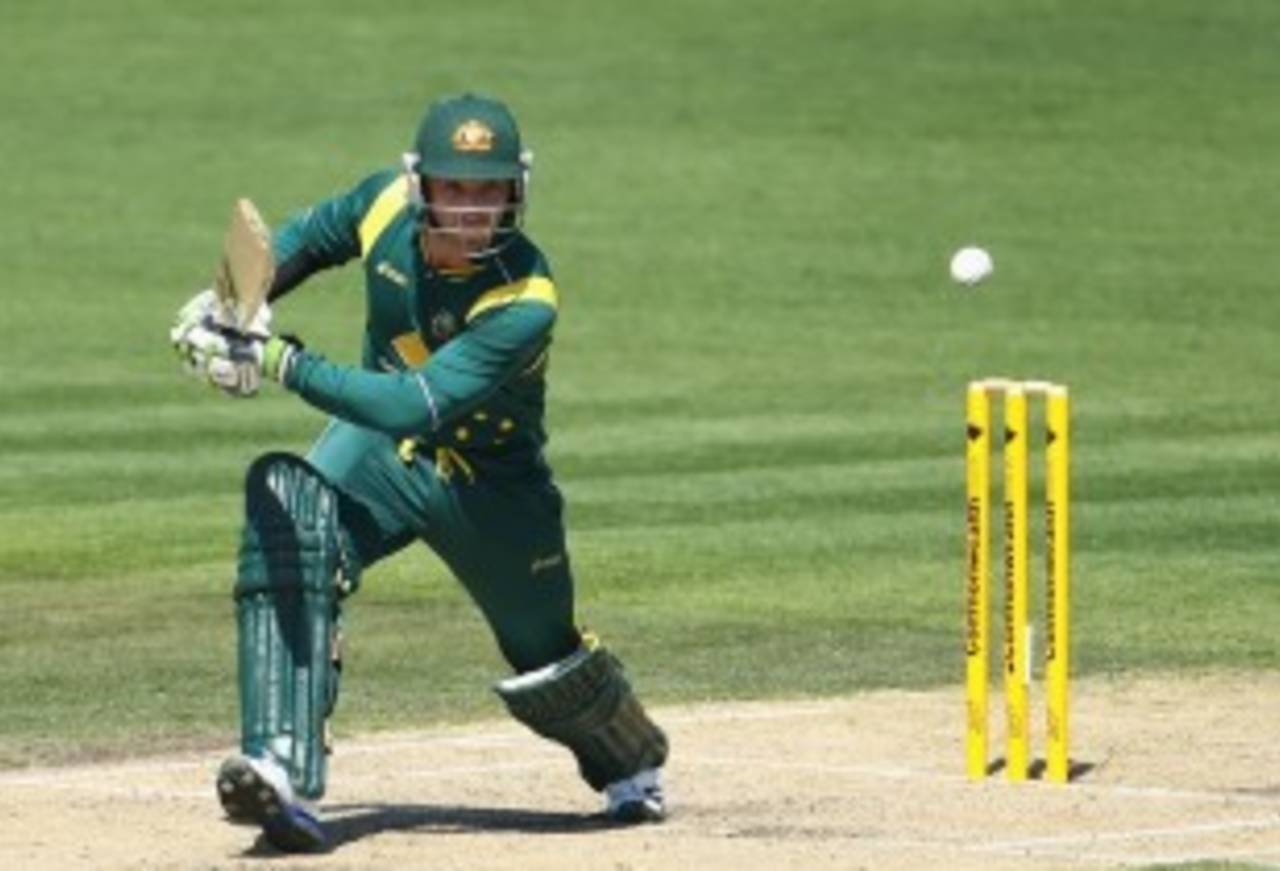
Clarke was injured again in Hobart - ankle this time not hamstring - thus Bailey was back in charge. Hughes made another hundred, this one a gem of an innings in its construction and pace. Australia held off a late Angelo Mathews charge and levelled the series 2-2. The improved Hughes is having a good summer. He has the happy knack of making runs come what may and understands that 50-over batting is an art in itself. During the coming months, Indian pitches and English swing bowlers will tell just how much he has improved.
A friend of mine, a pro golfer who has had a lifelong affair with cricket, sent a text during Sri Lanka's pursuit of 247. It was the period in the middle when singles tick over, the period that is the eye of the 50-over storm. It read: "50 overs… first 10 dash, next 30 cook dinner, last 10 sit tight for a result. Bit like basketball." I replied that I liked 50-over cricket because it had a natural ebb and flow and that it had more appeal than the one-paced 20-over game. He came back: "Wouldn't know, never watched a T20 in my life. 3 forms of the game can't survive. 35 overs seems about right to me."
If - and I say if because I'm not convinced yet - cricket is indeed cannibalising itself, 35 overs is a way to go. There is just enough time to be bowled out, which is crucial to the fabric of the sport, and not quite enough time to throttle back during the predictable middle overs. Maybe you play with two new balls and have a first 15-over period where, say, three fielders have to be in an attacking position and only three can be outside the 30-yard ring. After that you resort to the regulations of T20 as we know them. Urgency but not disrespect: the best of both worlds perhaps?
Mark Nicholas, the former Hampshire captain, presents the cricket on Channel 9 in Australia and Channel 5 in the UK
© ESPN EMEA Ltd.
| ||||||
| Comments have now been closed for this article |
||||||
A prolific and stylish middle-order batsman for Hampshire, Mark Nicholas was unlucky never to have played for England, but after captaining his county to four major trophies he made his reputation as a presenter, commentator and columnist. Named the UK Sports Presenter of the Year in 2001 and 2005 by the Royal Television Society, he has commentated all over the world, from the World Cup in the West Indies to the Indian Premier League. He now hosts the cricket coverage for Channel 9 in Australia and Channel 5 in England.

Anti-corruption efforts need to be proactive
Ian Chappell: Rather than relying on the police or media to uncover rot in the game, cricket has to get tough with its own
Even at the height of his success with the national side, Sreesanth was a lonely cricketer who felt hard done by. By Ajay Shankar
Jayaditya Gupta: Gauging from the official broadcast of the IPL you'd be hard-pressed to guess there has been a spot-fixing scandal over the past few days
Go Figure: S Rajesh and Andy Zaltzman explore the hidden secrets behind 222
Jarrod Kimber: In this week's News Hurl, Warner rages, Yusuf kicks, a political party moralises, and Maxwell remains awesome
As we go into the last week of the league games of IPL 2013, seven teams have a mathematical chance of making the last four. Here's what each of those teams needs to do
Pollard sledges Watson, Dravid is angry
Plays of the day from the IPL match between Mumbai Indians and Rajasthan Royals in Mumbai
A talent that didn't know its own worth
Sreesanth wasn't the most likeable team-mate or opponent, but he had skill beyond doubt, which we might have seen the last of
Unfortunate Sunrisers let match slip away
For 36 overs, Sunrisers painstakingly built a position of strength only for one terrible over to spoil it for them
Kartik wins in Royal Challengers' loss
It is hazardous to go by bowlers' figures in T20, but his figures of 4-0-17-1 in defence of just 115 were possibly an accurate reflection of how well he bowled
Unfortunate Sunrisers let match slip away (73)
For 36 overs, Sunrisers painstakingly built a position of strength only for one terrible over to spoil it for them
As we go into the last week of the league games of IPL 2013, seven teams have a mathematical chance of making the last four. Here's what each of those teams needs to do
Dravid and the art of T20 captaincy (56)
Despite a small squad bereft of big names, Rajasthan Royals' captain has churned out win after win
Pollard sledges Watson, Dravid is angry (43)
Plays of the day from the IPL match between Mumbai Indians and Rajasthan Royals in Mumbai
'I have decided to return to my natural game' (39)
Misbah-ul-Haq talks about his approach to the captaincy, the criticism he has copped for his defensive style, and the lessons from the drubbing in South Africa
ICICI Bank M2I. Register Now and Get A Gift Offer.
Safe & simple online money transfer. Apply Now!
Buy Wisden 2013 & get a FREE Playfair
Available now at Cricshop
I reckon if the 35 over game gets the bill this is the format that I would like to see ... first 5 overs mandatory power play ... between 10 and 25 overs both 5 over batting and bowling power plays must be completed ... In the power plays fielding restrictions will be in place ... but then no T20 and no ODI ... the game must also start at the conventional 50 over start times so as to add 2 hours extra in case of rain / weather / lights stoppages ... a 2:20 playing limit must be imposed strictly ... A special revamped rain formula must also be introduced because Duckworth Lewis is not a fair system ... because it rewards a team that is coasting to victory with a smaller victory target ... The target should be the total pro-rata plus one using the scoring periods that the second team will face at the run rate for each period ... first power play pro rata + second 5 overs pro rata batting/bowling power play pro rata + other middle overs pro rata + last 10 overs pro rata + 1
Although 50 overs has become the standard for ODIs a varying number of overs have been used over the years in one day games. I think it would be worth experimenting a bit with different numbers of overs. There could also be adustments made to the number of overs allowed per bowler or fielding restrictions. Teams could be allowed to name 12 players to take part in the game.
I captain a team that plays on a regular basis, 35 or 40 over matches. The beauty of that length of time is that you can construct an innings without being rushed, but without the long periods of consolidation you find in 50 over matches. I usually set the bench mark of getting to 20 overs only a few wickets down and a healthy total of about 100. Giving 15 overs to go at a run a ball or better and push for a strong total. It is always interesting, and holds suspense. Bowlers have a max of 7 overs.
I see a day where 2 formats is the norm. Something has to fall into the middle because 20 overs is not enough, and 50 is seemingly too much in a modern society. Tests will always be popular where it has long endured, as it is the pure form of the game. The model which will attract the wider world audience is the game that holds suspense and action, while providing an even contest. That is not quite 20 overs, and its not 50. The answer lies in the middle, 35.
Please make cricket an easy game. It is too complicated..and don't make it further..general people want it as a simple one..just simple.
Posted by kharidra on (January 27, 2013, 7:43 GMT)In order to make the middle overs attractive there is need to reduce that period and the 40 overs a side ODI precisely provides that opportunity. Furthermore a study of the first power-play and extending it by another 2 overs provides another opportunity to reduce the rather monotonous middle over period when combined with the fact that there only 40 overs to a side. Also by introducing NO-Power-Play option in the P1 for a 3 over period which needs to be compensated for in the middle over period.
Posted by Divinetouch on (January 27, 2013, 5:16 GMT)Mark u are too bias a commentator for your thoughts to be counted.
Posted by drpramit on (January 26, 2013, 20:38 GMT)We r already fed up with 3 formats n here comes d fourth one, let it be a 3 format for sometime, yes we can reduce ODI to 40 or 45 overs & there is no need of so many power plays, 1 power play of 10 over would be enough in that case....
Posted by LuJaMe on (January 26, 2013, 2:59 GMT)I feel a 35 over game is where the future lies. I like many people here find the middle overs of an ODI to be tedious and certainly detracts from the game. The Twenty20 is too short but has the action and suspense that is required these days to keep people interested.
I would set it out as such:
35 overs per team. First 10 overs as powerplay. Overs 11-25 have no fielding restrictions. Overs 26-35 only 5 fielders outside the circle and only one behind square.
Each bowler gets 7 overs each with the Captain entitled to enforce 2 power overs extra from one of the bowlers.
12 players named with the option to 'sub' at any stage of the innings. 1 sub per innings per team.
Sorry to say it but cricket as a spectator sport is all about the batsmen. Fans want to see big hits and risk taking. If bowlers are good enough then the wickets will come. And bowlers out there are good enough. Mix that with highly skilled fielding and I think you have a very interesting game. More emphasis on skill.
Posted by Gloucsfan on (January 26, 2013, 2:07 GMT)Limited overs cricket is boring. Get rid of all of it at international level and just play tests
Posted by Punit.Acharya on (January 25, 2013, 17:47 GMT)I believe 40 overs is the way to go.Either play 40 overs outright or in split innings 20-20 format.But split innings has its own complications which would completely overhaul the ODI format and would bring about drastic changes.
40 overs (single innings)is the ideal way ahead...keep first 10 overs mandatory powerplay...with the batting powerplay to be chosen between 15-30 overs that would make middle overs phase bit exciting.
Allow one bowler to bowl 10 overs..remaining a max of 8 overs.