
Suryakumar Yadav cashes in when no one else does
On a pitch that was grippy, two-paced and a nightmare for anyone looking to hit through the line, the India captain played some jaw-dropping shots to finish on 84 not out

Karthik Krishnaswamy
Feb 7, 2026, 7:29 PM • 16 hrs ago
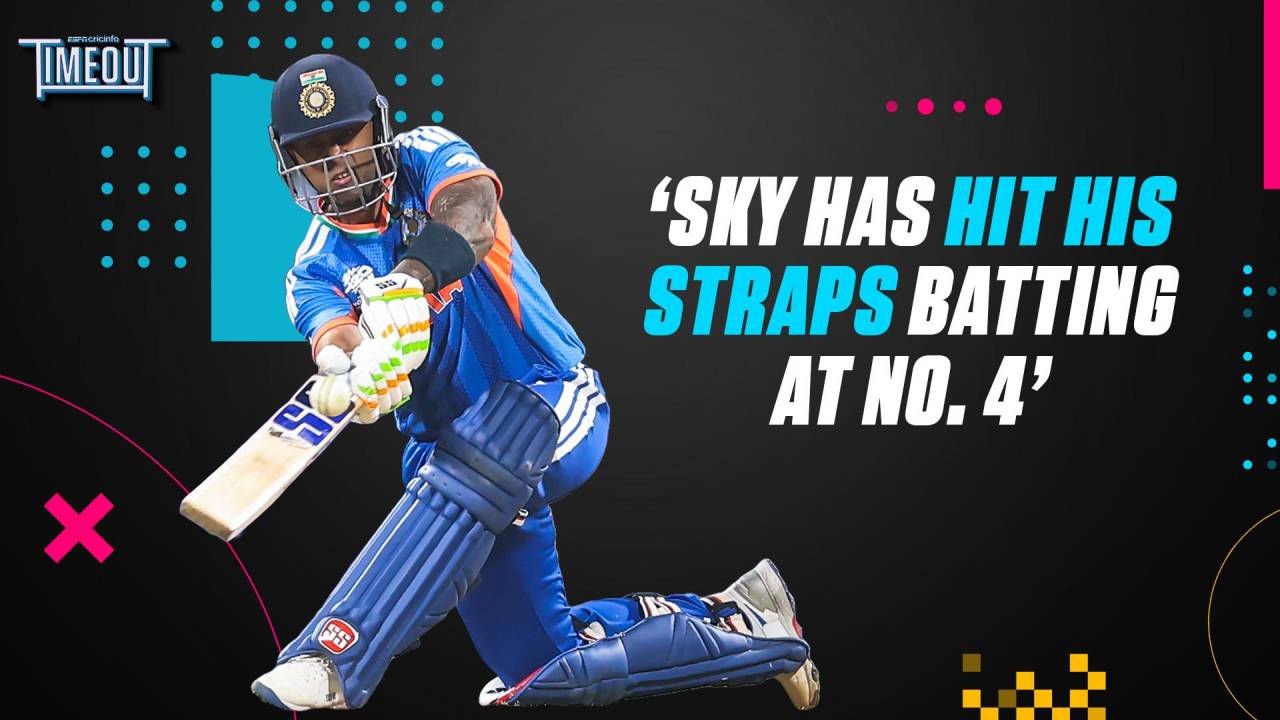
Suryakumar Yadav has six half-centuries in T20 World Cups. Three have come against Associate teams, and two against recent or recent-ish Associates Afghanistan and Zimbabwe.
Seldom has a cricketer assembled a more misleading record.
On Saturday night he made his second T20 World Cup fifty against USA, leading India to victory by 29 runs. Seldom has a T20I finished with a more misleading margin.
No previous T20 World Cup had begun with one team as heavily favoured to win as India were this time. And 13 overs into their opening game at the Wankhede Stadium, they were 77 for 6. Against USA.
For an American parallel to the possibility that hung in the air, you would have had to reach beyond cricket, and go all the way back to Belo Horizonte, 1950. And unlike England's footballers at that World Cup, India were playing this one at home.
Suryakumar must have scarcely felt at home despite this being his home ground. Far less, certainly, than the three players in USA's XI who had once been his Mumbai team-mates.
The world was so off-kilter that the Wankhede Stadium, which can almost always be trusted to provide flat T20 pitches with true bounce, had thrown up the kind of pitch its curators occasionally prepare in Test cricket when India feel pressured to win with spin. This wasn't quite the 2004 minefield on which Michael Clarke took 6 for 9 with his part-time left-arm spin, but it was something like its T20 equivalent: grippy, two-paced, a nightmare for anyone looking to hit through the line.
To complicate matters, it was just the kind of pitch that can become more straightforward to bat on for the chasing team if dew sets in. Dew is almost a fact of life in Mumbai night games. India were 77 for 6. USA would be chasing.
This was the context, and Suryakumar, India's captain, and a man who until recently had been in the worst form of his international career, had to do something about it.
Fortunately for his team and their fans, Suryakumar had done it before. Dig deeper into his innings against Associates and ex-Associates, and you see it again and again. Who took India from a sluggish 107 for 4 in 15 overs to a total of 186 against Zimbabwe in 2022? Who turned 62 for 3 in the ninth over to an ultimately comfortable win over Afghanistan in 2024? And who, the last time they met USA, came in at 10 for 2 on a tricky New York pitch and steered India home in a low-scoring game?
You know the answer because we've already told you, but this is the fate that has befallen Suryakumar. Or one of the fates. He's a bona fide legend of T20 with an endless list of other achievements, but this has been a defining feature of his time in T20 World Cups. He has been India's rescuer when they have fallen into sticky situations against teams they are expected to beat.
And none of the previous situations were quite as sticky as this one.
The thing about elite players like Suryakumar is that they make what follows look inevitable. It's an illusion, of course, and elite players, like everyone else, sometimes need luck to go their way. On 15, Suryakumar had closed his bat face too early on a legcutter that gripped and straightened, and Mumbai emigre Shubham Ranjane had put down a sharp return chance.
That chance also spoke of the difficulty of this pitch, of the grip USA's bowlers were getting, whether it was their spinners or their seamers bowling change-ups. It was the kind of pitch that seemed designed to limit Suryakumar's effectiveness, because his go-to shots behind the wicket are all about harnessing pace onto the bat.
And USA's bowlers were doing a lot of things right in their effort to deny Suryakumar his pet shots. Both spinners, Harmeet Singh and Mohammad Mohsin, turn the ball away from the right-hand batter, and both were hammering the ball just short of a sweeping length and landing it well outside off stump, showing a willingness to err on the cut side rather than the sweep side. The right-arm seamers were going around the wicket and looking to angle the ball away from Suryakumar's arc. The left-armer, Saurabh Netravalkar, was exaggerating his usual angle from over the wicket by bowling away-cutters into the pitch.
But elite players are elite problem-solvers. Suryakumar had two ways of countering USA's plans: try new things or back himself to pull off the shots that have made his name.
He went with the latter approach. He backed his stride and reach and kept sweeping the spinners. He kept going against the seamers' angle and targeted his favourite area, square and behind square on the leg side. And he kept pulling it off, to sometimes jaw-dropping effect.
Take the shot he played off Netravalkar to go from 35 to 39. Left-arm over, a cutter pitching just short of a length and deviating so extravagantly that a left-arm fingerspinner could have bowled it. Suryakumar took guard with his back foot on off stump but made no pre-delivery movements to counter this attempt to keep the ball away from his hitting arc.
He didn't move his feet at all, in fact, until after his bat met the ball somewhere around a 10th or 11th-stump line. It was only then, when a whip of rubber wrists had whisked the ball over the man at square leg, that the force of the shot made Suryakumar's feet jump to the off side.
How do you bowl to a guy who can do that?
It's a question innumerable teams and bowlers have asked over the years, and the that has taken innumerable forms.
On this day, USA had no answers. From 77 for 6, Suryakumar dragged India to 161 for 9. He finished 84 not out off 49 balls. In his time at the crease, the other end, extras included, contributed a combined 32 for 7 off 39 balls.
Years from now, you might look through Suryakumar's innings-by-innings list, see this 84* in a 29-run win over USA, and dismiss it as a batter cashing in against lower-ranked opposition. You wouldn't be wrong, factually, but you'd only be seeing a fraction of the picture.
Karthik Krishnaswamy is an assistant editor at ESPNcricinfo