
Potts out of luck as Stokes' coddling captaincy backfires on England
He's tried not to be over-bearing, but Stokes' failure to lead with the ball left his raw attack exposed

Vithushan Ehantharajah
06-Jan-2026
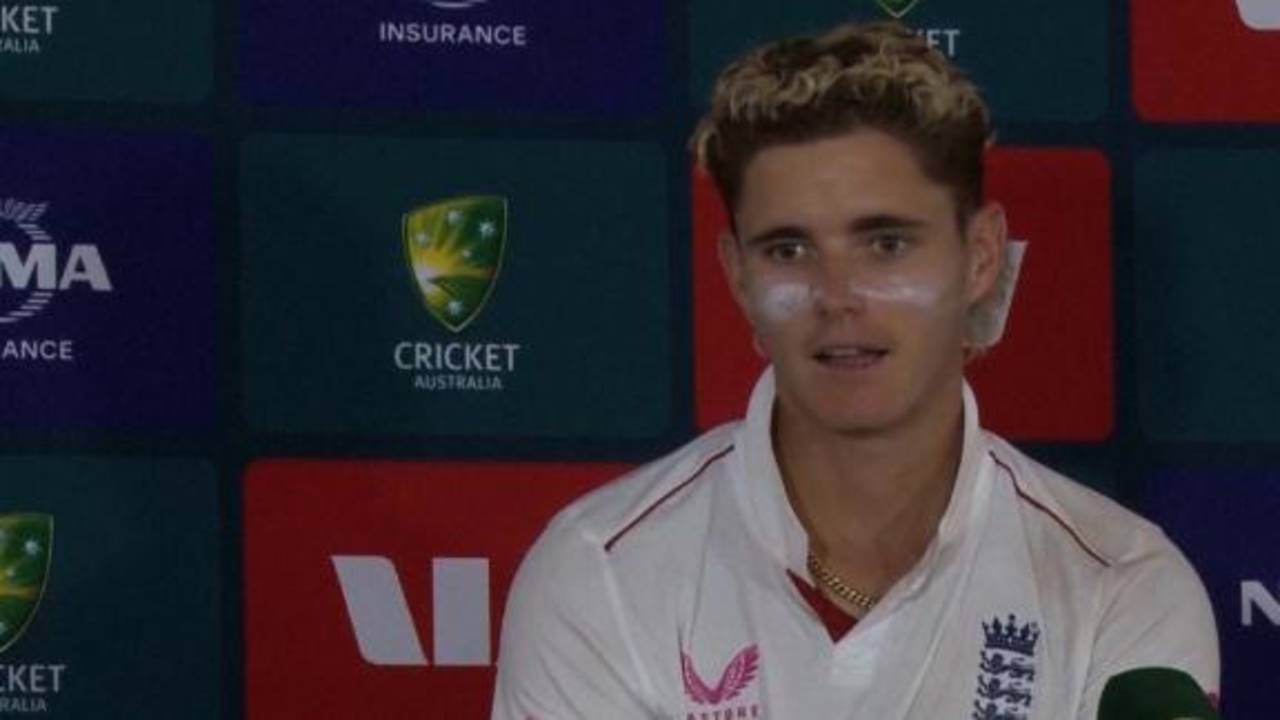
It was another one of those lung-busting, knee-pummelling Ben Stokes spells. The problem was, as has been the case for most of them this series, it was to cover for the deficiencies of his teammates and, ultimately, it was in vain.
England's captain took it upon himself to bowl the junk overs ahead of the second new ball. A seven-over spell, to be exact, in which Steven Smith and Usman Khawaja ticked Australia over 300. During the corresponding passage in England's first innings - when they had more on the board for the loss of five - the part-time duo of Marnus Lasbuschagne and Travis Head were operating in tandem. Only thanks to Jamie Smith's brain-fade did it prove inexplicably fruitful.
When the second new ball became available, Stokes handed it immediately to his chosen opening bowlers, Brydon Carse and Matthew Potts. Though two wickets were taken - Khawaja and Cameron Green - the concession of 57 in 11 overs led to the England captain taking it back for himself, as he had done with the original new ball after 10.
There's a lot to be said for Stokes' fibre, and the socialism with which he captains. The shares are spoiled but if there is hard work to be done, he is often front of the queue to do it. It's impressive, but for the fact that, as the team's most complete swing and seam bowler this Ashes (14 wickets at 24.60), he was diminishing his own resources and, thus, the team's.
Australia are 518 for 7 at stumps on day three, already a lead of 134 which is enough to open the possibility of an innings defeat on day four. And after the tourists were flash-fried by Travis Head, then slow-cooked by Smith in sweltering temperatures, it would not be a surprise if they fall from the bone easily on Wednesday.
Stokes has done his level-best to hold them together. As much with his 2 for 87 from 26 overs as the plate-spinning he had to perform to keep spirits up.
Before they left the field, each teammate was offered a low-five and pat on the back, to thank them for their efforts. He does it after every session, good or bad, and there have been plenty of the latter. As a day, though, this might have been the most chastening, not least coming after their first win over here in 15 years at Melbourne just last week.
There were token gestures of appreciation throughout. Each show of effort in the field brought a whoop, every throw from the deep applauded, and lots of both were required given the volume of long hops and drive balls served up. Even the five dropped catches in this innings - taking England's series tally to 16 - were used as encouragement that they were on the right track. Stokes, as ever, was the lead cheerleader, though he broke character when Ben Duckett's slack ring-fielding allowed a single to bring the scores level.
Stokes always carries a level of emotional awareness with him on the field, and part of that can be seen in his reluctance to use the new ball. Asked on this tour why he doesn't, and even ahead of the home series against India last summer, every response has the same combination of "why would I, when I have full faith in my brilliantly talented openers?"
It is a clear psychological play to pump up bowlers who, throughout, have been willing. Unfortunately, only Jofra Archer - who left with a side strain after the third Test - has proved himself worthy of being an opening bowler in an Ashes. Brendon McCullum says he deals with the "top two inches" but what of the rest?
The lack of preparation isn't just about Lilac Hill, but an attack devoid of guidance or real-world nous. A consistent bowling coach would have helped. But even experience of this regime does not seem to be helping. In the case of Ollie Pope, he has been along for the whole ride at No.3 and yet, after the third Ashes Test, has almost certainly played his last under this administration. An average of 20.83 across the live Ashes speaks to the fact that McCullum's spoon-feeding of sugar doesn't always end well.
Stokes, however, has made a point of putting the new ball where his mouth is. Day three of this final Test was the third time he has dug deep for a seven-over spell to bring the second new ball into play. The previous two both came in the Ashes-deciding match at Adelaide Oval, with the first innings the only time he kept himself on for two cursory overs with the new Kookaburra, at the end of day one. The second innings stint was his only contribution to the bowling effort after a grueling 83 off 198 deliveries to plaster over a patchy batting effort left him empty.
As for the first new ball, he has only opened twice in his career - once by his own volition, in the second innings of the first Test against Pakistan in Rawalpindi, over three years ago.
A broader problem with this iteration of Bazball is that, since a change in personnel for the start of the 2024 summer - including the retirements of Stuart Broad and James Anderson in consecutive home Tests - the new men in the attack have been coddled, which has seemingly left them unable to readjust or recalibrate themselves when the pressure is on. Stokes not taking the new ball, in case it belittles the other quicks, is another version of this indulgence.
While Stokes has once again proven to be an empathetic protector of his players in this series - particularly ahead of the Melbourne Test - this has been set against a tactically poor series across these Ashes Tests. And this here in Sydney ranks comfortably as his worst display.
The fields during the stand between Head and Michael Neser were rogue and confusingly defensive - particularly to a nightwatcher - considering England were still 150-plus in front. The burning of two reviews on Neser smacked of desperation. And as the day wore on, Stokes' preference for Jacob Bethell (15 overs) over Jacks (eight) was odd. How can the latter, who bowled 39 on a turner in Adelaide, be relegated to second-string weeks later?
It is hard to know how much of all that is linked to Stokes' inability to trust where his bowlers will land their next delivery. Certainly, the pre-2024 chapter of his captaincy is littered with macro- and micro-examples that demonstrate md an implicit trust in his attack.
Back on those flat decks on the 2022 Pakistan tour, he ordered the likes of Anderson and Ollie Robinson to utilise whatever swing there was up top before then exclusively going to cross-seam deliveries to rough up the ball to fast-track periods of reverse swing. As soon as that came into play, he set creative fields in front of the bat. Robinson, a skilful operator who does not possess the traditional high pace associated with reverse swing, prospered as England triumphed 3-0.
The most famous example of Stokes' galaxy-brained thinking came in the last Ashes, at home in 2023, when he brought on Harry Brook to bowl his brand of "sweatband seamers" to Steve Smith in the 15th over of Australia's first innings of the series. Granted, it simply amounted to trying to out-weird the most prolific and strangest cats in the game, and Stokes himself ended up dismissing Smith for 16. But it was an out-of-the-box plan hatched earlier that year when Brook managed to dismiss Kane Williamson at Wellington - the first time Brook had bowled in Test cricket.
Maybe it was creative for creativity's sake, but it at least spoke to a mind willing to push the boundaries of convention through ingenuity. Now, he seems to be throwing things at the wall and seeing what sticks.
Unfortunately for Potts, his torrid outing might be the best vessel for charting the move from those imaginative heights to these dull lows.
Down on pace, clearly technically rusty and beleaguered after a chastening experience up top to Head, he was brought on at the dregs to bowl short. It ended up being one final, embarrassing act.
A bouncer midway through his final over looped over Smith, triggering the batter - 116 to his name - to jerk out a wide signal in his usual bizarre manner. Potts stared him down and was about to engage before the cheers of 46,161 confirmed the umpire had agreed. Back Potts went to finish his 25th and last over. With 0 for 141, he is just five runs away from the most expensive none-for by an English seamer.
Potts was a Bazball OG, featuring in the first five Tests and taking 20 wickets at 28 before losing his spot to Robinson. Ever since, he has been kept around but never trusted, as evidenced by the fact his last eight caps have come against seven different opponents. During that period, he was even dropped for an incredibly raw Josh Hull for the final Test of the 2024 season - in Sri Lanka - because England wanted something sexier, like a tall left-armer.
All the while, he has been diligent to the point of offering England's batters their most effective preparation in the nets, in lieu of anything more meaningful. And perhaps that is why they expected he could slot in on the flattest pitch England have come across on this tour and, well, send down as many overs as he has, in stifling conditions.
Potts played for the Lions in their warm-up against the main team, their other fixture at Lilac Hill against a Cricket Australia XI, and then went to Canberra for the Prime Minister's XI fixture. So he has at least had some cricket leading up to this first appearance. But just as his place at the SCG came down to a lack of options - Matthew Fisher, who joined from the Lions, was the only other seamer still standing - his trip to Canberra had a whiff of PR from a management group that only admitted to their pre-series shortcomings after the terminal defeat in Adelaide. Tongue, who also played, came in for that decisive third Test, but both Potts and Bethell have only seen action once the Ashes were dead.
Potts is a whole-hearted bowler, who never shirks a challenge, and yet he has seemingly dulled on skill and speed ever since those promising first outings. Had Jamie Overton not retired and Chris Woakes not been pushed to retire following injury, he would not be on this tour.
Thrust into the action, he kept going, and retained that enthusiasm in the field. It is a credit to him that he kept coming back, even if this was an Ashes debut at a historic ground. But Stokes should not have kept calling upon Potts, particularly for a second new-ball spell that should have been his.
It was a clear attempt to pump up Potts' tyres after a harrowing experience with the first one. Ironically, Stokes' failure in that moment was in not protecting him.
Vithushan Ehantharajah is an associate editor at ESPNcricinfo