
No, thank you - when teams refused to play at venues in ICC tournaments
While the BCB and the ICC work out whether Bangladesh will play the 2026 T20 World Cup in India or not, we revisit other instances of teams refusing to play an ICC tournament in a host country

Sreshth Shah
07-Jan-2026
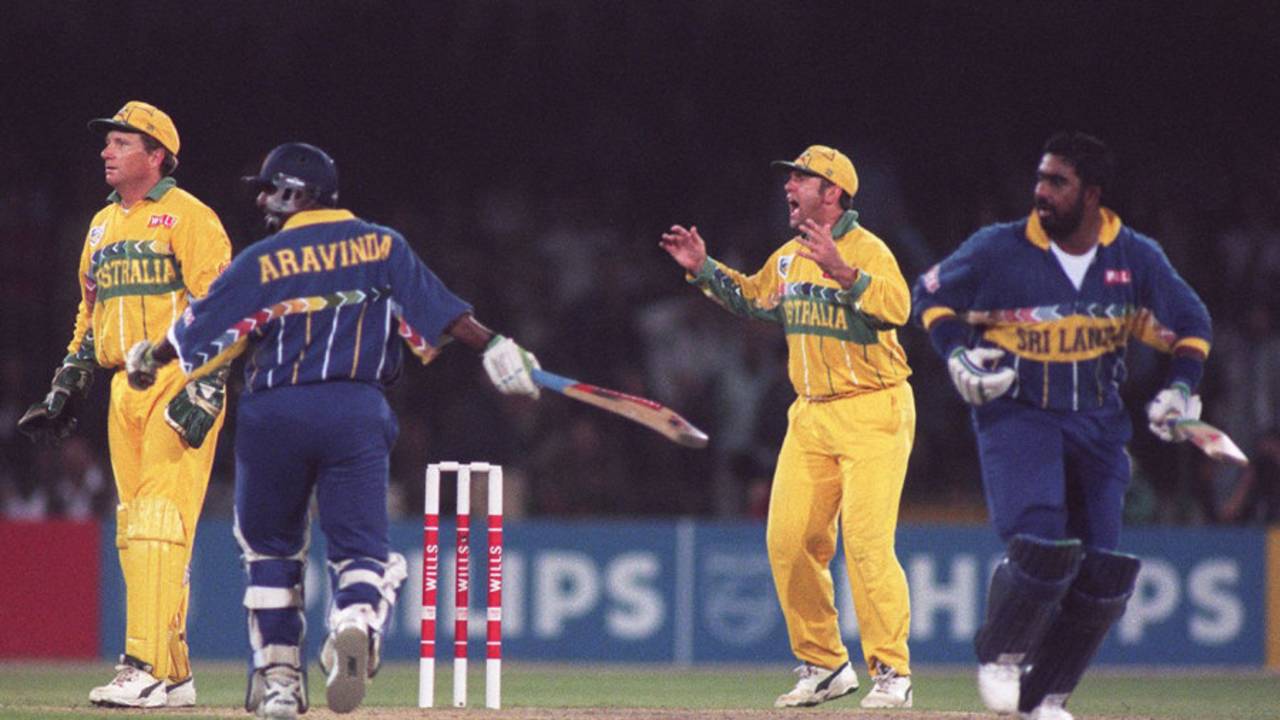
1996 ODI World Cup: Australia refused to play in Colombo, and went on to lose the final to Sri Lanka • PA Photos
The BCB and the ICC are currently in discussions over whether Bangladesh will play their 2026 T20 World Cup fixtures in India due to security concerns. Here are five other instances when teams refused to play an ICC tournament in a host country.
1996 ODI World Cup: Australia, WI refuse to play in SL
In the lead-up to the 1996 ODI World Cup, co-hosts Sri Lanka were in the midst of a civil war and a bomb explosion in Colombo in January, two weeks before the start of the tournament, heightened security concerns.
In a gesture of solidarity with their co-hosts, a combined XI from India and Pakistan played a friendly game against Sri Lanka in Colombo before the tournament began. Australia and West Indies, however, refused to travel to Colombo for their group matches against Sri Lanka and were made to forfeit points from those games.
Sri Lanka qualified comfortably for the quarter-finals - so did Australia and West Indies - and went on to beat Australia in the final in Lahore.
2003 ODI World Cup: England skip Zimbabwe; NZ give Kenya a miss
The 2003 ODI World Cup, the first one in Africa co-hosted by South Africa, Zimbabwe and Kenya, had two instances of teams refusing to play in a host country.
England declined to play Zimbabwe in Harare because of the stance of the UK government - headed by Tony Blair - against the Robert Mugabe regime in Zimbabwe. New Zealand refused to travel to Nairobi to face Kenya because of security reasons. There had been a bombing in Mombasa a few months earlier.
Both England and New Zealand requested that their games be moved out of Harare and Nairobi but the ICC refused and awarded walkovers to Zimbabwe and Kenya, respectively. England were eventually eliminated in the first round of the World Cup, while New Zealand snuck into the Super Sixes from Group B. Kenya, who benefited from the forfeiture, went on to make the semi-finals.
2009 T20 World Cup: Zimbabwe pull out
Five years later, relations between Mugabe's Zimbabwe and the UK had not improved, creating uncertainty over whether England would remain hosts of the 2009 T20 World Cup if Zimbabwe's players could not get visas to travel for the tournament. Eventually in July 2008, the ICC and Zimbabwe reached an agreement they called a "win-win" solution. Zimbabwe pulled out of the tournament "in the larger interest of the game", saying they did not want to be "gatecrashers" to a "party they weren't invited to" but received their full participation fee. An Associate team, Scotland, was selected from the qualifiers to replace Zimbabwe.
2016 U-19 World Cup: Australia withdraw
In October 2015, Australia pulled out of a bilateral series in Bangladesh due to security concerns, and by the time the 2016 Under-19 World Cup came around, their stance remained the same: "threat to Australian interests in Bangladesh" was as high as earlier. The ICC said it "respected" Australia's decision not to travel to Bangladesh but were "disappointed". Ireland replaced Australia in the tournament.
2025 Champions Trophy: India say no to Pakistan
The 2025 Champions Trophy was going to be the first ICC tournament in Pakistan in 29 years. They had been confirmed as hosts in November 2021, but the big question was whether India - who hadn't played in Pakistan since 2008 - would travel, given the fraught political relations between the countries.
Pakistan visited India for the 2023 ODI World Cup, but there was no clarity over whether India would reciprocate two years later. Eventually, as the tournament grew closer, the BCCI said India would not travel to Pakistan for their Champions Trophy games, saying it had not received government clearance. After plenty of back and forth between the two boards and the ICC, a compromise was reached for the 2024-2027 cycle: for any ICC tournament hosted by India or Pakistan, matches involving the other country would be played at a neutral venue. As a result, India's matches in the 2025 Champions Trophy were played in Dubai and they went on to win the tournament.
Sreshth Shah is a sub-editor at ESPNcricinfo. @sreshthx