
Josh Hazlewood looks to reclaim his place as Australia's T20 pace-bowling anchor
He's been a front-line bowler for the side in Tests and ODIs but he has quietly also built an impressive body of work in T20 cricket

Andrew McGlashan
03-Feb-2026 • 9 hrs ago
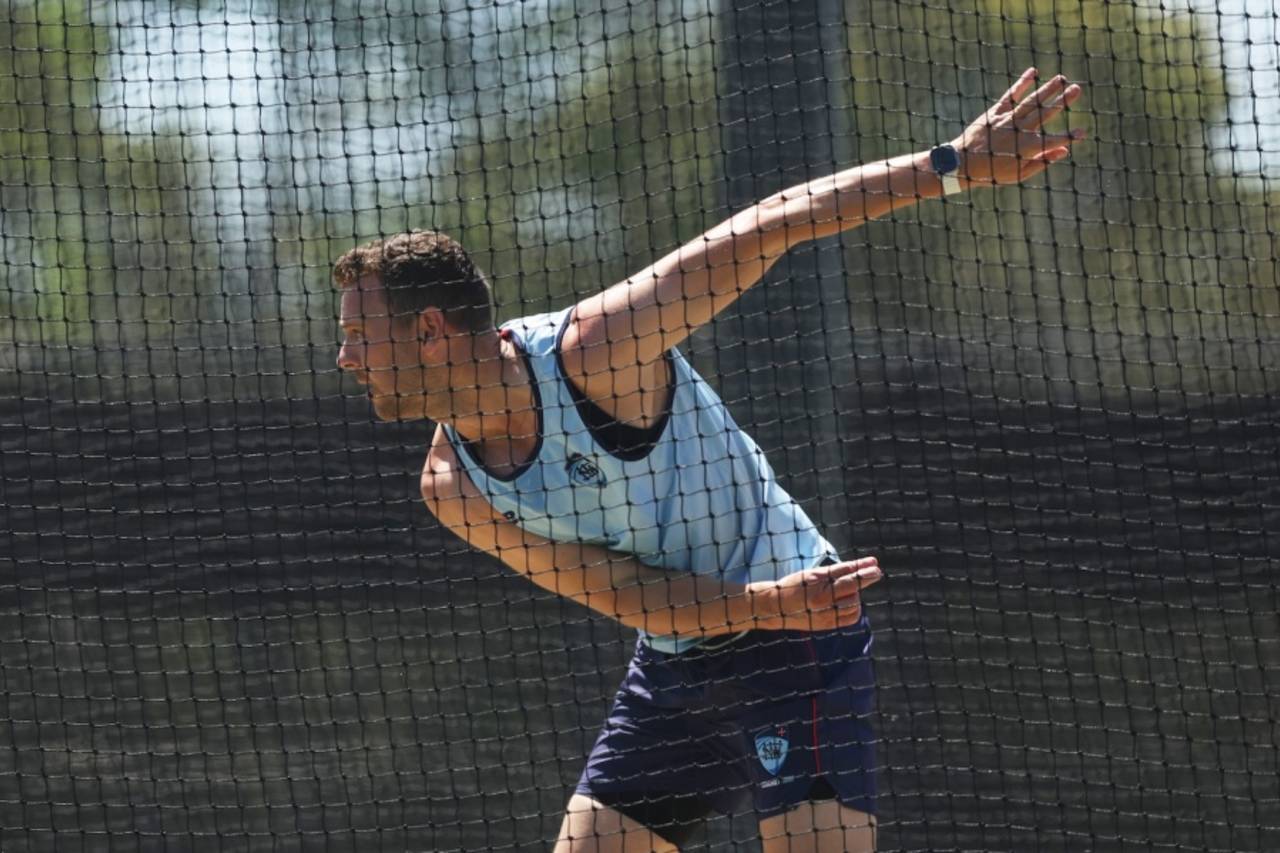
Hazlewood missed out on the Ashes with injury and has been in rehab since then • Getty Images
Abhishek Sharma, India's dashing T20 opener, played superbly at the MCG in October last year, his 68 off 37 balls contributing more than half the team's 125 in pace-bowler-friendly conditions. But he was left wide-eyed by the challenge presented by Josh Hazlewood.
"The way he bowled today, I haven't seen something like this in T20s," Abhishek said. "It was something new for me, because I'm a batter that wants to dominate. But seeing how he was bowling, it seemed like he had a plan and he was just executing it."
Hazlewood, who took 3 for 13 that day, was bowling like a beast at the time and looked primed for a major role in the Ashes series. However, that was curtailed by hamstring and Achilles injuries which left him following - or not - from afar. "I didn't watch much to be honest," he says. "Might have seen 50 overs across the whole series."
Over the last six weeks, Hazlewood has been working on his comeback to return at the T20 World Cup. He had hoped to be fit for Australia's warm-up match in Sri Lanka ahead of the tournament, but the timeline has shifted a little and he will now spend extra days at home to complete his rehab before joining the squad. There is a chance Australia may start with 14 available players, as was the case in 2023 ODI World Cup as Travis Head recovered from a broken hand, until Hazlewood is ready. There's a reason why.
Hazlewood might most often be recalled for his Test match and ODI career, particularly within his own country, but he has built a formidable T20 record despite not playing a match in the format for nearly four years from between March 2016 and January 2020.
Since then, he has taken 133 wickets at 20.44 with an economy rate of 7.57. Of the 75 quick bowlers to have sent down at least 2000 deliveries between January 2020 and the end of last year, Hazlewood's average is the second best (behind Jasprit Bumrah's) and his economy ranks him eighth. He helped Australia to their only T20 World Cup title, in the UAE in 2021, taking 3 for 16 in the final against New Zealand, and last year was the leading wicket-taker for Royal Challengers Bengaluru, who won their maiden IPL crown.
"I think I played for nearly 12 months straight, from the IPL through to when I got injured," Hazlewood says. "I did well in basically every game I played, just about, through that period. My consistency was really good, the pace of the ball was really good, the body was good.
"I'd say it's been coming out well for a number of years, and really the only time when I'm not playing is when I'm injured. I'm not getting dropped or I'm not out of form at any stage, and that's probably how the last four or five years have been.
"I think you just know your game so well. You're experienced and you keep a pretty level head. All that experience adds up and you bowl well."
Hazlewood is the only one of Australia's Big Three to have played T20Is since the last World Cup, in the Caribbean. Pat Cummins has been ruled out of this upcoming edition and Mitchell Starc has called time on his international career in the format. Hazlewood is the senior figure among an emerging crop of pace bowlers that includes Nathan Ellis and Xavier Bartlett in this tournament.
"There's a lot of T20s around the world, so it's different to a Test match," he says. "When someone young comes in, you go, 'Oh, okay, he's played 30 [Sheffield] Shield games, but he hasn't played a Test match,' whereas T20 franchise stuff is big, you get large crowds, and so I guess the step's not as big [to T20Is] but, yeah, I'd say I feel like the leader of the attack."
Hazlewood can operate at any stage of a T20 innings, but a collection of his most compelling performances have come when something akin to Test-match mode has kicked in. Although it doesn't provide a complete picture, an illustration of this comes from how he takes his wickets: since the start of last year, 23 of his 34 T20 wickets have been logged by ESPNcricinfo as coming from length or short-of-a-good-length deliveries.
In that spell against India at the MCG last year Mitchell Marsh had him bowl his four overs straight through, such was the threat with the ball nipping around. Earlier that month he had done it for the first time in his whole T20 career, against New Zealand in Mount Maunganui.
But what has also stood out in Hazlewood's second coming as a T20 bowler is that he has the skills to adapt, although he is self-deprecating about his repertoire. "I wouldn't say I've got many tricks. Don't tell the batters," he says with a laugh. "We always talk that if things are on your terms, you stick to your strengths, and if it's on their [the batters] terms, most of our bowling meetings would be [about] what we're going to do to duck and dive. Using your change of pace, your yorkers… What line are they? What bouncer line are you bowling? What field are you setting.
"I just think the more you play, you're a half-step ahead of the batter more often than not. If you get behind in an over, that's when you can go for the big ones; you go for 18-plus, it sort of changes the momentum of the game. But the more you play, you just learn a little bit all the time."
Hazlewood is unsure of what the World Cup would throw up for the bowlers. Australia play all their group matches in Sri Lanka, with their Super Eights, should they qualify, in India. Part of the planning around a potential late entry for Cummins is that they may not need all their fast bowlers during the Sri Lanka leg, although Hazlewood recalled his success in 2022, when in a bilateral series he took 4 for 16 at the Premadasa and 2 for 25 in Pallekele, the two venues Australia will play at.
"I think it's really luck of the draw sometimes," he says. "[In India], the IPL has more consistently flat wickets [and the Impact-sub rule], which makes a big difference. You can have a team three down in the powerplay in IPL and they just keep going because they think, well, we're either going to get bowled out or we're going to get a big score because we're going to take it on."
He also believes the pressure of a World Cup has the potential to bring scores down a peg or two. "I think World Cups in particular, every game means a little bit more," he says. "If you get out, you can lose that game and be out of the tournament, so there's consequences to those dismissals. I think as a bowler, that sort of helps us a little bit. We control the game a little bit more, potentially.
"There's still going to be games where it's flat, they're none down off the powerplay and away you go. But there's going to be more games where it's two or three [wickets down] and then [they say], 'Okay, we've just got to pull back now.' And sometimes if the games are at the same spots, the wickets can get a bit tired, so your attack might look a bit different or what you're bowling might look a little bit different."
Whatever the conditions and whoever the opposition, Hazlewood's record suggests he'll find a way of making an impact. That's why he is being given as much chance as possible to be there.
Andrew McGlashan is a deputy editor at ESPNcricinfo